


This is an updated and greatly expanded version of an article published in 2023. This BLP overview piece provides the context needed to understand what follows. People unfamiliar with the BLP story should read it first.
Media bias in general, and Wikipedia’s treatment in particular, has made it far more difficult for Brilliant Light Power (BLP) and Dr. Mills to create widespread awareness of the reality of Hydrino and the experimental evidence for it.
This is extremely problematic, as BLP’s Hydrino-based SunCell technology is poised to radically increase global prosperity, but widespread skepticism about Hydrino has been a persistent headwind for the company’s vitally important efforts to commercialize it.
Many people turn to Wikipedia when first encountering an unfamiliar subject. Unfortunately, the BLP Wikipedia page has severe defects and is profoundly misleading.
The Meta-Problems With Wikipedia
I’ll discuss the page’s many specific problems below, but first I must explain two broader problems related to the page. Without this context, it is impossible to understand why the page is so full of misinformation and why so many are inclined to read it and then dismiss BLP and its technology.
Meta-Problem 1
By my conservative count, Dr. Mills and his collaborators have published 73 Hydrino experimental papers in 26 different peer-reviewed journals, some of which are quite highly regarded, including Applied Energy, Chemistry of Materials, International Journal of Hydrogen Energy, Solar Energy Materials and Solar Cells, and Electrochimica Acta. Across this body of work, Dr. Mills’ co-authors included a wide range of highly credentialed researchers. As I’ll discuss below, there have also been a number of wholly or partially independent Hydrino replication papers published in peer-reviewed journals.
Despite the controversy surrounding Hydrino, this experimental work has repeatedly passed muster with journal editors and peer reviewers and been accepted for publication.
The BLP Wikipedia page does not tell readers any of this.
The version of the page reviewed below has 51 footnotes, and not even one refers to this body of experimental work. The only referenced source authored by Dr. Mills is his self-published book. Seven peer-reviewed physics papers or comments are cited. Six of those are attacks on the evidence for Hydrino, and one is a reply to one of those attacks. In short, the referenced peer-reviewed literature record is biased and misleading.
This is because Wikipedia applies special guidelines to subjects its editors classify as fringe science, and the BLP page is edited under those guidelines. To make matters even worse, biased pseudonymous BLP page editors won’t even abide by the already arguably unfair Wikipedia guidelines.
How BLP Got The Fringe Label
The decision to denote a particular subject as “fringe” is not referenced on the page itself, but rather in the page’s metadata. A 2006 Wikipedia Arbitration Committee ruling sorted heterodox ideas into four categories:
Obvious pseudoscience.
Generally considered pseudoscience.
Questionable science.
Alternative theoretical formulations.
The top two categories fall under Category:Pseudoscience, and the BLP page is filed in this category. The BLP page does not attempt to justify this treatment, and the reader isn’t even made aware of it unless one scrolls to the very bottom of the page. This categorization places the BLP page under Wikipedia’s most adversarial editing guidelines.
The guideline’s own test for separating pseudoscience from a legitimate alternative theory asks whether an idea “lacks the strong scientific evidence or rigour that would justify such major changes.” I would argue that 72 peer-reviewed journal articles and multiple successful independent Hydrino replication experiments mean that the BLP page clearly should not fall into this category.
The Bias That Results
Once the pseudoscience label is (mis)applied to a topic, the independent sources rule, WP:FRIND, takes over. This rule says that the relative space a page devotes to an allegedly fringe theory “should follow from consideration primarily of mainstream secondary sources.” It also says that “Points that are not discussed in these mainstream sources should not be given any space in articles.”
In practice, this means that more than 70 peer-reviewed Hydrino experimental papers receive no coverage unless mainstream secondary sources independent of BLP discuss them. Think about how bizarre that is: a single sentence summarizing research published in a respected journal such as Applied Energy is not permitted to be mentioned.
The page editors then fail to properly apply this already unfair rule by not permitting any mention of the independent Hydrino replication record.
The no-original-research policy, WP:PSTS, is a related policy that creates another obstacle to an honest page. This policy precludes analysis and synthesis of primary source material by page editors. Wikipedia guidelines do permit careful descriptive use of primary sources and allow routine calculations, so a simple, verifiable count of papers is not automatically prohibited as “synthesis.”
The biased BLP page editors then arbitrarily grant themselves permission to disobey these guidelines: they will not permit even a simple enumeration of the primary Hydrino research record, something Wikipedia’s guidelines do allow, and something the fringe guideline cannot override, since it states those policies prevail if there is a conflict.
To make matters even worse, Wikipedia’s treatment of supposedly fringe topics is asymmetric. The same fringe guideline contains a provision called parity of sources, WP:PARITY. It says that when a fringe theory is primarily described in amateur or self-published sources, criticism need not appear in a peer-reviewed journal to be referenced in the page. This guideline doesn’t suspend Wikipedia’s ordinary reliability requirements, but it permits criticism from sources outside the peer-reviewed literature.
This results in a truly bizarre and unfair situation: Dr. Mills’ body of experimental work had to clear referees and peer review at 26 different journals to exist, and yet none of it appears on the BLP page, while attacks on it by journalists and random bloggers that face no such scrutiny are exempt, as you’ll see below.
The biased page editors also arguably misapply this rule, as every single Hydrino experimental paper describes Hydrino theory in a peer-reviewed journal article; Hydrino theory thus cannot be regarded as self-published and thus this guideline should not apply.
A final policy that contributes to the farce that is the BLP Wikipedia page is WP:ONUS. Verifiability of information does not guarantee inclusion, and the burden of achieving consensus and subsequent inclusion falls entirely on the editor seeking to add disputed material. Fringe-tagged pages sit under Wikipedia’s contentious-topics enforcement regime and are watched by editors who specialize in policing them.
Favorable material therefore must pass a series of hurdles that unfavorable material does not and the biases of page editors greatly influence whether such material may be added to a page. As we’ll see below, there are a great many relevant objective facts that clearly qualify even under Wikipedia’s dubious standards for pages like that of BLP, and yet none of them are mentioned.
There is a specific recent example of how this all plays out in practice. On April 2nd, 2026, a request was made on the article’s talk page. The request simply asked that the page acknowledge BLP’s issued patents and stop implying that no peer-reviewed engagement with Dr. Mills’ work exists. Two editors refused the request the same day. One said, “Patents are not automatically notable.” The other said, “NPOV is not the same as ‘All sides get their say.’” In other words, a polite, policy-compliant request to add verifiable and clearly relevant facts that are objectively permitted by Wikipedia rules was rejected within hours.1
Armed with knowledge of the institutionalized bias introduced by these policies, you can see why a conspiracy isn’t required to explain the systemic misinformation promoted on the BLP page. You do not need biased editors to produce a biased page: the rules themselves make balanced treatment of a topic such as BLP inherently impossible to achieve. However, the pseudonymous BLP page editors are indeed biased, and they make matters even worse by failing to properly apply the already unfair guidelines.
The net effect of all this is that the readers of the BLP Wikipedia page receive a profoundly misleading account of the theory underlying Hydrino, the vast trove of peer-reviewed experimental evidence which supports it, and BLP’s efforts to commercialize a Hydrino-based power source.
This article is not bound by Wikipedia’s rules nor subject to unfair treatment by biased page editors. I will examine the primary literature record, review the critics and their arguments, explain why those arguments fail, and show that the BLP Wikipedia page is pure, unadulterated, nuclear-grade misinformation.
Meta-Problem 2
The second meta-problem is that understanding the depth and breadth of Dr. Mills’ Hydrino research requires a great deal of work, even for a trained scientist. You’ll see what I mean in the sections below where I unpack some of the research cited by Wikipedia. Trained scientists also face the mental hurdle of the fact that the existence of Hydrino is such a direct assault on the very foundations of modern-day atomic-scale physics they learned in school.
This problem is further compounded by the fact that Dr. Mills’ claims about Hydrino seem so unbelievable at first glance. “So you are telling me that there is a new state of hydrogen that current theory says can’t exist, and that the process of converting ordinary hydrogen to this new lower-energy state could render every other energy source obsolete?” Yes, that is exactly what he is telling you, but it is admittedly hard to believe at first.
Most people are not inclined to expend much effort investigating a claim that initially sounds as wildly improbable as the BLP/Hydrino story. Even for someone motivated to properly examine Dr. Mills’ experimental work, doing so takes dozens of hours.
For those willing to put in the time, there are multiple resources available that provide vital context on the work of Dr. Mills and his efforts to commercialize Hydrino-based technology.
My co-author on the Hydrogen Revolution Substack, Professor Jonathan Phillips, has published an excellent book-length monograph on Hydrino, the theory behind it, and his experience working alongside Dr. Mills for many years. It is designed to be accessible to educated laypeople and does a fantastic job of laying out the basics of Hydrino science step-by-step. It also provides an overview of the basics of Dr. Mills’ atomic theory, from which the prediction of Hydrino states sprang forth. Professor Phillips also provides a number of fascinating anecdotes about his time with Dr. Mills and his work on Hydrino experimentation.
Professor Phillips is one of the few scientists that have published independent Hydrino replication work, as will be discussed below.
Chapter 1 of the monograph is available here.
There are also two books on Dr. Mills and BLP that provide vital context and accessible overviews of the experimental evidence for Hydrino are Brett Holverstott’s The End of Fire and Thomas Stolper’s America’s Newton. They make an initially unbelievable story much easier to understand and evaluate. An unbiased Wikipedia article would quite obviously permit reference to these books, but no such reference is made.

While reading these three resources isn’t strictly necessary for understanding this piece, they will help the interested reader better understand how and why Dr. Mills has been ignored and the factors that led to such a biased Wikipedia article.
Refuting Wikipedia
What follows is a point-by-point refutation of the material currently contained on the BLP Wikipedia page. Facts that should and would be added to an unbiased and complete presentation are also discussed.
Screenshots of each paragraph contained on the Wikipedia page as of August 2026 are used as the basis for my commentary.
Readers unfamiliar with the basics of Hydrino science should first read this BLP overview piece, which explains the basic theory, BLP’s Hydrino-based technology and why it is so important, and discusses some of the experimental evidence for Hydrino in layperson-digestible fashion. The context it provides is necessary to understand what follows.
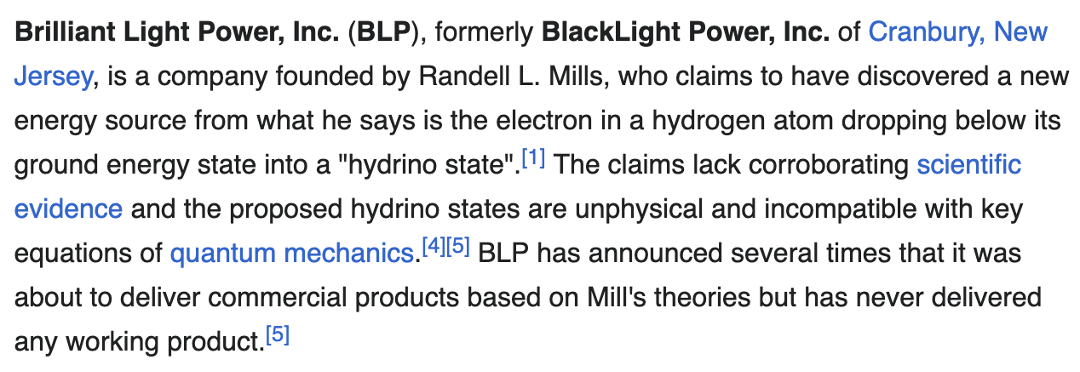
The initial paragraph sets the tone for the rest of the piece by leading with an outright falsehood. The phrase “The claims lack corroborating scientific evidence…” is complete and utter nonsense.
Webster’s Dictionary defines the word corroborate as follows:
To support or help prove with evidence or authority: make more certain.
As mentioned above, Dr. Mills has provided the scientific community and the world at large with a massive volume of empirical evidence for Hydrino, much of which is in peer-reviewed journals, and much of which was published with an array of very well-credentialed co-authors.
By my count, Dr. Mills and his co-authors have published 73 Hydrino experimental papers in a total of 26 different peer-reviewed journals.2

Figure 1: Full List of Hydrino Experimental Papers.
Dr. Mills and his many well-credentialed co-authors have collectively utilized nearly two dozen different analytical techniques across the listed papers. They report results that strongly support the existence and predicted characteristics of Hydrino states of hydrogen.
Philosophers of science use the term consilience for independent lines of evidence, each with different possible failure modes, that converge on the same explanation.
Dr. Mills’ body of work achieves that kind of cumulative support by using many experimental techniques to test distinct predictions of Hydrino theory. Taken together, the papers present a mutually reinforcing body of extremely strong evidence that the Wikipedia page does not even acknowledge.
Even if we define “corroborating” as wholly independent third-party replications of Dr. Mills’ own work, as we’ll see below, several researchers have published such replications.
Dr. Mills’ magnum opus, The Grand Unified Theory of Classical Physics (GUTCP), contains very specific theoretical predictions about the nature of Hydrino and the conditions required for its formation. His vast body of experimental work shows that those theoretical predictions are borne out experimentally, as does the experimental work of other scientists.
While it is true that Hydrino states of hydrogen are incompatible with key equations of standard quantum mechanics (SQM), the dominant paradigm of atomic-scale physics, Dr. Mills does not claim that they are compatible. He quite explicitly rejects SQM as a flawed theory.
Dr. Mills’ excellent paper “Maxwell’s Equations and QED: Which is Fact and Which is Fiction” provides an overview of the flaws that Dr. Mills contends are inherent in SQM.3
The scope of the GUTCP is vast and extends far beyond merely predicting new states of hydrogen. Its central claim is that the same physical laws that govern planets and electric circuits also govern atomic scale phenomena, with no need for the probabilistic rules of SQM. From that single starting point, the GUTCP explains everything from the masses of fundamental particles to gravity and the expansion of the universe.
The GUTCP has closed-form, analytical solutions for a very broad array of atomic scale phenomena, such as:
Ionization energies of multi-electron atoms and ions
Molecular bond energies, angles, and distances
Lepton mass ratios
Lamb shift
Fine structure and hyperfine structure
This is a very partial list and many more solutions are outlined in the GUTCP.
In contrast to the GUTCP, for many atomic and molecular systems, SQM offers no known exact, closed-form solution, so physicists must use approximation methods or numerical calculations rather than obtain the answer directly from an explicit formula.
The GUTCP also has classical physical law-based solutions for many canonical experiments that supposedly “prove” SQM is correct, such as:
Single electron and single photon double slit experiments
Stern-Gerlach
Davisson-Germer
Aspect
Wheeler delayed-choice
This is again a partial list and the interested reader is encouraged to review the GUTCP for additional information in this regard.
The GUTCP has undergone comprehensive review by two Ph.D.s. Dr. Mark Nansteel and Professor Randy Booker spent multiple years checking virtually every equation of the GUTCP.4 Profesor Booker did the bulk of the review, and Dr. Nansteel covered a handful of chapters. A zip file with their review can be found here.
Professor Booker had this to say about his findings in his review of Chapter 7 of the GUTCP, which covers two electron atoms and ions:
I was able to verify the CP [classical physics] results of Chapter 7 in excellent agreement with my own calculations. I was able to replicate the derivation of Dr. Mills’ equations to an excellent degree of accuracy. All my results in Table 7.1 agree very well with Dr. Mills’ results. All of my values agree with Dr. Mills’ results in Table 7.2. I find this to be confirmation that the calculations included in Chapter 7 are indeed valid and reproducible.
To be able to solve a two-electron atom/ion using Dr. Mills’ Classical Physics is truly an amazing feat. A two electron system is a three body problem, which in classical mechanics has no closed form solution. It has to be solved by approximation methods using numerical analysis on a computer, and then the results are only an approximation. The fact that Dr. Mills’ theory can solve two-electron systems exactly is truly remarkable. And the agreement with experimental values shows very little error. This is a tremendous accomplishment and should not be taken lightly. Quantum mechanics can’t solve these systems exactly, and must rely on approximation methods, and the results aren’t very close to experimental values even then. Only this new theory of Classical Physics can solve them exactly. I never thought I’d see the day when this was accomplished, until I met Dr. Mills and his theory. Remarkable. [Emphasis added.]5
I’ve had the pleasure of speaking with Professor Booker, and he told me that he believes that Dr. Mills has indeed unified all of physics into a coherent whole and constructed the replacement theory for SQM. Note that Professor Booker has a Ph.D. in physics from Duke and was chair of the physics department at UNC Asheville.
Although there are many compelling reasons to take the GUTCP very seriously indeed, as Professor Booker notes, the vast majority of physicists do not, for a host of complicated reasons which are beyond the scope of this piece.
The usual defense of those arguing against alternatives to SQM such as Dr. Mills’ GUTCP and its prediction of Hydrino states of hydrogen is that SQM is “proven”; hence, any alternative model is necessarily irredeemably flawed. We see hints of this argument in the above excerpt. However, this position is unscientific.
Theories may be proven in mathematics simply by demonstrating they are consistent with a man-made set of rules. In contrast, no scientific model is ever truly “proven,” as nature makes the rules and mankind is forced to make educated guesses about them.
Given this situation, the best scientific test of a theory is to find it inconsistent with observation. In other words, the proper focus of the scientific method is on experiments designed to disprove a model.
One of the most interesting and novel predictions of the GUTCP is Hydrino. Per the rules of the scientific method, the GUTCP predictions of the characteristics of Hydrino must be evaluated via experiments capable of disproving them. As discussed below, none of the BLP Wikipedia entry’s critiques provide any discussion of experimental evidence inconsistent with Hydrino theory (because there isn’t any quality evidence to this effect), while the entry entirely ignores a massive trove of evidence consistent with it.
Dr. Mills and his many collaborators have published a great deal of experimental work that in principle could disprove the predictions of Hydrino theory. However, the results of all these many hundreds of experiments, collectively relying on many different analytical techniques, failed to disprove Hydrino and were instead consistent with theoretical predictions.
Missed Timelines
The Wikipedia entry correctly states that Dr. Mills has claimed to be close to delivering a commercial Hydrino-based product several times in the past. However, overly optimistic assessments of commercialization timelines in no way detract from Dr. Mills’ evidence regarding the existence of Hydrino states of hydrogen, which has grown ever stronger as the years rolled by and the journal articles stacked up.
The history of innovation is largely one of iterative trial-and-error engineering improvements slowly but surely taking products from idea to crude proof of principle to polished final product, often over the course of many years. That history also shows us that this process often takes far longer than people doing the work initially expect.
The closest analogue to BLP’s efforts to commercialize a Hydrino-based power device is that of fusion power plants. Humanity has been attempting to control the awesome power of fusion since Princeton’s Model A stellarator was first fired up in 1953.
Humanity has been failing ever since. As the old joke goes, fusion power is 30 years away and always will be.
As of 2026, no fusion power device has delivered net electricity, although not for lack of trying, nor funding. I do not mean to denigrate all the many worthy efforts towards a working fusion power plant. Quite the contrary, I think it’s fantastic that so many brilliant minds are stretching the boundaries of science and engineering.
However, it’s probably the best comparison for the situation with BLP’s Hydrino technology. As evidenced by the many billions that have been and continue to be thrown at fusion start-ups, no one dismisses the possibility of a successful fusion power plant simply because it has taken a really long time to engineer one. For precisely the same reason, no one should dismiss BLP’s claims simply because it is taking a long time to engineer a Hydrino-based device.
Another modern example of the challenges of going from idea to commercial product is that of the lithium-ion battery. Stanley Whittingham outlined the basic underlying chemistry at Exxon in 1976, and in 1980, John Goodenough found the cathode material still used today. The science was settled, but the path to a commercial product was painful. Exxon’s early cells caught fire, and they shelved the project when oil prices fell.
Even with the resources of a giant corporation at their disposal, scientists had trouble getting from concept to product. The failures along the way were failures of materials, corrosion, and stability, the same problems BLP has fought with various iterations of its Hydrino-based devices.
However, they were never failures of the basic chemistry, and the difficulties did not imply that the underlying science was unsound. Sony finally shipped the first commercial lithium-ion cell in 1991, fifteen years after Whittingham’s demonstration.
Nobody argues that the fifteen-year delay proved lithium-ion chemistry was wrong.
Similarly, Dr. Mills’ missed timelines prove nothing about Hydrino. Rather, they simply show that he is doing what many developers of new technology have done, which is to underestimate how long the engineering takes.
Douglas Hofstadter’s famous law describes the timeline problem exactly: “It always takes longer than you expect, even when you take into account Hofstadter’s Law.”6
Furthermore, it’s very important to keep in mind that what Dr. Mills is attempting to do has absolutely no historical precedent. No one has ever made a truly foundational scientific breakthrough of the class of Hydrino, and then attempted to almost single-handedly turn that idea into a commercial energy technology vastly superior to all other energy technologies.
There is literally no metric by which we can assess how long such an effort should take.
Finally, a close examination of the history of Dr. Mills’ efforts shows tremendous engineering ingenuity and clear progression of key metrics by which power generation devices are assessed, such as power density, which has increased by many orders of magnitude over his three decades of work. As we’ll see below, a number of very well-credentialed scientists have provided validation reports on multiple iterations of BLP’s various Hydrino-based energy devices.
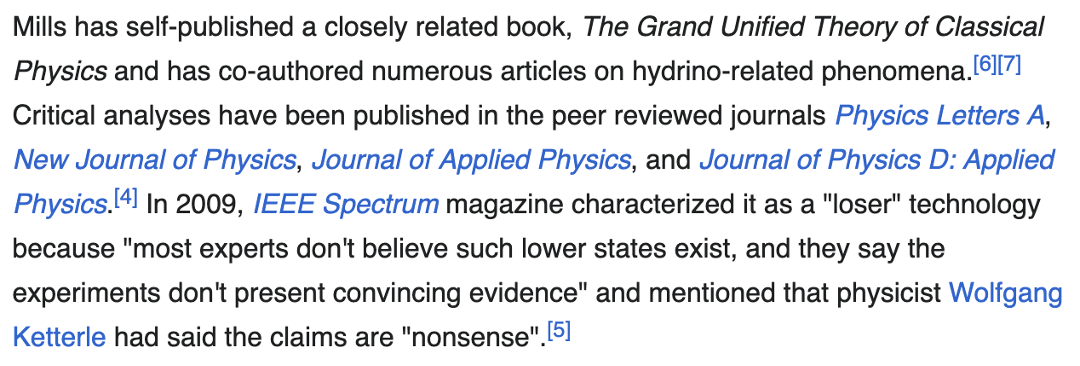
As we’ll see below, the referenced analyses mentioned in this paragraph are all fatally flawed, as they do not attempt to experimentally disprove the existence of Hydrino states, but instead attempt to show why such states are incompatible with the currently dominant paradigm of SQM.
As stated above, Dr. Mills makes no claims that Hydrino states of hydrogen are compatible with SQM. It is also notable that the tiny handful of published theoretical critiques of Hydrino states are featured prominently, while the many studies with careful, peer-reviewed experimental work showing crystal-clear agreement with the predictions of Hydrino theory are ignored.
The last sentence of the paragraph contains several examples of the logical fallacy of appeal to authority. This is a dangerous game, given the history of scientific revolutions:
1543: Copernicus’ heliocentric theory is met with mixed reviews: “Many experts don’t believe Copernicus’ claim that the earth revolves around the sun. Ptolemaic epicycles model the motions of the heavens with startling accuracy.”
1896: Lord Kelvin, one of the most respected scientists of his time, confidently proclaims the following about the possibility of airplanes: “I have not the smallest molecule of faith in aerial navigation other than ballooning or of expectation of good results from any of the trials we hear of.”7 The Wright Brothers begged to differ.
1912: Alfred Wegener proposes his theory of continental displacement. Much of the geology field condemns him in the strongest possible terms. He was accused of “Germanic pseudo-science.” His lack of formal credentials led a critic to say that it was “wrong for a stranger to the facts he handles to generalize from them.” Despite the theory being fundamentally correct, it took an astounding 50 years or so for Wegener’s theory to be widely accepted by geologists.
1933: Ernest Rutherford proclaims to the British Association that splitting the atom isn’t a viable source of energy. As summarized by The Times, “We might in these processes obtain very much more energy than the proton supplied, but on the average we could not expect to obtain energy in this way. It was a very poor and inefficient way of producing energy, and any one who looked for a source of power in the transformation of the atoms was talking moonshine.”8 Twelve short years later, the first nuclear bomb was detonated.
These are far from the only examples of scientific breakthroughs facing ridicule. Here is an elegant visualization of some of the many scientists whose ideas were initially rejected, only to later be acknowledged as correct.
Part of the beauty of the scientific method, properly understood and implemented, is that it provides a systematic methodology for ensuring that incorrect beliefs of purported experts in a particular field don’t remain permanently entrenched. However, for the scientific method to work its magic, it is incumbent upon the scientific community to engage with compelling novel experimental results, regardless of their implications for the dominant scientific paradigm. This, rather than pronouncements by perceived authorities, is how science progresses.
As such, it is long past time for the scientific community to simply replicate Dr. Mills’ experimental results rather than continue to object on theoretical grounds.

This paragraph gets some key points wrong and is missing context.
Dr. Mills’ first paper, titled “Excess Heat Production by the Electrolysis of an Aqueous Potassium Carbonate Electrolyte and The Implications for Cold Fusion,” was accepted by Fusion Technology in April 1991 and published in its August 1991 issue.
The experimental setup shared important features with the so-called “cold fusion” cells of Fleischmann and Pons. However, instead of the heavy water used in their cells, Dr. Mills used ordinary water, a potassium carbonate electrolyte, and a nickel cathode, and proposed a very different explanation for the reported excess heat: Hydrino formation.9
While it is technically true that Dr. Mills’ arguments around Hydrino contradict current theory, this oversimplifies the matter. SQM identifies -13.6 eV as the “ground state”: the lowest energy eigenvalue of the nonrelativistic Coulomb Hamiltonian for hydrogen. Dr. Mills very explicitly rejects the validity of that entire framework and argues that GUTCP’s classical field model permits lower-energy states.
The dispute is therefore over which model correctly describes the atom, not over whether SQM itself permits Hydrinos. It is important to remember that only experiment may settle a dispute between competing frameworks. “Your reproducible experimental result is impossible because my theory says so” is not a scientific argument.
Furthermore, Dr. Mills contends that SQM’s stated reasons why hydrogen can’t fall below the “ground state” are not valid. In a 2005 paper he writes that:
“…the standard theoretical explanation for the stability [of the hydrogen atom] from Feynman is based on the Heisenberg Uncertainty Principle (HUP). Upon further scrutiny, Feynman’s argument is found to be internally inconsistent and fatally flawed, and brings to light the many inconsistencies and shortcomings of QM and the intrinsic HUP that have not been resolved from the days of their inception. Unfortunately, these issues are largely ignored by the physics community.”10
The key point that the Wikipedia excerpt gets wrong is this: Dr. Mills’ early work was engaged with by multiple independent scientists and most of them were able to replicate his results, as we’ll see below. Not all these early replicators accepted his explanation for the source of the excess heat (more energy out than in, beyond what could be explained by normal chemistry) found in his experiments and theirs, which strengthens their independence but does leave the mechanism in dispute.
What is unfortunately true is that the wider scientific community did fail to properly engage and undertake a sustained and coordinated evaluation of Dr. Mills’ early results and the successful third-party replications.

This section needs updating. As of August 2025, BLP has raised approximately $140 million from a wide array of investors.11 While it is true that sustained funding does not validate the science, it is relevant omitted context.
As stated, the list of investors is accurate, although it is far from a complete list.

The second paragraph here is wrong.
BLP was one of 54 companies approved to participate in New Jersey’s Technology Business Tax Certificate Transfer Program, which allowed qualified technology and biotechnology companies to raise cash by selling unused state net-operating-loss carryovers and research-and-development tax credits. Contemporary reporting estimated that participating technology companies would receive on average $1.1 million each from these sales, but the amount varied widely by company.12
BLP later moved away from the electrochemical cells it pursued from 2008 through 2012 after the technology encountered corrosion problems. However, it did receive outside validation on this electrochemical-based Hydrino technology, called “CIHT,” for Catalyst-Induced Hydrino Transition, from a number of very well-credentialed individuals.
For example, here is a validation report by Professor Henry Weinberg, Ph.D. in chemical engineering from UC Berkeley. The report concludes:
“To summarize, when first hearing of the claims of BLP, it would be irrational not to be very skeptical, and prior to meeting Randy Mills I was extremely skeptical. However, after having visited BLP, having participated in experimental design and execution, and having reviewed vast amounts of other data they have produced, I have found nothing that warrants rejection of their extraordinary claims. On balance, I recommend continued funding of BLP for at least another 24 months while they engage in catalyst optimization research and CIHT cell “numbering up” development. To be able to use hydrogen from water as a cheap and nonpolluting source of power would represent one of the most important technological breakthroughs in history.”13
Dr. Terry Copeland, Ph.D. in chemical engineering from MIT, produced a similar report, available here. He also concluded the CIHT technology had merit, saying:
“In summary, BLP has successfully fabricated and tested CIHT cells capable of producing net electrical output up to 50 times that input to maintain the process. Some cells have produced steady power for over one month. The power generation is consistent with Dr. Mills theory of energy release resulting from hydrino formation. No other source of energy could be identified.
BLP has achieved a historic success for a technology that could be directly commercialized as an alternative form of power generation. Potential applications range from stationary power infrastructure including the large-scale electrical grid to distributed and micro-distributed scales and motive fuels infrastructure. The promise ultimately will be driven by economics.”14
Professor Nick Glumac, a Ph.D. in mechanical engineering from the California Institute of Technology, also produced a validation report on the CIHT technology. He summarizes his results here:
“On December 21, 2011 I visited BLP and observed tests of and protocols for the CIHT cells. Three cells were prepared during my visit while I watched. The results generated by these cells were very consistent with those of similar cells, based on data provided to me by BLP, with electrical outputs from 10 to 2000 times the input energy. In addition, I viewed control cases that were run, and discussed with the engineers the data acquisition and sample preparation processes. After the visit, I conducted analyses of alternative possible energy routes for the observed energy release and shared these results with BLP. Based on my observation, I find no plausible alternative explanation for the observed energy release other than that of a novel electrochemical effect. Recommendations to further refine the results and exclude possible, but highly unlikely, energy sources are presented.”15
The corrosion issues mentioned above ultimately precluded the CIHT design from becoming commercially viable, but the basic technology worked as claimed by Dr. Mills.
In 2013, BLP had a key breakthrough. Dr. Mills realized that by running high current through the Hydrino reaction medium, he could radically increase the rate of Hydrino formation and thus dramatically increase the power density of the reaction. The new SunCell technology relies on this crucial insight and is far superior in every respect to the CIHT cells. The current challenge lies in sustaining and capturing the intense power output without SunCell component degradation.

This paragraph is factually accurate but both wildly misleading and greatly lacking in scope, as will be shown below.
As mentioned previously, Dr. Mills has produced 73 Hydrino experimental papers in 26 different peer-reviewed journals. Given the vital scientific and technological importance of the claims and the relative accessibility of many of the experiments, the lack of sustained engagement by the wider scientific community is a profound failure.
While it is true there has not been truly widespread engagement, that does not mean there has been none. As mentioned above, Dr. Mills was able to get a strong signal of excess heat from his initial experiments outlined in his work in Fusion Technology.
Right from the initial publication, numerous reputable individuals and labs began replication efforts of Mills-type cells and were able to replicate Dr. Mills’ findings. The NASA report mentioned above was just one such effort.
That trend of engagement and corroboration has continued throughout the years, albeit sporadically.
Below are links and discussion of some of those third-party papers and reports. The bulk of them are fully independent replications of Dr. Mills’ early experimental work.
Note that some of the papers referenced are replications of Dr. Mills’ own published experimental work, and others are more recent reports from third parties who evaluated various iterations of BLP’s Hydrino-based energy devices.
Independent Replication Work
We’ll start by providing a list of the early Hydrino experiment replication work that was independent of Dr. Mills and BLP.
Robert Bush - California State Polytechnic University
Physicist Robert Bush obtained a preprint of Mills’ first paper and built a cell to its specification. In the words of Tom Stolper, author of America’s Newton, a book about Dr. Mills and his work, Bush found to his surprise that “it worked.”16
While Bush did not at the time support Dr. Mills’ explanation for the source of the excess heat, he was solidly convinced of its presence in Mills-type light water cells, and within a few months of Dr. Mills’ announcement, he had submitted his results to Fusion Technology. In the article, he wrote that Dr. Mills had published his work in admirable detail, called the discovery “an inestimable scientific treasure,” and recommended Mills-type cells to other researchers because the effect could be achieved “robustly and in a highly reproducible fashion.”17
Although Bush preferred a nuclear reaction as the explanation for the excess heat, he was not shy about confidently stating that his test cells found excess heat beyond ordinary chemistry:
“…there seems to be little doubt about the results with our light water cells yielding gains from ~25% to ~300% accompanying higher input powers from several tenths of a watt up to ~15 W. Certainly, Mills and Kneizys are to be commended for their work. The fact that in our preliminary studies excess powers and higher gains with the Mills-Kneizys-type cells have been much easier to attain and far more reproducible for us than has been the case for the heavy water cells employing palladium cathodes encourages us to recommend light water research to other research groups.”18
Vesco Noninski
According to Tom Stolper in his book America’s Newton, the electrochemist Vesco Noninski was dispatched to BLP’s then-headquarters in Lancaster, PA in 1991 by cold fusion advocate Eugene Mallove for the express purpose of debunking Dr. Mills, whose light-water results were complicating the cold fusion story.19 He had been following the cold fusion saga right from its genesis with Fleischmann and Pons.
Noninski planned to stay at BLP a day, but he ended up staying a month. His independent confirmation of excess heat in a Mills-type light-water cell appeared in Fusion Technology in March 1992, the first published replication of a Mills-type cell by an outside scientist. Noninski’s paper concludes the effect seen in Dr. Mills’ experiments is real and reproducible:
“It seems, however, that the reality of the effect can qualitatively be established with the described procedure. It seems also that the reported effect is reproducible and can easily be demonstrated.”20
According to Stolper, “Noninski found Mills to be ‘a very fine scientist’ whose work deserved to be followed up; and Noninski did follow it up, briefly, at Brookhaven National Laboratory, on Long Island, NY, in the fall.”21
The Hokkaido Groups
At Hokkaido University’s Catalysis Research Center, electrochemist Reiko Notoya replicated the excess heat and improved the cell, substituting sintered porous nickel for Dr. Mills’ coiled wire and publishing in Fusion Technology in 1993, with a larger study following in 1994.2223
In a separate Hokkaido effort, Ohmori and Enyo reported excess heat from light-water electrolysis across nickel, gold, silver, and tin cathodes.24
They note that, with nickel cathodes, only cells with K2CO3 produced excess heat, whereas cells with Na2CO3 did not, as predicted by Dr. Mills.
Notoya interpreted her results as being driven by some type of fusion, which I believe works in Dr. Mills’ favor on the independence question: the confirmations were coming from researchers who rejected his theory while reproducing the excess heat effect.
The Idaho National Engineering Laboratory
Nuclear engineer Michael Jacox read Dr. Mills’ 1991 paper and persuaded his employer, the Idaho National Engineering Laboratory, to buy three test cells built by Thermacore, an engineering company that became interested in Dr. Mills’ initial work and began their own replication efforts. Jacox ran controlled experiments on them beginning in 1992.
Stolper reports that constant-current runs yielded 10 to 20 percent excess heat while pulsed-current runs, Dr. Mills’ preferred mode of operation, produced a power gain of nearly four, a figure far greater than even the deliberately hostile assumption of 100 percent gas recombination (an alternative explanation put forth by skeptics as the source of the excess heat) inside the cell could explain.25
Stolper recounts what came next:
“Jacox’s immediate supervisor thought the results good enough for a press conference, but early in 1993, someone went to the Vice President for R&D and said, “You’ve got to stop these guys.” He did. Management was afraid of becoming embroiled in the cold fusion fiasco and killed the entire project, just as Jacox was beginning side-by-side tests of control cells and active cells. Management also decided that no one was to acknowledge that any work on Mills-type energy cells had ever been done at the Idaho National Engineering Laboratory. Jacox had been working at all hours of the day and night in a state of high excitement, and he was angered by the decision to stop and keep quiet; but he had a family to support. He had seen people threatened with firing over cold fusion. He knew that he hadn’t been dealing with fusion of any kind, because he and his colleagues had checked for nuclear products and hadn’t seen any, but that knowledge wouldn’t pay the mortgage.”26
The work was shut down and never published, although an internal technical report was produced titled “The Search for Excess Heat in the Mills Electrolytic Cell.” Unfortunately, this report is not publicly available.
Jacox’s own account of the episode came in a 1999 interview given to The Village Voice:
“We followed the protocols Randy suggested and followed his technique and we got the same results he had.”27
Jacox also described a later anomaly:
“[we found] an anomaly that we could not explain with conventional theory but that we could explain with Randy Mills’s theory. That does not necessarily validate the Mills theory, but gosh.”28
Thermacore Report
Here is a 1994 report done by Thermacore, who independently built a number of Mills-type cells starting in 1991. This report outlines testing of a hydrogen-diffusion nickel/potassium carbonate cell that was more advanced than the cells in Dr. Mills’ early experiments. The whole report is worth a read, but the conclusion pulls no punches:
“Excess heat energy was measured at an average level of 24.3 watts ± 6.4 watts. Our confidence to report excess heat comes as a result of repeated testing and reevaluation of the test procedures and that the shrunken hydrogen molecule has been identified by an independent university.”29
The report goes on to state that Dr. A. Miller of Lehigh University examined the surface of the nickel cathode with electron spectroscopy for chemical analysis and found an unusual feature with a peak at 55 eV, which the report attributes to a Hydrino species.
All cell construction work and testing were performed at Thermacore and Lehigh, although BLP and Dr. Mills did consult on the work.
NASA Lewis Research Center
As the Wikipedia entry notes, there was a replication effort at a NASA lab. However, it leaves out important information.
In 1994, NASA’s Lewis (now Glenn) Research Center tested a Thermacore-type cell on loan from BLP. The team of Niedra et al. measured up to 11 watts of apparent excess heat on roughly 60 watts of input, with power gains of 1.06 to 1.68. They published the results as a NASA Technical Memorandum with the title “Replication of the apparent excess heat effect in a light water-potassium carbonate-nickel electrolytic cell.”30
The memorandum’s cautious label of “inconclusive” rested on the possibility of near-total gas recombination as the source of the excess heat. This is an assumption that Stolper notes was farfetched at the 5-amp constant current used, which should result in little recombination. Niedra himself said the cell worked and that he wanted to continue the research, but NASA management did not and the research efforts went no further.31
Haldeman At MIT
Charles Haldeman, an engineer at MIT’s Lincoln Laboratory, was part of a group of scientists that visited Thermacore in 1992. Intrigued by what he saw, he requested and received funding as told by Stolper:
“Haldeman submitted a report to the Advanced Concepts Committee at the Lincoln Lab, recommending that a Mills-type cell be built and tested, and on January 15, 1993, they unanimously approved a cash outlay of $25,000 for a three-month shot at verifying it. The committee approved about ten projects a year at that level, and there was no objection from management to this one.”32
Stolper also gives us a window into the fear and career risk associated with anything resembling cold fusion. After noting the extreme lengths Haldeman went to in order to rule out prosaic explanations as to why the experimental apparatus might be generating excess heat, Stolper writes that:
“So extreme was the climate of skepticism that only the cleanest experiments and the most spectacular results produced by workers of the highest repute at a leading institution would have enough credibility to produce follow-up funding and lead to follow-up work at other first-tier laboratories.”33
Haldeman’s test cell showed strong excess heat output, enough to convince management to provide further funding for his efforts:
“Haldeman persisted. He consulted with Mills and Good, and they persuaded him to focus on running an open cell, to let the cell breathe. Haldeman was eventually able to get a strong result, on the order of 200% excess heat. It was enough to convince management to commit another $75,000 to the effort, a small sum in the world of high-tech research, but enough to proceed. After a few experiments, Haldeman was convinced that the excess heat he saw wasn’t being produced by anything resembling conventional fusion. His lab had the standard safety instruments used to check for the presence of dangerous gamma rays and neutrons. The production of even a small amount of heat by fusion would have triggered the instruments, but they stayed quiet.”34
Haldeman’s final report outlined excess heat of 5x to 14x the corrected net energy input, although it leaves the question of the source of the heat unanswered.35
The report can be downloaded here.
It should be noted that the modest excess heat found in Haldeman’s work and the work of the other groups referenced above reflects the early stage of development of Hydrino technology; the experiments were performed only a few years after Dr. Mills formulated the Hydrino hypothesis. Dr. Mills has advanced the technology very considerably in the interim, and the excess heat achievable from Hydrino formation is now much, much larger, as we’ll see below.
Phillips Paper
Here is a link to a paper titled “Evidence of catalytic production of hot atomic hydrogen in RF generated hydrogen/helium plasmas” by Professor Jonathan Phillips and C. Chen.
The paper outlines successful independent replication of Dr. Mills’ Hydrino plasma experiments from the early and mid-2000s. It shows evidence consistent with a predicted effect of Hydrino formation in radiofrequency plasmas containing hydrogen and a Hydrino catalyst species. As with the Conrads paper discussed below, controls were performed. The Hydrino formation signal was only evident in H2/He plasmas, and no Hydrino formation signal existed in H2/Xe plasmas.
These results are predicted by Hydrino theory and contrary to other models that seek to explain the anomalous hydrogen heating found in certain plasmas like those found in this paper. The paper concludes that the results are in accordance with the predictions of Dr. Mills.36
This is correct, and the results are very difficult to explain otherwise. I’ll discuss this paper in more detail below.
Partially Independent Replication Work
Although not fully independent, several Hydrino experimental papers have been spearheaded by well-credentialed scientists other than Dr. Mills, with the analytical work being performed in the labs of those scientists, rather than at BLP headquarters.
Conrads Paper
Here is a link to a 2003 paper titled “Emission in the deep vacuum ultraviolet from a plasma formed by incandescently heating hydrogen gas with trace amounts of potassium carbonate.” The lead author is Professor Hans Conrads, former director of the Institute for Low Temperature Plasma Physics. He was one of the world’s foremost plasma experts at the time.
The analytical work was independently done in Conrads’ lab in Europe. Dr. Mills was not present for it.
The experiment involves cells designed to initiate a low-voltage hydrogen plasma by incandescently heating hydrogen gas in the presence of K2CO3. Potassium is predicted to catalyze the Hydrino (1/2) state. A plasma was formed that was dependent on the presence of K2CO3, despite an electric field much weaker than that typically required to form a glow discharge. Control experiments with Na2CO3, which is not predicted to support Hydrino formation, did not form a plasma. Anomalous prolonged light emission continued even after input power was cut off, indicating the presence of some other source of energy.
The paper concludes:
“The emission from a plasma was observed at low temperatures (e.g. ≈103 K) from atomic hydrogen and potassium. The release of energy from hydrogen was evidenced by the hydrogen Lyman and Balmer emission which identified the presence of a hydrogen plasma. The persistence of emission following the removal of all of the power to the cell indicates that [an] unknown chemical power source is present. The implication is that a new plasma and light source for the vacuum ultraviolet has been discovered.”37
Again, although it’s true that Dr. Mills was a named author on this paper, the experimental work was done independently of him but corroborates his own findings.
Hagen Paper
Here is a link to a very important paper titled “Electron paramagnetic resonance proof for the existence of molecular Hydrino.” The paper’s lead author is Professor Wilfred Hagen, a world-class expert in the use of electron paramagnetic resonance (“EPR”) spectroscopy to identify compounds that are EPR active.
The paper involves EPR spectroscopy analysis of a gallium oxyhydroxide compound that is complexed with molecular Hydrino (GaOOH:H2(1/4)). The compound is generated by operating a SunCell prototype which relies on molten gallium as one of the electrodes. The gallium is then treated with potassium hydroxide. The compound is a crystalline form of GaOOH with molecular Hydrino trapped inside microscopic cages within the crystalline lattice.
This compound can now be produced on demand by Dr. Mills, who has dubbed it “Hydrino in a bottle.” Brilliant Light Power has indicated it will provide samples on demand to qualified labs for testing.
While it is true that Hagen did collaborate with Dr. Mills on this paper, all EPR analytical work was done at Professor Hagen’s lab at TU Delft. As with the Thermacore paper, this paper does not mince words with its conclusion:
“In summary, the present study provides compelling EPR spectroscopic and gas chromatographic evidence for the existence of molecular hydrino, and, by inference, for the reality of atomic hydrino, and it provides plausibility of the electron model in GUTCP. In more general terms our results are a significant test against falsification of GUTCP. In view of the possible far-reaching implications of this conclusion for the theory of quantum mechanics, for hydrogen-related chemistry, for astrophysics of dark matter, and for energy transduction and production technology, it is also offered as an urgent invitation to academia at large to repeat and extend the described experiments in lieu of refutation on quantum mechanical theoretical grounds.”38
We leave it to the reader to decide if one of the world’s foremost experts in EPR spectroscopy would write those three sentences if he wasn’t pretty darn certain of his findings, given the controversial nature of the topic of Hydrino. We also encourage anyone with access to EPR equipment to reach out to Dr. Mills for a sample of the Hydrino compound analyzed in this paper and attempt to replicate Hagen’s findings.
Professor Hagen has called on the scientific community to replicate his results, saying this about Hydrino and the GUTCP during a recent podcast episode with Brett Holverstott:
“We, as a scientific community, as a worldwide scientific community, cannot afford to ignore this. We should do something about it and do something different from what my dear colleagues have done until now, which is only criticizing on the basis of theory. Of course, it doesn’t fit the standard quantum mechanics because it [the GUTCP] is supposed to be an alternative. It shouldn’t fit. What you physicists should do is roll up your sleeves and get into the lab and try to disprove what he [Dr. Mills] says.”
Indeed. Professor Hagen understands that experiment has the final say in science.
3rd Party SunCell Validation Reports
In addition to the fully and partially independent replication work published in peer-reviewed journals discussed above, BLP has consistently solicited well-credentialed experts to perform third-party validation of their Hydrino-based energy technology, and found such experts willing to do so.
While it’s true that this evidence is of lower quality than fully independent replication work published in a peer-reviewed journal, I believe it is still worth mentioning. All three of the individuals referenced below have excellent credentials, and their findings are far, far outside the realm of anything explicable by ordinary chemistry.
Nansteel Report
Here is a link to a report completed by Dr. Mark Nansteel, a third-party consultant that has done work on behalf of BLP. He is an expert in thermal modeling. The report measures the power balance (output power relative to input power) of a prototype SunCell. The report finds a SunCell power gain of 3.62x or greater, with net power generated by the Hydrino reaction of 169 kW.39 Note that the absolute level of power output is much higher than that of the experimental apparatus from the 1994 Thermacore report, reflecting the dramatic advances made by Dr. Mills over the intervening years.
Booker Report
Here is a link to a report authored by Professor Randy Booker, a physics Ph.D. who at the time taught at UNC Asheville. As with Dr. Nansteel, Professor Booker finds extraordinary results produced by the SunCell prototype:
“Brilliant Light Power has discovered a novel power source, the liquid gallium SunCell, which produces a large excess of heat. These input power and output power numbers have been validated by me and are correct. I have also been given access to the data files taken during the two molten metal experiments for this validation. As for the gallium, there is no chemical reaction at all responsible for this excess power. Testing shows that there’s 100% gallium before and there’s 100% gallium after in the cell. All of the observed energy in these cases must come from the HOH hydrino plasma reaction occurring in the reaction cell. The gains for the two molten metal experiments reported here were in the range 2.50-2.79 at excess power levels of 194-218 kW. I am led to the conclusion that the generation of the large net excess power in the liquid gallium SunCell experiment is real and reproducible.”40
Tse Report
Here is a report completed by Dr. Stephen Tse, a professor of Mechanical & Aerospace Engineering at Rutgers. As with the reports from Dr. Nansteel and Professor Booker, this report measures the power balance of a prototype SunCell. The report finds a maximum power gain of 4.74x with net power of up to 341 kW.41
Skeptics are encouraged to reach out to Hagen, Nansteel, Booker, and Tse, all of whom have publicly available contact information, to discuss their findings.

This paragraph is accurate but misleading and lacking full context. Not surprisingly, the article makes no mention of the positive findings of the report, linked here, which concludes:
“The recent spectroscopic studies have revealed some surprising results, which suggest that a highly energetic low pressure mixed gas hydrogen propulsion system could be realized. Based on the quantitative results of the plasma experiments and the qualitative results obtained to date on the BLPT and BLMPT test firings, the team believes that Phase II funding is justified to continue this work.”42
Here is the full quote that the Wikipedia page truncates about Marchese’s experience with BLP and their technology:
“I was there quite a bit and really looked around, kicked the tires, talked at length with their engineers, observed their experiments, and did my own,” Marchese says. “I’m really pretty confident as I’m ever going to be that there’s no fudging going on. For me to not continue with this study would be unethical to the scientific community. The only reason not to pursue this would be because of being afraid of being bullied.”43
NIAC Phase II funding is very competitive, and unfortunately, Marchese’s request for a Phase II was not granted.

Anderson is seen here carrying on the long tradition of distinguished scientists providing sweeping pronouncements on topics with which they are unfamiliar. Arthur C. Clarke has some words of advice on the wisdom of proffering such opinions:
“When a distinguished but elderly scientist states that something is possible, he is almost certainly right. When he states that something is impossible, he is very probably wrong.”44
Neither Anderson nor Chu has attempted replication of Dr. Mills’ experimental work, nor attempted to provide a refutation of the Hydrino hypothesis on theoretical grounds. This is not altogether surprising, as acknowledging the merits of Dr. Mills’ Hydrino hypothesis would cast doubt on the framework on which Chu and Anderson built their careers and reputations.
Science does not proceed based on the opinions of perceived authority figures. Science proceeds, among other ways, by community replication of novel experimental findings.
The mention of the withdrawn patent again betrays an apparent effort to paint a biased picture. The patent in question was withdrawn under unusual circumstances, as detailed in chapter 5 of Brett Holverstott’s excellent book on Dr. Mills’ work, The End of Fire.45
Setting aside the referenced patent, the casual reader of the biased Wikipedia page is not made aware of the many patents granted throughout the world since 2000. The company’s patent strategy has been overseen by one of the top patent lawyers in the nation, Scott Doyle. Dr. Mills’ exceptional patent writing ability combined with Scott Doyle’s expert guidance has borne tremendous fruit, with extremely comprehensive patent coverage granted and pending in most major energy markets.
Why does the Wikipedia page not make mention of the extensive global patent portfolio, despite its existence being a purely objective fact? Below is a table from a 2023 BLP business presentation showing the extensive set of granted and pending patent applications.

Figure 2: List of Granted and Pending BLP Patents by Country.
As written, it sounds as though BLP applied for a single patent and that patent was withdrawn.
The reality is that it has extremely comprehensive patent coverage in virtually every major market. An unbiased Wikipedia article which touches on the patent issue would permit mention of these many patents after discussing the early patent difficulties faced by BLP.
Unfortunately, this Wikipedia entry is anything but unbiased.

This is largely factually accurate, although again characteristically biased. It is true that Robert Park greatly interfered with BLP’s efforts to get the patent referenced above granted. Esther Kepplinger was a patent official, not a trained physicist, so it seems likely that Robert Park had influence on her quoted concern. Tom Stolper documents the outside interference in the USPTO process in America’s Newton.46
The claim that the patent involved cold fusion and perpetual motion is blatantly false and betrays a lack of even basic familiarity with the patent claims. Nowhere in the patent in question does Dr. Mills claim that fusion of any sort is occurring. Furthermore, Hydrino-based power sources are not perpetual motion devices. Dr. Mills took great pains in the patent to explain at length that the source of the energy release was from the electrons of hydrogen atoms transitioning to a lower-energy state. There is nothing mystical about this explanation: ordinary exothermic chemical reactions likewise release energy when the reaction products have a lower enthalpy than the reactants.

This is largely accurate. However, while it’s true that BLP’s claims do violate SQM, they do not violate classical physical laws, the same laws operative at the scale of our everyday lives.
It’s important to note that the physicists in question were not objecting to BLP’s claims based on evidence from their own attempted experimental replications of Dr. Mills’ many peer-reviewed publications. In essence, they were objecting to reproducible novel experimental data on theoretical grounds. A theoretical objection alone does not establish that a reported experimental result is wrong. Reproducible empirical results always trump theoretical objections in science, and Dr. Mills has provided extensive experimental evidence that Hydrino exists and has properties precisely predicted by his GUTCP. As we saw above, some of that evidence has been independently corroborated by numerous well-credentialed scientists.
Because SQM does not permit Hydrino states of hydrogen, and because the evidence for Hydrino is so overwhelming, I believe it would be more correct to say that SQM violates the laws of physics. We are just waiting for the scientific community to catch up.

This is all true but not mentioned are the unusual circumstances around the USPTO and UK patent office applications. Brett Holverstott and Tom Stolper go into detail on these episodes in their books The End of Fire and America’s Newton.4748
Once again, the Wikipedia page focuses on the early patent controversy and not the fact that BLP has repeatedly been granted many dozens of patents subsequently.
Misleading and dishonest.
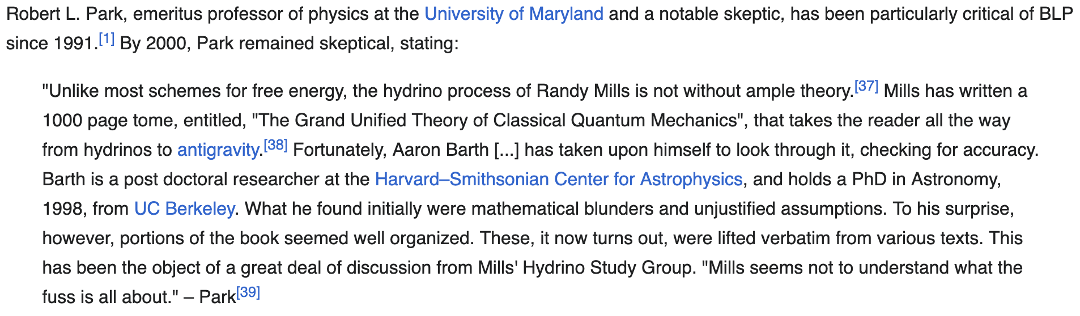
Robert Park has certainly been a particularly vocal critic of BLP; this much is true. In keeping with the rest of the Wikipedia entry, this anecdote is framed in a misleading way. Stolper has the full story of Aaron Barth’s critique:
“Barth wrote a five-page critique of Mills’ third book that focussed on alleged mathematical failures and was a good summary of the standard view of the book. Barth couldn’t deal with Mills’ experimental results, because they exploded the myth of Schrodinger-based QM, so, following other critics, he just ignored them, giving the excuse that they were separate from Mills’ theory.
In the email debate, Barth also accused Mills of inappropriate citation, a charge that Park mentioned in his online column. Mills has a photographic memory (one of his friends from college recalled that not only could Mills recite a book once he had read it, he “could tell you what stain was on what page”), and it got him into trouble here. In the January 2000 print edition of his book, which was almost 800 pages long, Mills reeled off several pages from a standard text on general relativity, by Robert Wald of the University of Chicago, and interspersed his own comments on how to improve the derivation. Mills cited Wald, but Mills didn’t demarcate Wald’s material clearly from his own comments, as Mills did with other quoted material elsewhere in his book. Not clearly demarcating his critique of general relativity as presented by Wald was a mistake on Mills’ part, which he corrected, but which his enemies continued to take advantage of anyway.”49
With the context of the Barth critique provided by Stolper, we see yet again how the Wikipedia article seems deliberately designed to mislead.

Note how much of the Wikipedia article relies on the mere opinion of Robert Park. As discussed above, there have been multiple independent experiments whose results are consistent with the Hydrino hypothesis.
Park never conducted or commissioned a Hydrino replication experiment, despite the many experiments to choose from. He never published a peer-reviewed rebuttal of Dr. Mills’ data or his theoretical work. He engaged in administrative lobbying rather than science.
Furthermore, it is not true that BLP has a patent problem. It has extensive global patent coverage on all key aspects of its technology, as we saw above.

Yet again we have Robert Park’s opinion being used to lead readers of the entry to an erroneous conclusion. Park supplies no experimental evidence that supports his conclusion that the science is “just wrong.” In anti-scientific fashion, he simply asserts it.
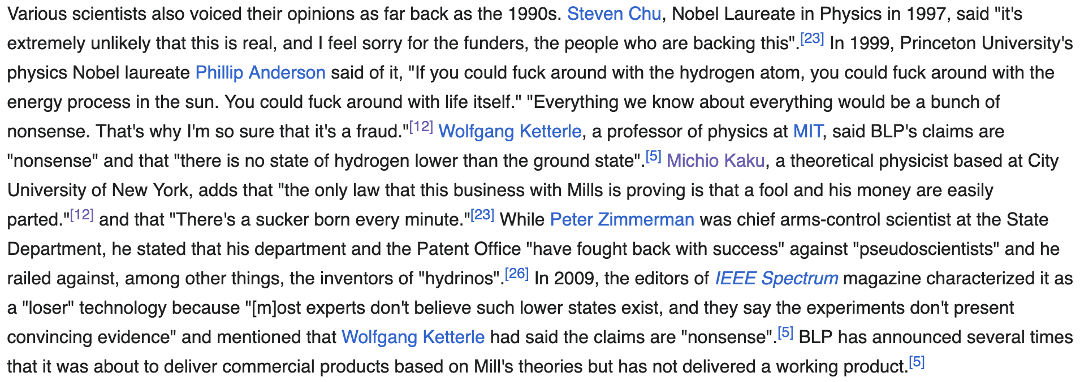
As Rutherford demonstrated with his quote on deriving energy from the atomic transformations, even the greatest of scientists must be very, very careful in making pronouncements about the supposed impossibility of scientific claims.
None of the quoted scientists in this passage have engaged with Dr. Mills’ empirical evidence for Hydrino or attempted to disprove the Hydrino hypothesis through their own experimentation. Only rigorous experiment can disprove a scientific claim, but that takes effort. Far easier to instead make ad hominem attacks on Dr. Mills and his investors.
However, many of Dr. Mills’ experiments are not difficult to replicate. Some of those experiments have been replicated, fully independently, with results published in peer-reviewed journals.
No scientist would deny that a new state of hydrogen would be an astoundingly important finding. If experiments demonstrating evidence of this new state are inexpensive and easy to perform, why not simply run the experiments instead of running one’s mouth?
As mentioned above, it is true that Dr. Mills has not yet delivered a working product. However, he has advanced Hydrino technology tremendously over the years, increasing the power density of the Hydrino reaction by many orders of magnitude.
Furthermore, BLP does appear to be close to a commercially viable SunCell. This business presentation posted on the BLP website details the current stage of development of the SunCell. BLP has also posted many impressive videos of prototype SunCells on the company’s YouTube page. As we saw above, well-credentialed outside experts have validated the technology repeatedly.

This section highlights how absurdly lopsided the BLP Wikipedia page really is.
It’s somehow permissible to cite a random blogger with no scientific expertise alleging securities fraud with zero evidence to that effect, and yet impermissible to cite three decades of peer-reviewed research encompassing many hundreds of experiments relying on nearly two dozen different analytical techniques, all pointing to the singular conclusion that Hydrino exists and has precisely the properties as claimed by Dr. Mills.
Does our random blogger cite the experimental record? Does he run his own replications? Does he examine the GUTCP math that predicts Hydrino states and attempt to demonstrate its falsity? Does he review the independent peer-reviewed literature that supports Dr. Mills’ claims? Does he attempt to interview any of the many well-credentialed scientists who have publicly stated, sometimes at significant career risk, that they believe Dr. Mills is correct about Hydrino?
Our random blogger does not do these things.
A superficially reasonable critique of Dr. Mills is that he has overpromised and underdelivered. However, I think this criticism is unfair. First, I believe he, quite reasonably, expected that the scientific community would replicate his work on a widespread basis and come into consensus about the reality of Hydrino. Obviously, BLP would be much better positioned to attract funding and talent if Dr. Mills was being hailed as one of the greatest scientists in history for his discovery of Hydrino.
The problem facing BLP in engineering a Hydrino-based power device is one of iterative engineering, and it obviously could have been iterating through the Hydrino power device design space much, much faster if Dr. Mills had the capital and talent he deserves at his disposal. There is no roadmap for how to do this, and history shows that trial-and-error engineering is the only path forward in these circumstances. The misguided controversy over Hydrino has slowed such iteration.
Additionally, as we saw above with the example of fusion power plants, it can take many decades to turn new physics into a commercially viable technology.
Finally, as I mentioned previously, it is very important to keep in mind the fact that what Dr. Mills is attempting to do has no precedent. No one has ever made a scientific discovery of the magnitude of Hydrino and then proceeded to successfully lead the effort to commercialize a practical device with profound global implications based on the fundamental scientific breakthrough. There is no way to know how long such an effort should take.
Perhaps more than any other section of the BLP Wikipedia page, this one highlights the extreme bias on display. If the uninformed opinion of a random blogger who doesn’t cite a single piece of peer-reviewed literature can be featured prominently, then obviously an objective page with an objective rule set for composition would also permit mention of sources like the independent replication work referenced above, the books on BLP by Stolper and Holverstott, and the assessments of third party experts like Professor Booker, at a minimum.
Given that the Wikipedia page editors do not permit mention of these items, we can draw an obvious conclusion.

Here is yet another example of the absurd bias on display on the page. In this very same article, we hear from Professor Peter Jansson of Bucknell, who has a Ph.D. in engineering from the University of Cambridge and has provided independent third-party validation for BLP’s technology.
“One of the validators is Bucknell University electrical engineering professor Peter M. Jansson, who is paid for his evaluations of BLP technology through his consulting company, Integrated Systems. Jansson says that being compensated for his time ‘does not in any way cloud my judgment as an independent investigator of scientific discoveries.’ He adds that he debunks most ‘new discoveries’ he checks out.
‘BLP scientists are doing real science, and to date, I have found no errors in their scientific methods or approaches,’ Jansson says. ‘Over the years, I have witnessed many BLP devices clearly capable of creating excess energy at meaningful levels. I think it may take some period of time for the scientific community to absorb, digest, and accept the possibility of lower energy states of hydrogen. I think Dr. Mills has made a compelling case.’ Jansson adds that commercial viability remains a challenge for BLP, but the way forward is being held up by business issues, not scientific ones.”50
Why is this very favorable quote from a well-credentialed expert not referenced?
The Wikipedia passage also lacks very important context: the quotes it references are not Dr. Mills saying those things directly to the reporter who wrote the article. Rather, they are quotes by a third party, Howard Wilk, who is claiming that Dr. Mills said those things to him at some point in the past.
I’m quite skeptical that Dr. Mills did say those things, because he very clearly has isolated Hydrino in the past, if one has a reasonable definition of the word “isolated.” The experimental record unequivocally shows this.
Even if we take the strictest possible definition of the word “isolated” to mean Hydrino that can be bottled and analyzed via scientific apparatus, this was arguably achieved as early as 1994, as outlined in the Thermacore paper we referenced above, in which Professor Miller took samples of the nickel cathodes of the devices that company built (independent of BLP) and found evidence consistent with the predicted signature of Hydrino using electron spectroscopy for chemical analysis.51
As Dr. Mills has gathered more experimental knowledge over the years, it has become ever easier to isolate Hydrino for analysis. It’s now dead simple to make “Hydrino in a bottle.”
In this preprint paper, Dr. Mills and Professor Hagen demonstrate that when FeOOH is ball-milled, Fe2O3 complexed with molecular Hydrino, H2(1/4), is formed.52 It is shelf stable for at least some period of time (although how long is not clear), and can be analyzed via electron paramagnetic resonance spectroscopy, Raman spectroscopy, X-ray photoelectron spectroscopy, and gas chromatography.
The paper finds that the compound has unique signatures specific to each analytical technique which are otherwise quite inexplicable.
They are the “obvious observations” that the passage above leads the reader to believe don’t exist. I encourage interested scientists to reach out to Dr. Mills about performing replications.
As to the final line, the notion that Dr. Mills is making no progress towards commercialization: this is nonsense. The latest SunCell prototypes are making vastly more energy at much higher power density than earlier Hydrino-based device prototypes, and as we saw above, multiple very well-credentialed third-party experts have put their reputations on the line saying so.
Here is a video of the prototype SunCell in operation:
This video was included in a July 1, 2026 post on the BLP website. The accompanying text says that optical power out from the SunCell seen in this demonstration is 85 kW. BLP does not provide a firm figure on input electrical power for this run, but my guess is that it’s in the neighborhood of 5-10 kW.

This section references an article that is very deliberately designed to make Dr. Mills sound like a crank, one that wholly ignores the vast body of experimental evidence for some of the claims referenced. The author cites none of the experimental record, nor does he interview any of the numerous scientists that have partially or wholly backed the claims of Dr. Mills.
The single fair point: Dr. Mills has indeed “made numerous extraordinary and difficult-to-believe claims…”
However, in the case of Hydrino-related claims, he has backed up those claims with correspondingly extraordinary evidence. The evidence he has published for Hydrino is so strong that I believe it can be considered “proven,” as the word is used colloquially.
Given Dr. Mills’ correct prediction of Hydrino states of hydrogen, I believe we should place much greater weight on his predictions that fall out of other aspects of the GUTCP.
There is also a philosophical question embedded in the legitimacy of the claims that have been made by Dr. Mills that are referenced in this passage. The question is this: does a scientific fact require consensus before it’s regarded as such? I believe Dr. Mills would contend that the answer is no. I fall into this camp as well.
Einstein was right about special relativity, even before this was widely recognized by the scientific community. Darwin was right about his theory of evolution by natural selection before his famous work was published.
I contend the same is true about Dr. Mills and his scientific discoveries. While it is the case that none of the claims referenced in this passage have any widespread scientific consensus about them, I believe Dr. Mills is correct to make them regardless. He is just waiting for everyone else to catch up.
Truths about our universe existed long before humans began investigating them. Scientific facts precede consensus.
Refuting Quantum Mechanics
Let’s start with his claim to have “refuted quantum mechanics.” Assessing this claim is conceptually simple, even if one doesn’t have a physics background.
The hydrogen atom is the simplest atomic system. One electron, one proton. Even the most hardened skeptic of Hydrino states of hydrogen would admit that their existence would be a vitally important aspect of any valid model of the hydrogen atom.
The entire point of an atomic theory is to correctly model all properties of atomic systems, so a valid theory had damn well better get hydrogen right.
The standard Schrödinger equation for an isolated hydrogen atom has no physically admissible, square-integrable bound-state solutions below its ground state. In plain English: SQM does not permit Hydrino states of hydrogen. Indeed, one of the main criticisms of Dr. Mills is that his contention they exist is forbidden by SQM; therefore, he must be wrong.
It’s as simple as this: if SQM explicitly says that Hydrino states of hydrogen can’t exist, and yet those states do exist, then the standard SQM description of hydrogen is wrong. Experiment is always the final arbiter in science.
I believe that given the breadth and depth of the experimental work that Dr. Mills has published consistent with his predictions about Hydrino, it’s reasonable to say that the evidence for it is so overwhelming that denial of its existence is simply a display of ignorance of that evidence. As stated above, I firmly contend that scientific facts precede consensus, and I think it is quite reasonable for Dr. Mills to say that he has refuted SQM. It’s simply the case that the broader scientific community has not yet properly engaged with all the varied evidence for Hydrino, for myriad reasons beyond the scope of this article.
Mysteries Of The Sun
As for Dr. Mills’ claim that he has solved the mysteries of the sun: a full explanation as to why this is likely true is beyond the scope of this article, but Dr. Mills has provided compelling evidence that Hydrino processes are the solution to perhaps the biggest solar mystery: the solar corona heating problem. The linked article phrases the mystery well:
“We all know from our own experience that when we move away from a hot body, the surrounding temperature decreases. So why is the Sun’s corona—the atmosphere of hazy plasma that extends millions of kilometers into space and is visible as a pearly white crown during total solar eclipses—so much hotter than the visible surface of the Sun? The temperature difference is tremendous: The average effective temperature of the photosphere—the surface layer of the Sun, where its light originates—is 5800 K. In comparison, the corona’s average temperature is a staggering 1–3 × 10⁶ K, and parts of it can reach temperatures as high as 107 K during highly energetic solar flares.”53
The original line of evidence that indicated that the solar corona was very, very hot was novel coronal line emission: specific frequencies of light that didn’t correspond to any known element at the time. The hypothetical element was dubbed “coronium.”
The first observation of novel line emission came during a solar eclipse in 1869, but it wasn’t until 1939 that Walter Grotrian first identified its real source: highly ionized states of iron. Bengt Edlén published a detailed paper on the topic in 1943.54
These highly charged states of iron and other elements are currently assumed to be formed by collision with very hot (high kinetic energy) electrons. In this model, these electrons collide with iron and less highly charged iron ions and ions of other elements present in the corona, and then knock off additional electrons to form very highly charged states such as Fe13+. These ions then release light of specific unique wavelengths.
It takes a great deal of energy to achieve these highly ionized states. For example, it takes 361 eV (compare that with 1.48 eV released per atom of hydrogen combustion) to remove 1 electron from the Fe12+ state to reach the Fe13+ state, which is responsible for one of the most prevalent of the spectral bands seen in the corona, the 530.3 nm line, the one that was initially attributed to the unknown “coronium.”55
This model therefore requires that the electrons that drive these highly ionized states possess hundreds of eV of kinetic energy, which corresponds to temperatures of several million kelvin.
The open question in this model is this: what is supplying and maintaining all the energy to create the very high-kinetic-energy electrons required to create these highly charged states? How can the corona achieve temperatures of several million kelvin while the sun’s surface is only 5,800 kelvin? There are existing explanations for how such high-energy electrons are created having to do with magnetic fields carrying energy from on and below the sun’s surface up to the corona.
However, Dr. Mills contends that the mystery is much more satisfyingly solved by the mechanism of Hydrino formation and its associated energy output.
Let’s walk through the logic as to why he makes this contention and why it’s reasonable, starting with an observed fact: the solar corona is a low-pressure plasma system.
The next fact: although not yet widely acknowledged, the experimental evidence for Hydrino formation in low-pressure terrestrial plasmas is very, very strong.
Dr. Mills and collaborators have published numerous papers outlining comprehensive evidence that Hydrino formation occurs in these terrestrial plasma systems that mimic aspects of the Sun’s corona. Here are some of those papers:
Spectroscopic study of unique line broadening and inversion in low-pressure microwave generated water plasmas.56
Comparison of excessive Balmer α line broadening of inductively and capacitively coupled RF, microwave, and glow-discharge hydrogen plasmas with certain catalysts.57
Fast H in hydrogen mixed gas microwave plasmas when an atomic hydrogen supporting surface was present.58
Substantial Doppler broadening of atomic-hydrogen lines in dc and capacitively coupled RF plasmas.59
Tests of features of field-acceleration models for the extraordinary selective H Balmer α broadening in certain hydrogen-mixed plasmas.60
Professor Jonathan Phillips has also found strong evidence of Hydrino formation in hydrogen/helium plasma systems. His wholly independent 2008 publication in the International Journal of Hydrogen Energy referenced previously corroborates Dr. Mills’ own findings and disproves a competing class of models for the unique findings in these systems.61
I would contend the evidence indicates that Hydrino formation is intrinsic to low-pressure terrestrial plasma systems that contain hydrogen and a Hydrino catalyst species: it necessarily occurs if conditions are right, and those conditions just happen to mimic those of the solar corona. I would thus further contend that the evidence is strong enough to conclude that Hydrino formation is ubiquitous in the corona of all stars, not just our Sun.
Dr. Mills’ explanation for the observation of highly ionized states of iron and other elements in the corona is thus as follows:
The corona is a relatively cool low-pressure hydrogen/helium plasma system, cooler than the sun’s surface (although still very hot by Earth standards!).
The conditions of this relatively cool plasma are such that Hydrino formation is always occurring.
The energy released by Hydrino formation is responsible for driving the highly charged ion states that then emit the observed wavelengths of light.
Although it’s not yet widely known, stars are giant factories constantly creating vast quantities of Hydrino, which is quite obviously the dark matter of our universe. This is not yet considered scientific fact, but one day soon, it will be, and a great deal of astrophysics and cosmology will have to be revised as a result. If you are skeptical of this claim, I encourage you to carefully read the 6 referenced papers above.
Dr. Mills goes into more detail on the solar and astrophysical data that supports his contention that Hydrino formation is responsible for a wide array of phenomena, including the solar corona heating problem, throughout the universe in his excellent 2017 paper “Mechanism of soft x-ray continuum radiation from low-energy pinch discharges of hydrogen and ultra-low field ignition of solid fuels” published in Plasma Science and Technology.62
It is beyond the scope of this article, but Dr. Mills has recently added to Hydrino theory with a new prediction: a Hydrino decay process can occur with very deep Hydrino states wherein the Hydrino atom’s electron collapses onto the proton, causing proton decay. This can drive a host of nuclear effects. This Hydrino decay process is likely a very significant contributor to nuclear processes both deep within the Sun and in its outer layers.63
Dark Energy
Dr. Mills has indeed explained the phenomenon known as “dark energy.” More accurately, he has explained the observation that dark energy was proposed to account for. However, his explanation does not require any mysterious new form of energy permeating all of space.
First, a bit of history. In 1998, two teams measuring distant supernovae made the wildly surprising discovery that the expansion of the universe is accelerating. This result was wholly unanticipated by most scientists. Mainstream theory said that the rate of expansion should be slowing due to the attractive influence of gravity.
The shocking discovery subsequently won the 2011 Nobel Prize in Physics. The scientific community coined the term “dark energy” as a sort of placeholder to describe whatever is causing the observed acceleration. In the minds of mainstream physicists, its physical nature remains unknown to this day.
Although the observation shocked most of the physics community, it didn’t shock Dr. Mills. He had predicted it 3 years prior, in the 1995 edition of the GUTCP (then titled the Grand Unified Theory of Classical Quantum Mechanics).64
The GUTCP disposes of the need for some mysterious “dark energy” to drive the observed acceleration of the expansion of the universe. In the GUTCP, the creation of matter from light causes spacetime contraction and time dilation, analogous to the Lorentz transforms of special relativity. The opposite process occurs as matter converts back into light, a process currently occurring on a vast scale in stars.
This conversion of matter into light, occurring in stars all throughout the universe, causes an expansion of spacetime itself. Eventually, as stars exhaust their matter, the expansion reaches a light-filled maximum, and the process reverses itself.
The GUTCP universe is thus oscillatory in nature, forever expanding and contracting in trillion-year cycles. We are early in an expansion cycle with a mostly matter-filled universe and the rate of expansion is currently accelerating.
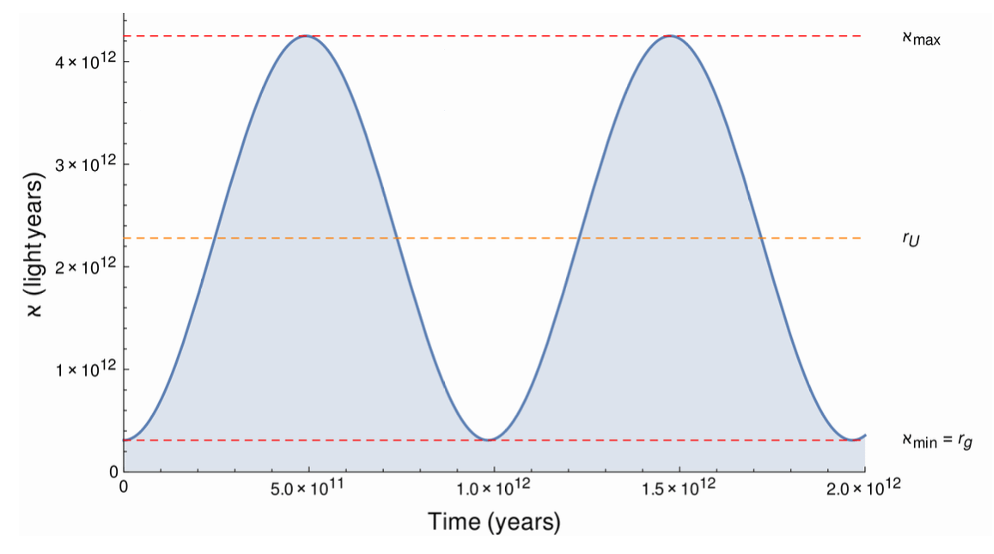
Figure 3: Figure 32.4 from Chapter 32 of the 2025 edition of the GUTCP – This figure shows the hypothesized trillion-year cycles of expansion and contraction of the universe. As we are very early in an expansion phase, the rate of expansion is accelerating.
To be clear, Dr. Mills’ model of the universe is in very explicit opposition to the current dominant theory of cosmology, Big Bang theory.
However, I believe Dr. Mills’ cosmological theory will ultimately be borne out, and that he is justified in claiming to have discovered the source of so-called “dark energy,” in precisely the same way that Einstein was justified in claiming that special relativity was correct as soon as it was formulated, regardless of whether the scientific community had yet formed that consensus.
Another prediction that falls naturally out of Dr. Mills’ model is that there should be large-scale structures that form during the contraction phase of the universe. This would mean that telescopes like the James Webb Space Telescope that can observe very far into the past should observe features that are at odds with what current theory permits, such as stars that appear far older and galaxies far more mature than conventional models comfortably permit.
Scientists are now producing papers reporting unexpectedly early galaxy formation.65
Hydrino Power
On to the next claim in the passage: that Hydrino can produce power very cheaply at enormous power density.
Dr. Mills has repeatedly demonstrated the latter half of that claim to be true. For example, in a paper published in 2018 in the Chinese Journal of Physics titled “Power determination and hydrino product characterization of ultra-low field ignition of hydrated silver shots,” Dr. Mills measured peak optical energy of about 800 joules over a 40 μs (microsecond) period from a hydrated silver shot detonated by a very high-current discharge. The watt is a measure of power, the amount of energy delivered per unit of time: one watt equals one joule per second.
Because the Hydrino reaction is so energetic, and happens so quickly, it releases a great deal of energy in a short period of time. In the case of the experiment, 800 joules delivered over 40 microseconds represents roughly 20 MW of peak optical output.
The hydrated silver used to produce this result was 80 mg in total, and the paper states it was around 1 mol% water.66 Let’s run through the math on how to convert that result to a per-liter-of-water basis so we can examine the validity of Dr. Mills’ claim in the passage above.
An 80 mg shot with 1 mol% water means the experiment used about 0.135 μL of water as a source of hydrogen and catalyst for the Hydrino reaction. One liter of water therefore contains about 7.4 million times as much water as the silver shot used in the experiment.
Multiplying the 20 MW peak optical power figure times 7.4 million, we arrive at 148 TW of peak optical power on a per-liter-of-water basis. That is 148 trillion watts of peak optical power on a per-liter basis.
Now, one may quibble about this, as this experiment may not scale up such that an entire liter of water could be made to undergo the Hydrino reaction in the same way it did on a small scale in the experiment outlined in the paper. However, it is the case that when one converts the experimental value in the paper into per-liter terms, one arrives at a figure of tremendous power density.
One can further quibble with the expression in watt terms and argue that joules are a better way to express things. Let’s run the math on that.
The silver shot in question released about 4,600 joules of energy as light in total. To scale that up into a per-liter-of-water basis, we multiply 4,600 times 7.4 million and get 34,040,000,000 joules. For a frame of reference, one liter of gasoline contains about 32,000,000 joules of chemical energy.
As to the former claim about the cost of producing power with Hydrino-based devices, the current iteration of the SunCell will quite obviously produce power very, very inexpensively if successfully commercialized. No purchased fuel is required (since water can be condensed from the atmosphere and electrolyzed to provide the required hydrogen fuel), and the projected capital cost of the SunCell is quite minimal relative to the projected electrical output: something like $100 per kW, and perhaps less when scale manufacturing kicks in. The levelized cost of electricity production (LCOE) for the commercial SunCell is projected to be around $0.001 per kWh, although the rate charged to customers will be higher.
Compare this with a new utility-scale combined-cycle natural-gas power plant, for which a 2025 estimate put costs at approximately $2,400 per kW of generating capacity in the United States.67 Lazard estimates that the LCOE for such a plant is between $0.05 and $0.12 per kWh: 50 to 120 times higher than the projected SunCell figure.68
Antigravity
The final sentence of the Wikipedia passage contains a rather blatant inaccuracy. Dr. Mills has never stated that Hydrino will produce an anti-gravity effect. The Forbes article from which the passage is quoting refers to another article by Erik Baard in the Village Voice, referenced previously. In that article, Baard makes mention of an antigravity effect hypothesized by Dr. Mills in this passage:
“Mills says the answer may again lie in the electron, which according to his theory might be made to respond negatively to gravity. He quickly emphasizes that this part of his work awaits experimentation, and he has kept quiet about it so far because he’s quite aware of how his critics will ridicule it. Mills is uncharacteristically coy in referring to the antigravity machine as a ‘relativity device.’”69
It is true that he has posited the existence of such an effect in his GUTCP, but it does not arise from Hydrino. He points to the known phenomena of black hole electron jets and the vertical discharge lightning called blue jets as two observable natural manifestations of this antigravity effect. Although the effect has yet to be properly tested, it is a valid hypothesis and Dr. Mills has outlined how it could be tested in Chapter 35 of the GUTCP.70
Figure 4: Black Hole Electron Jet and Blue Jet Lightning - Dr. Mills contends these are driven by an antigravity effect whereby free electrons are caused to take on a state of negative curvature. He calls such states “pseudoelectrons” and contends that they are repulsed by gravitational fields, rather than attracted, as in the case of ordinary matter. There are existing explanations for these phenomena, but Dr. Mills’ hypothesis may prove superior. Only time will tell. Until then, it remains a valid, testable scientific hypothesis.
Other Hydrino Claims
As to the other claims, all but one have been made by Dr. Mills, and they are defensible. One of the referenced claims was not made by Dr. Mills.
Regarding the Hydrino reaction serving as an explosive or propellant: an experiment in the Chinese Journal of Physics paper referenced above compares the blast wave from the detonation of hydrated silver and titanium shots to the blast wave from gunpowder. In some of the experiments, the resulting blast pressure exceeded the blast pressure of gunpowder.
Regarding the claim that Hydrino could make ships rustproof: Hydrino states have far greater electron binding energies than ordinary hydrogen. Dr. Mills proposes (and has synthesized) some Hydrino-containing compounds that exhibit unusual chemical stability and may serve as corrosion-resistant coatings, among other applications. Dr. Mills has filed a patent application that details how such compounds could be created.71
Regarding the claim that such coatings would endow ships with stealth properties: a careful reading of the article from which this claim is sourced reveals it was not made by Dr. Mills, but rather by Michael Kalleres, a BLP board member at the time. I do not believe that Dr. Mills has publicly made this claim.
Regarding the claim that Hydrino may permit the creation of very high energy-density batteries: as mentioned above, Hydrino states of hydrogen have very high electron binding energies. The same patent application referenced above outlines conceptually in great detail how this property could be leveraged to allow the engineering of such batteries.72 BLP elected to pursue means of generating power via the Hydrino reaction rather than devote its limited resources to engineering a working Hydrino-based battery, but I believe such a Hydrino-based battery is possible, and it’s likely one will be commercialized in the future.
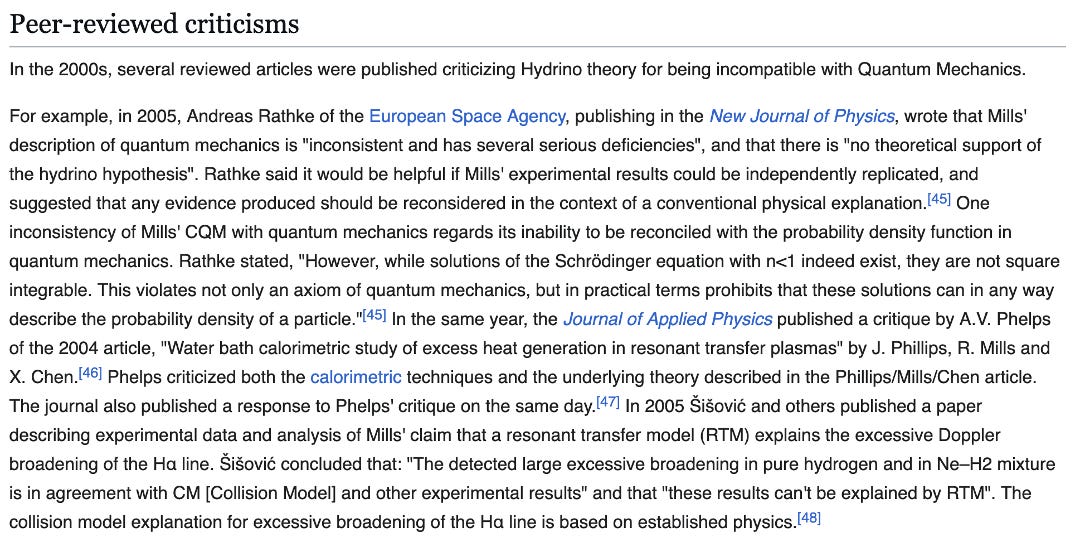
It is true that a handful of articles attempting to refute the Hydrino hypothesis on theoretical grounds have been published. However, they all have fatal flaws that doom them to irrelevance.
The most important point here: Dr. Mills does not claim that Hydrino states of hydrogen are compatible with SQM.
Rathke
Rathke’s 2005 paper is the purported physics authority Wikipedia leans on most heavily. The page quotes his sweeping verdict that there is “no theoretical support of the hydrino hypothesis,” then repeats his observation that Schrödinger wave equation solutions with a principal quantum number below one are not square integrable. This verdict is theoretical in nature and not an evaluation of the Hydrino experimental work discussed above.
A reader comes away with exactly the impression the page seems to intend: a professional physicist worked through Dr. Mills’ GUTCP atomic model that predicts Hydrino states of hydrogen on its own terms and caught fatal mathematical defects.
Ironically, precisely the opposite is true.
Rathke’s paper does not contain any Hydrino replication experiments nor does it analyze any experimental data. There isn’t any substantive discussion of Dr. Mills’ experimental work at all; Rathke explicitly states that reconsideration of the experimental evidence is beyond the scope of his paper. Tellingly, he does acknowledge “the wealth of experimental evidence that has been published in peer reviewed journals in favour of the hydrino model,” and he closes by recommending that the experiments be “independently reproduced by some other experimental groups.” Indeed.
The paper is instead a pencil-and-paper theory exercise. Rathke presents his critique as a direct mathematical evaluation of the GUTCP atomic model: “we did not resort to any physics argument,” he writes, “but instead directly checked the alleged solution of the underlying equations of motion.” He concludes that the theory is irredeemably flawed: “Hence there is no way to cure the flaws of the theory by adding physical assumptions.”73
Rathke staked his critique of the GUTCP model on his math. And therein lies his problem: his critique’s merit and its ability to assess the “flaws of the theory” are entirely dependent upon whether the math was done correctly.
It wasn’t.
Rathke’s paper has two main parts: one in which he attempts to critique the math of the atomic model of the GUTCP that predicts the existence of Hydrino states of hydrogen, and a second part in which he considers whether SQM permits Hydrino states.
In the first part of the critique that attempts (and fails) to analyze the GUTCP model, Rathke made a very consequential sign error when separating the GUTCP model’s wave equation, flipping a minus sign to a plus in his Eq. 8.
He then presented the same wrong sign in Eq. 9 as what Dr. Mills’ 2002 paper “The grand unified theory of classical quantum mechanics” “states,” even though that paper prints the correct minus sign.74
The correct sign is also printed in Dr. Mills’ 2001 paper “The nature of free electrons in superfluid helium—a test of quantum mechanics and a basis to review its foundations and make a comparison to classical theory,” which Rathke also references.75
Rathke carried the error through his analysis of the angular solutions. He somehow did not notice this elementary mistake.
He also makes a basic transcription error in Eq. 16.

Figure 5: The Scene of the Mathematical Crimes - The plus sign in Eq. 8 is supposed to be a minus sign and this error is carried through to Eq. 9. In Eq. 16, Rathke mistakenly drops the square from the radial factor’s denominator: 1/r replaces 1/r². He copies this factor correctly in Eqs. 5 and 6, then incorrectly when testing it, and he attributes the incorrect version to both of Dr. Mills’ papers, each of which prints 1/r² (Eq. 2 of the 2002 paper and Eq. 39 of the 2001 paper). Unlike the more significant sign error, this error does not change the outcome of his radial test.
As Dr. Mills’ response, published in Volume 20 of Physics Essays (full preprint version available here), points out, the correct form of the equation appears in the very reference Rathke cited.76 In fact, as stated above, both papers Rathke analyzes do print it correctly: the minus sign appears in Eqs. 23 and 24 of the 2002 paper and in Eq. 51 of the 2001 paper.77
A bit of background is required to understand the consequences of the sign error. A wave confined to the surface of a sphere can vibrate only in certain patterns, much the same as a drumhead or string on a guitar can only sound certain notes. These patterns are called spherical harmonics and their math is well-known. This math is used anytime you are describing waves on a sphere, and SQM uses the same functions to describe the angular shapes of electron orbitals.
In the GUTCP model, they describe the pattern of charge and current on the electron’s spherical shell, and in excited states the pattern generally rotates around the sphere, so that at any fixed point the charge oscillates in time.
Rathke attempted to analyze whether the pattern and oscillation fit together in the GUTCP wave equation. The wave equation links the pattern’s index, its oscillation frequency, and the speed of the wave. The sign of its time-derivative term determines whether the permitted time dependence is oscillatory or exponential.
That sign is the one Rathke got wrong in Eqs. 8 and 9. This elementary sign error matters greatly. With Rathke’s flipped sign, imposing the spherical-harmonic condition forces the time-dependent solutions to grow or decay exponentially instead of describing the periodic motion required by Dr. Mills’ proposed solution. On that incorrect basis, he rules out the oscillating part of Dr. Mills’ angular solutions.
Restore the correct minus sign and the demanded behavior becomes ordinary oscillation, which is the kind of solution Dr. Mills’ GUTCP model uses.
Rathke’s argument against that oscillatory behavior rests upon his own math error.
With the sign corrected, his case against the oscillation shrinks to a narrower complaint, stated in a single sentence of his corrigendum without the comparison being shown: that the frequency the corrected equation allows for each pattern is not the frequency in Dr. Mills’ solution.
That complaint assumes the wave travels around the sphere at one fixed speed, the electron’s own speed. Dr. Mills’ wording arguably invited that reading: both the 2001 paper Rathke cites and his rebuttal paper describe the speed in the equation as “the linear velocity of the electron.”78
However, the response also directs readers to the GUTCP’s section on the electron’s rotational parameters for the demonstration that his angular solutions satisfy the wave equation.79
In the current edition of the GUTCP, that section explains that the speed of the charge wave is not constant but varies across the sphere with the pattern itself, and it recasts the wave equation as the textbook equation for a spinning rigid object, a “rigid rotor,” whose energies depend on the pattern through the same factor that appears in Rathke’s corrected condition.80 Physicists can debate that step, but it is a substantive answer to the frequency objection, an objection Rathke’s corrigendum never develops beyond a single sentence.
For a paper whose whole premise is reviewing another physicist’s math, this is comically shoddy work.
More than a year after initial publication of his paper, Rathke conceded his error on Eq. 8. A corrigendum was added on the last page of the paper’s PDF, and it credits discovery of the error to Dr. Mills: “This error was first noticed in [1].” Reference 1 is a 2005 preprint of Dr. Mills’ published rebuttal paper.81
Rathke’s corrigendum, dated June 23, 2006, appears after the original paper’s references in the linked PDF. It acknowledges Rathke’s mistake on this point and gives a corrected frequency condition, then asserts without a reworked full derivation that “the sign error does not change any of the conclusions of the paper.”
For the oscillating part of Dr. Mills’ solution, that claim holds only because the corrigendum substitutes a new argument for the one the sign error destroyed. His mistake demolishes the argument he actually published against that oscillation, namely that the equation forbids it outright.
Dr. Mills’ massive point-by-point rebuttal defends his angular solution and addresses Rathke’s remaining claims in detail, but Rathke elected not to engage with this material.
The rest of Rathke’s critique of the GUTCP model has a more fundamental problem: he leaves out essential parts of the model.
He claims the model can produce only hydrogen’s ground state, because when he combines Dr. Mills’ wavelength condition with an electron circling in the bare electric field of the proton, only one orbit works.
However, in the GUTCP model, an excited state is not just an electron sitting in the proton’s bare field. Rather, it is an electron together with an absorbed photon. The trapped photon’s field partly cancels the proton’s central pull, so the electron experiences a central charge reduced by a factor of n and settles at n times the ground-state radius, which Dr. Mills uses to calculate the familiar excited states.
The 2001 paper Rathke cites says it directly: “Excited states comprise an electron with a trapped photon,” whose field “superposes with the field of the proton.”82
Rathke’s Bohr-style calculation leaves the photon out, so it finds only one state. He then assumes the radii come from “some other procedure (which Mills does not specify).” But Dr. Mills specifies it explicitly in both papers Rathke analyzes
The 2002 paper, which Rathke is discussing in that very passage, solves the ground-state radius from an explicit force balance and states that the excited-state radii come from the same kind of force balance with the trapped photon’s field included.83
Both papers write down that field and give the resulting net central charge at each excited-state radius, 1/n times the proton’s, and the 2001 paper adds that the field “provides force balance.” Put that field into the force balance and the radius comes out at n times the ground-state radius in a single line of algebra, which Dr. Mills’ response carries out explicitly.84
The same equations, with a field that adds to the proton’s central pull instead of subtracting from it, give the Hydrino states at 1/2, 1/3, 1/4, and so on of the ground-state radius. The 2001 paper lists them in the very same equations as the ordinary excited states, and Rathke’s verdict that the model “does not contain solutions that predict the existence of hydrinos” never mentions those equations.
In fact, the trapped photon appears nowhere in Rathke’s paper; the only photon Rathke discusses is the one a catalyst eventually emits. The predicted Hydrino radii simply follow the reciprocal pattern of ordinary excited-state radii. Rathke somehow completely missed a vital component of the GUTCP model, even though that component is spelled out in detail in papers he cites.
With the photon’s contribution included, Dr. Mills shows closed-form calculations for excited states of hydrogen and helium that very closely match experimental values. For more than 100 excited states of helium, he reports agreement with the measured energies to roughly five significant figures.85
Rathke also argues that the existence of Hydrino states cannot be derived from the GUTCP wave equation. He draws this very sweeping conclusion from a narrow, inappropriately applied test.
A wave equation in three dimensions allows motion in every direction, including in and out, toward and away from the nucleus. Rathke took the in-and-out part of that equation by itself and checked whether Dr. Mills’ thin shell of charge satisfies it. It does not (nor is it supposed to), and from that he concludes that there is no way to derive Hydrino states from the GUTCP.
With this argument, Rathke demonstrates that he doesn’t understand a very basic aspect of the GUTCP model, an aspect that is again spelled out clearly in the papers he cites.
Dr. Mills agrees that the shell does not satisfy that part of the three-dimensional wave equation, and says so plainly: the shell “is not a radial solution” of it.86
The reason is the core of his model.
Dr. Mills starts from the full three-dimensional wave equation and imposes a single, empirically true physical requirement: a stable electron must not radiate. He found that any in-and-out motion of the electron’s charge would radiate, so a stable electron must not move in this way.
Imposing this condition leaves the electron’s charge confined to a thin spherical shell, with all its motion running across the shell’s surface. In-and-out motion happens only when the atom absorbs or emits light. In a stable atom, the in-and-out part of the equation has nothing to describe, and the equation reduces to its two-dimensional, surface-only form.
In the 2001 paper Rathke cites, but apparently didn’t read carefully, this is all clearly stated. The shell is introduced as the radial function “which satisfies the boundary condition” of non-radiation, and Dr. Mills says that applying that condition to the three-dimensional wave equation “requires that the functions must be solutions of Eq. (51), a two-dimensional wave equation plus time.”87
The size of the electron shell is a separate question, and the wave equation does not settle it. In the GUTCP atomic model, each allowed electron radius is fixed by a balance of forces among the electron, the proton, and any trapped photon. That force balance, discussed above, is what produces both the ordinary excited states and the Hydrino states.
A spherical balloon provides an analogous mental image: ripples might run across its surface, but its size is set by the balance of pressure inside and out, not by the ripples.
Rathke looked for the Hydrino states in the one part of the equation the model sets aside, so it is no surprise he did not find them. His test never engages Dr. Mills’ reason for setting it aside, or the force balance that determines the radii.
In the GUTCP model, the shell is a constraint imposed by physics. It confines the electron’s charge and current to a spherical surface at a fixed radius relative to the nucleus, and the wave dynamics then occur across that two-dimensional surface.
Again, Dr. Mills argues that the three-dimensional equation is the wrong one for a stable electron, because an electron moves radially only when it gains or loses energy, that is, only when the atom absorbs or emits light.
Rathke’s radial test therefore checks the shell against an equation Dr. Mills explicitly says does not apply to it, and he never engages with Dr. Mills’ reason for using the two-dimensional one.88
Recall Rathke’s claim that he “did not resort to any physics argument” and that no physical assumption could cure the flaws he found. Apart from the angular analysis, each of the other two defects he lists depends on an omission, born of a profound lack of reading comprehension or an outright failure to read the relevant sections in the first place.
His ground-state-only result omits the trapped photon’s field, and his radial test omits the surface constraint, imposed because a stable atom does not radiate. Both are stated explicitly in the 2001 paper he cites. His claim has it backwards: the flaws he found arise precisely because he left the physics out.
The non-radiation condition, which is the actual mechanism by which the GUTCP model selects its solutions and the entire reason the delta function appears, is never mentioned in Rathke’s paper. The only “non-radiative” process he refers to is a different one, the catalytic transitions by which an electron moves between states, and those, having declared the model inconsistent, he declines to discuss.
The non-radiation condition is a vitally important detail at the very heart of the GUTCP model, and the model cannot be judged without it. Rathke attacks the model without addressing its stated starting point, even though both papers he analyzes name the non-radiation condition in their abstracts.
The 2002 paper gives the condition a section of its own, and the condition itself is standard classical electromagnetism.89
A point charge radiates whenever it accelerates, but, as Abbott and Griffiths wrote in the American Journal of Physics, “it is possible for an extended charge to accelerate without radiating.” The test Dr. Mills applies, that the electron’s current must not contain components moving in step with light, is the same criterion Goedecke published in Physical Review in 1964, which Abbott and Griffiths called “a stunningly simple test for the absence of radiation.”90
The 2001 paper spells out the resulting two-dimensional constraint in its Section 2.2.91
Unlike the sign error, this profound problem is never corrected. Rathke credits Dr. Mills’ rebuttal for identifying the sign error, but the corrigendum still does not address the non-radiation condition or explain why the surface constraint should be discarded.
Rathke also concludes that the GUTCP model is incompatible with special relativity. Dr. Mills’ response disputes that conclusion, arguing that his equations of motion are the same in every frame and that relative motion corrects only the electron’s radius. He points to the included closed-form calculations of the electron g-factor, fine and hyperfine structure of hydrogen, and the Lamb shift as experimental confirmation of this correction.92
This issue is separate from Rathke’s claim that the GUTCP contains no Hydrino solutions.
Again, Rathke’s six-sentence corrigendum corrects only his math error on Eq. 8. It does not engage further with Dr. Mills’ lengthy refutation paper, which demonstrates in detail that Rathke either misunderstood the model he attempted to criticize or never bothered to understand it in the first place.
After sloppy math errors and a failure to correctly engage with the GUTCP atomic model, Rathke moves on to Section 3 of his paper, where his criticism goes from mathematically botched to beside the point.
Dr. Mills argued in his 2001 paper that the Schrödinger equation itself admits below-ground-state solutions just as valid as the ordinary ones, and that they are excluded only by a boundary condition he regarded as a postulate rather than a consequence of first principles.93
Rathke responds to that contention in his 2005 paper and insists that SQM forbids physical Hydrino states.94 He notes that Schrödinger equation solutions below the ground state of n = 1 are not square integrable and that stability theorems cap the binding energy of an isolated hydrogen atom. Within SQM, that is a fair reply.
However, square integrability is exactly the requirement Dr. Mills’ argument calls into question: the 2001 paper rejects what it calls “the postulated Schrödinger boundary condition,” which “leads to a purely mathematical model of the electron,” along with the reading of the wave function as a probability.95
Rathke’s reply rests on precisely those premises: square integrability, which he calls “an axiom of quantum mechanics,” and the requirement that a solution “describe the probability density of a particle.” That restates the premises under challenge rather than defending them. It is an argument about what SQM allows, not what nature allows, and it does not in the slightest refute the alternative framework Dr. Mills proposes.
Furthermore, this back-and-forth on the appropriateness of the boundary conditions applied to the Schrödinger equation and their consequence in terms of whether Hydrino solutions to it are permitted is ultimately irrelevant.
An analogy makes the irrelevancy of the debate in this section clear: Rathke is a swan researcher whose theory defines all swans as white. When confronted with reliable reports of a black swan, he patiently explains that his theory says it can’t exist.
The existence of Hydrino states is the claim being tested. You cannot refute a prediction born of a new theory and backed up with solid, reproducible experimental evidence for it by showing that the prediction is forbidden by status quo theory.
Two key principles apply here:
If you are going to critique someone else’s math, you need to make damn sure you actually understand their math, and be damn sure your own math is right, lest you look foolish.
When two theories disagree, experiment is the final arbiter.
This episode is a microcosm of why the BLP Wikipedia page is so profoundly misleading.
Rathke grades his own mistaken reconstruction of the GUTCP model instead of the correct one. His angular derivation contained a very consequential sign error, caught by Dr. Mills, and he attributed the wrong sign to a paper that prints it correctly. His ground-state-only result leaves out the trapped photon’s field, even though both papers Rathke relied upon clearly show this essential aspect of the GUTCP model. His radial test holds the electron’s shell to a three-dimensional equation Dr. Mills explicitly says does not apply to it.
All these errors were born of sloppy math and lack of reading comprehension. Furthermore, Dr. Mills subsequently highlighted them in his rebuttal paper. However, even though Rathke’s corrigendum credits an early version of that rebuttal with catching the sign error, it addresses only that one error, and the correction appears well after the publication of the initial paper, on the final page of the paper’s PDF.
Despite these fatal flaws, the casual reader of the Wikipedia page is given the mistaken impression that a competent professional physicist reviewed Dr. Mills’ work and found it wanting. Wikipedia mentions neither the corrigendum nor Dr. Mills’ published response.
The reality is that a physicist thoroughly butchered his review through his own mathematical errors and complete and utter failure to understand and engage with Dr. Mills’ theory on its own terms.
Phelps
A. V. Phelps’ critique of Professor Jonathan Phillips’ “Water bath calorimetric study of excess heat generation in resonant transfer plasmas” paper also misses the mark.
First, let’s review the basics of the experiments in the original paper, which are about as simple as physics gets. The Phillips team put a small microwave plasma in a 45-liter water bath, supplied different gas mixtures at matched microwave power-meter readings, and measured how much the water warmed up.96
The point of the experiment was to test whether the introduction of gas mixtures predicted to support Hydrino formation into the microwave plasma produced excess heat beyond what ordinary chemistry would permit.
Ten control gases and gas mixtures, including krypton, krypton with hydrogen, nitrogen, and carbon dioxide, gave consistent heat measurements in the water bath that matched expectations based on nominal power input.
The gas mixtures that Hydrino theory predicts should support Hydrino formation and thus the production of excess heat, such as helium with hydrogen and argon with hydrogen, were also introduced into the microwave plasma. The paper reports roughly 50% more heat than the control gases, on average, at matched power-meter readings. Roughly 20 watts of excess heat was reported.
Professor Phillips and the team checked whether ordinary chemistry could account for these findings. The only known net-exothermic reactions among gases used for the experiments, ammonia formation and carbon dioxide conversion to methane and water, come to about 0.1 watt at the flow rates used, roughly two hundred times too small. Furthermore, these modest exothermic reactions were only possible in the case of the control experiment gases.
The central comparison in the series of experiments was between gases flowing through the quartz tube at matched forward and reflected power-meter readings.
Phelps’ comment paper claimed these experiments were not a convincing test.97 His core argument proposed that the experimental apparatus might simply lose more heat when a control gas or gas mixture was running than when a gas mixture predicted to support Hydrino formation was running. This would mean that the observed differences in heat production between control gases and the gases predicted to support Hydrino formation were due to a measurement failure rather than a real effect. Phelps alleges insufficiently documented calibration prevents distinguishing real excess heat measurements from “greater undetected power losses.”98
This is a remarkably incomplete assertion. In Professor Phillips’ published response, he pointed out that Phelps does not quantify a physical process that would explain this pattern of power loss, and that the typical heat difference was roughly 20 watts, larger than the reported correction terms combined.
Strangest of all, this mysterious unquantified extra loss would have to appear for the many control gas experiments and then shrink for every one of the gas mixtures predicted to support Hydrino formation. This would be despite the same cavity, matched power-meter readings, and the same water bath. Professor Phillips gives a description of the behavior Phelps requires of the experimental apparatus: “arguably anthropomorphic.”99
His point is that an explanation based on heat loss must account for why the measured excess appears so selectively in the predicted gas mixtures.
Professor Phillips also responds to the calibration aspect of the Phelps critique. He points out that the equipment was rigorously calibrated and that statistical analysis was applied to the data set from the experiments and it showed clear statistically significant results. I’d further add that Professor Phillips has decades of expertise in calorimetry and knows well how to calibrate calorimeters.
The rest of the Phelps comment paper critiques earlier experimental work on Balmer line broadening in hydrogen plasma systems by Dr. Mills and collaborators, including Professor Phillips, separate and apart from the work in the 2004 Phillips paper discussed above. Those critiques are dispatched by subsequent experimental work by Dr. Mills and Professor Phillips, which will be discussed at length below.
Professor Phillips was bound by the etiquette of scientific discourse in his response to Phelps, but I am not. Phelps offered a lazy critique wholly unsupported by any quantified loss mechanism.
Even if the Phelps criticisms of the Phillips paper had merit, the appropriate way to settle perceived calibration issues is through replication work, doubly so because the type of experiment used in the paper in question is straightforward and inexpensive to perform, and triply so because of the monumental importance of the existence of Hydrino states of hydrogen.
Arbitrarily dismissing evidence consistent with a scientific model by resorting to untested claims of experimental error does not invalidate that model. It’s just unscientific hand waving.
Phelps would need more than an unmeasured loss term to establish that the reported excess heat was an artifact. The only way to truly settle the issue would be to run his own experiments and publish his results.
He performs no such experimental work.
The Šišović Paper
As with Professor Jonathan Phillips’ demolition of Phelps’ misguided critiques on his 2004 paper, Dr. Mills and Professor Phillips have also published multiple excellent papers that very thoroughly disprove the claims in the paper by Šišović et al. referenced in the Wikipedia entry.
The 2005 Šišović paper is proffered as evidence that Doppler broadening of Balmer lines (I’ll explain what this is below) in certain mixed gas plasmas reported by Dr. Mills (and many others) has a conventional explanation.100 The authors were experienced spectroscopists and their measurements seem competent.
However, the experimental apparatus they use is utterly worthless as a way to properly test the relative merits of their preferred explanation, the Collision Model (CM) versus Dr. Mills’ Hydrino-based explanation for such line broadening (called RTM in the paper but herein referred to as the Hydrino model).
This is because the apparatus used in the paper was built in a way that made the authors’ preferred explanation unfalsifiable.
All the predictions the CM makes were subsequently tested by Dr. Mills and Professor Phillips with appropriate experimental design that could distinguish between the CM and Dr. Mills’ Hydrino-based explanation.
For those not interested in the technical details, here is the TL;DR explanation:
It’s possible that the findings of the Šišović paper and associated explanation were correct in the specific context of the experimental apparatus used.
However, the experimental apparatus in the paper was constructed in such a way that it made it impossible to properly test the merits of Dr. Mills’ Hydrino model as the explanation of Doppler broadening of Balmer lines in all contexts.
It’s quite straightforward to set up experimental apparatus that can determine whether all line broadening is caused by the CM mechanism of the Šišović paper.
Subsequent papers by Dr. Mills and collaborators, and a paper by Professor Jonathan Phillips, very conclusively disprove the CM as the source of line broadening in a variety of different contexts. Those same experiments are strongly consistent with the predictions of Hydrino theory.
Thus, while it’s possible that the CM holds true as the cause of Doppler broadening of Balmer lines under certain conditions, it most definitely does not hold true as a possible explanation for the line broadening observed in many different plasmas.
I’ll now dissect the problems with the paper in depth.
The Problems With The Šišović Paper
The paper and the corresponding papers from Dr. Mills can be a bit hard to follow for laypeople, so I’ll summarize the context of them briefly.
There are many experiments in the scientific literature that exhibit a well-known phenomenon in certain types of mixed gas plasma cells. Many of these papers are by Dr. Mills and collaborators, but many are by other groups such as the Belgrade group of Konjević and Kuraica. That phenomenon is called Doppler broadening of Balmer lines.
Doppler Line Broadening
First, I’ll explain what a Balmer line is.
Excited-state hydrogen atoms emit light of discrete wavelengths when falling from a higher-energy state to a lower-energy state. Each energy state is assigned a positive integer “n,” with n = 1 being the so-called “ground state” of hydrogen. This value “n” is called the principal quantum number.
The Balmer series is a set of discrete wavelength photon emissions that occur when an excited hydrogen atom falls from a state of n > 2 to the n = 2 state.
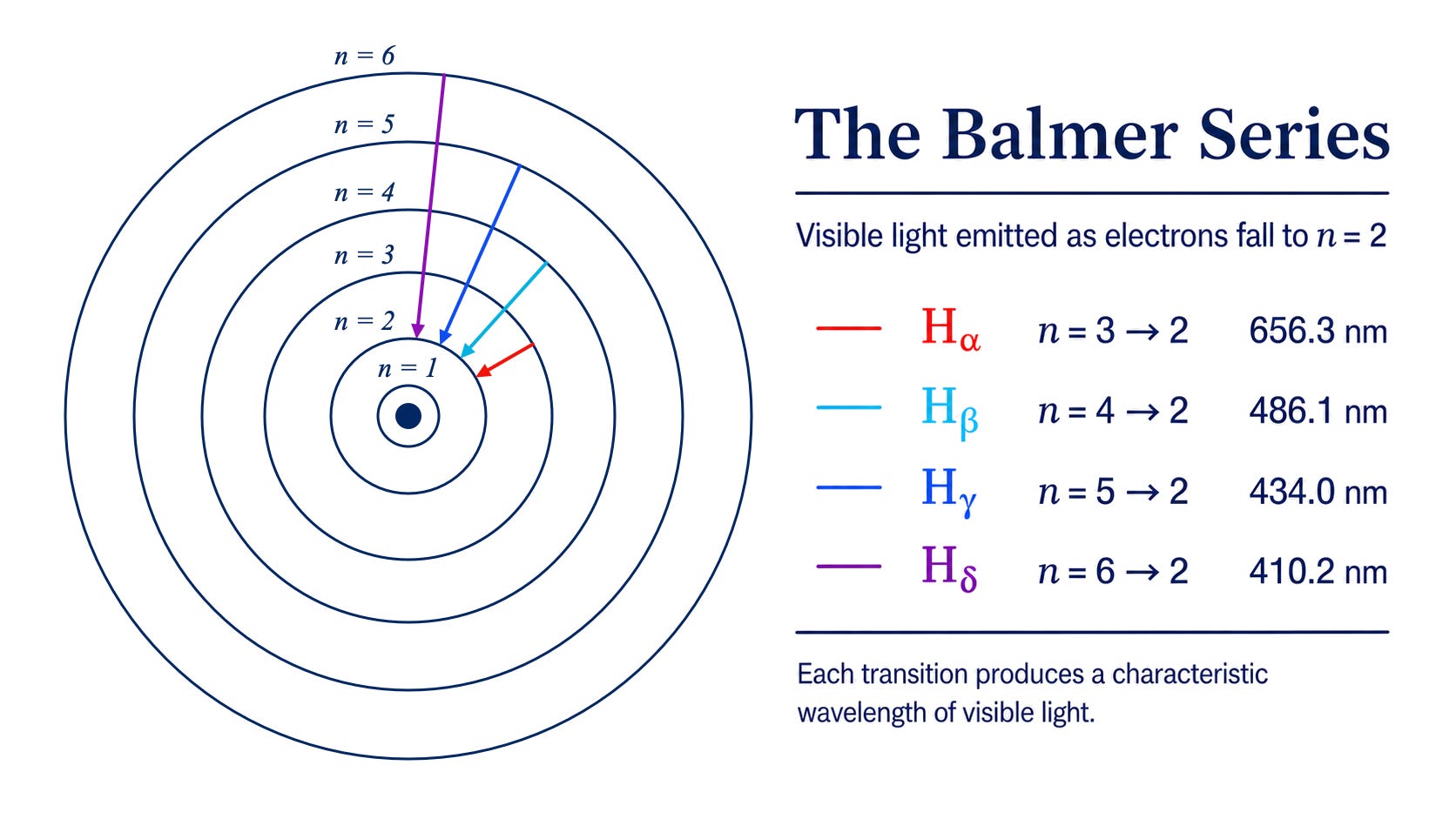
Figure 6: The Balmer Series - This is a series of discrete wavelengths of light corresponding to the hydrogen excited-state transitions shown in the figure. The Balmer α and Balmer β lines are most common and are caused by hydrogen falling from the n = 3 to n = 2 state and the n = 4 to n = 2 state, respectively. The degree of broadening of these spectral lines indicates how fast an excited-state hydrogen atom is moving relative to the point of observation.
An isolated, motionless hydrogen atom in an excited state would emit each Balmer line at one sharply defined wavelength as it falls to the n = 2 state. A spectrometer recording this photon emission would therefore record a narrow peak.
Doppler broadening of Balmer lines occurs when a Balmer series photon is emitted while the excited-state hydrogen atom is moving very quickly relative to a spectrometer measuring the light. This is commonly called “hot hydrogen,” meaning that it has a great deal of kinetic energy. This energy is often measured in electronvolt (eV) terms, which corresponds to a temperature. The degree of Doppler broadening allows us to determine how much kinetic energy that hot hydrogen has. For context, line broadening that indicates a 40 eV hot hydrogen species corresponds to around 460,000 K. Very hot!
Hydrogen atoms in a plasma are moving in different directions. Light from an atom moving toward the spectrometer is shifted slightly toward shorter wavelengths (blueshift), while light from an atom moving away is shifted toward longer wavelengths (redshift). The faster the excited-state hydrogen atom is moving, the greater the degree of blueshift or redshift.
The spectrometer observes millions of atoms simultaneously, so these small Doppler shifts blend into a broadened peak, as shown in Figure 7 below.
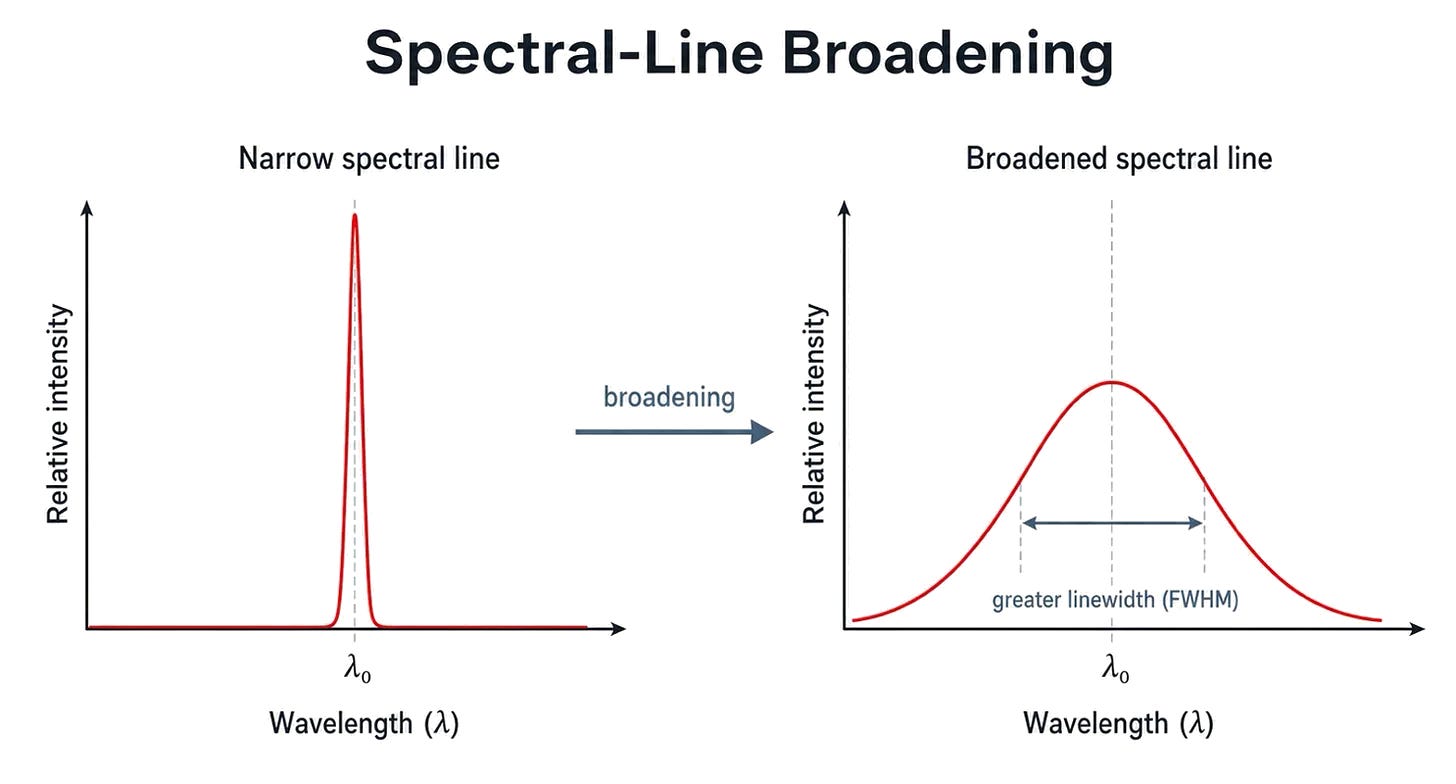
Figure 7: Spectral Broadening - The left image shows what a spectrometer records if Balmer series photons are emitted by a relatively stationary hydrogen atom: a very narrow peak at a specific wavelength. The right image shows what the spectrometer would record if the many hydrogen atoms in a population are moving very rapidly relative to the spectrometer: the spectral line in question would still center on the same wavelength, but instead of a narrow peak, it would resolve spectral “wings”: a broad hump shape. This is also called Doppler broadening.
By measuring the degree of Balmer line broadening, scientists can estimate how rapidly excited-state hydrogen atoms are moving inside a plasma; the more rapidly they are moving, the greater the degree of line broadening.
The reader has likely experienced an auditory version of this phenomenon as an emergency vehicle with sirens blaring passes by. As the emergency vehicle approaches, the pitch of the siren is higher relative to that of the stationary case. As the emergency vehicle passes by, the pitch decreases. Here is a good demonstration of the auditory Doppler effect.
If hot hydrogen species are moving both towards and away from the point of observation with mirror-image distributions of line-of-sight velocities, the observed Balmer line broadening will be symmetric. If not, the observed broadening will be asymmetric.
What Isn’t Controversial
It is very well-established and not at all controversial that certain types of plasmas containing hydrogen and other gases exhibit a very unusual degree of Doppler broadening of Balmer lines: far in excess of what is ordinarily expected, indicating that some process is imparting vast amounts of kinetic energy to the hydrogen atoms, making them “hot” and causing them to travel at high velocity. Here is a list of some of these papers:
N. M. Šišović, G. Lj. Majstorović, and N. Konjević, “Excessive hydrogen and deuterium Balmer lines broadening in a hollow cathode glow discharges,” Eur. Phys. J. D 32, 347–354 (2005).
R. L. Mills, P. C. Ray, R. M. Mayo, M. Nansteel, B. Dhandapani, and J. Phillips, “Spectroscopic study of unique line broadening and inversion in low-pressure microwave generated water plasmas,” J. Plasma Phys. 71(6), 877–888 (2005).
J. Phillips and C. Chen, “Evidence of catalytic production of hot atomic hydrogen in RF generated hydrogen/helium plasmas,” Int. J. Hydrogen Energy 33(23), 7185–7196 (2008).
E. L. Ayers and W. Benesch, “Shapes of atomic-hydrogen lines produced at a cathode surface,” Phys. Rev. A 37(1), 194–199 (1988).
S. Djurović and J. R. Roberts, “Hydrogen Balmer alpha line shapes for hydrogen–argon mixtures in a low-pressure rf discharge,” J. Appl. Phys. 74(11), 6558–6565 (1993).
W. Benesch and E. Li, “Line shapes of atomic hydrogen in hollow-cathode discharges,” Opt. Lett. 9(8), 338–340 (1984).
I. R. Videnović, N. Konjević, and M. M. Kuraica, “Spectroscopic investigations of a cathode fall region of the Grimm-type glow discharge,” Spectrochim. Acta B 51(13), 1707–1731 (1996).
Note that seven of the eight papers are by authors other than Dr. Mills.
What Is Controversial
The point here: the fact that dramatic Doppler broadening of Balmer lines occurs in certain types of hydrogen-based plasma cells is not at all controversial. It is very well established. However, the controversial part is the important question of what is causing the hydrogen atoms to move at such high velocities and thus display such profound Balmer line broadening.
It takes energy imparted to excited-state hydrogen atoms or ions to cause significant Doppler line broadening. The higher the energy, the more pronounced the broadening is. That energy must come from some source, and the Šišović paper has a model, the CM, for that source.
First, let’s review the mechanism that this paper offers as the source of the anomalous Balmer line broadening.
The CM is part of a family of models that are also known as Field Acceleration Models (“FAMs”). The latter name tells us the mechanism this family of models contends is the source of energy that causes the Doppler broadening of Balmer lines: strong electric fields.
There are a variety of ways to generate plasmas in hydrogen-based gas test cells. The experiments referenced in the Šišović paper relied on glow discharge cells, in which an electric current is used to generate the desired plasma state.101
The CM of the Šišović paper, and the FAMs more broadly, are entirely reliant on the presence of electric fields as the source of the energy to cause the observed line broadening.
The paper is quite explicit about this:
“…the electric field is essential for the CM to explain basic processes related to excessive Doppler broadening.”102
In a low-pressure direct-current glow discharge, a thin region of positive space charge called the cathode sheath forms next to the negatively charged cathode. Most of the applied voltage drops across this region. This voltage drop, called the cathode fall, produces a very strong electric field within the sheath.
The CM model as told by Šišović et al. has five basic steps:
Positively charged hydrogen ions in relative proximity to the cathode are accelerated toward it by the strong electric field.
Some smash into hydrogen molecules along the way and produce fast neutral atoms traveling in the same direction.
The rest of the ions reach the cathode itself, grab an electron, and bounce back off the metal surface as fast neutral atoms heading the other way.
Those rebounding atoms collide with more gas and produce still more fast atoms.
The collisions that create the fast atoms also excite them. A fast ion or atom slamming into a hydrogen molecule can dissociate it into hydrogen atoms and leave one in the n = 3 state. Alternatively, an ion can capture an electron directly into an excited state. Either way, the excited-state atom emits a photon within around ten billionths of a second, so the Balmer line emission occurs very close to where the collision happened.
The CM’s reliance on the strong electric field of the region of cathode fall means that it makes certain very specific predictions, ones that can be easily evaluated with proper testing.
They are as follows:
The biggest and most obvious prediction: the plasma absolutely must contain at least some region with a strong electric field. The corresponding test: does Balmer line broadening occur in plasmas that don’t have a strong electric field, or does it occur far away from the cathode fall in those plasmas that do have one?
The CM also predicts a location: the energy comes from the cathode fall, so the fast excited-state hydrogen atoms must be born nearby. Fast-moving atoms do not stay fast for long, because they collide with the surrounding gas and share their energy and slow down. At the pressures typical of these experiments a hot hydrogen atom travels only millimeters, at most about half a centimeter, before it collides and slows. Thus, if you sample the plasma a few centimeters away, the broadening should be gone. The corresponding test: is Balmer line broadening still observed well away from the cathode region? Crucially, the experiment must be done in a cell big enough to be able to measure well away from the cathode fall region to test this prediction.
It predicts a direction: an electric field is like a set of arrows pointing in a particular direction. Ions accelerate along those arrows, so the fast atoms should mostly be moving along that axis in the direction the arrows are pointing. The corresponding test: in a very low-pressure plasma system with a strong electric field, the degree of line broadening should look substantially different depending on whether the point of observation is parallel or perpendicular to the orientation of the electric field. The very low-pressure plasma system is a crucial aspect of this test, as it means that collisional scattering rates will be low, thus allowing the observation of whether the broadening looks different depending on point of observation. If the pressure of the plasma system is high, collisional scattering rates are high, and the movement of the hot hydrogen species that cause the line broadening becomes random.
It predicts the need for a “mirror.” The measured line broadening is symmetric, meaning roughly equal numbers of atoms are flying toward the observer and away. A one-way field can only accelerate ions in one direction, so the model needs the cathode surface to act as a reflector, bouncing the ions back with near-perfect efficiency. If the “mirror” isn’t there, then the measured line broadening is predicted to be asymmetric according to the CM. The corresponding test: is symmetric Balmer line broadening still present in plasmas driven by very thin pointed electrodes that lack a broad flat surface to reflect ions? The CM model says no, it should not be present.
It predicts the line broadening effect should scale with the electric field strength. Turn up the voltage and the line broadening should become broader. The corresponding test: determine whether altering the voltage produces a commensurate change in the degree of line broadening.
It predicts some degree of indifference to the ion species. An electric field pushes on electric charge. It does not know what element it is pushing, and it cannot specifically pick hydrogen atoms out of a mixed gas plasma. If helium ions and hydrogen ions are both present in the same plasma, both should be hot, particularly since helium is only four times heavier than hydrogen. Some degree of helium line broadening should also be observed. The corresponding test: determine whether helium line broadening is also observed.
Dr. Mills’ Hydrino model postulates that the source of the energy causing the observed Balmer line broadening is Hydrino formation, meaning that no strong electrical field is required to cause it. Instead, his model requires gas mixtures that are predicted to be supportive of Hydrino formation and conditions that permit the splitting of molecular hydrogen (the form in which hydrogen is typically found) into the atomic form required for the Hydrino reaction.
The Hydrino model predicts the opposite of the CM in all six of the cases listed above:
Plasmas that do not contain strong electric fields should still exhibit Balmer line broadening if atomic hydrogen and a Hydrino catalyst species are present in the plasma.
In plasmas with a strong electric field, the line broadening should remain present even well away from the cathode fall.
The line broadening should be isotropic, meaning the same from every point of observation, in both low-pressure and high-pressure plasma systems.
The line broadening should be symmetric regardless of whether a “mirror” is present.
The line broadening should be largely indifferent to electric field strength and should still be observed in plasmas that entirely lack strong electric fields if conditions for Hydrino formation are present.
The line broadening should be specific to hydrogen lines. Line broadening for other species should not be observed.
As you can see, we have multiple very clear differences between the two models which can be tested quite easily.
The problem for the Šišović paper and their claims about the CM is that the paper’s experiments were not appropriate for testing the differing predictions of the competing explanations for Balmer line broadening.
The core problem with the Šišović paper is that every experiment was performed in a very small hollow-cathode glow discharge, the exact type of apparatus that supplies the strong electric field and cathode surface required by the CM. The authors showed that changing the direction of the electric field changed the direction of the Doppler shift (blueshifted or redshifted depending on electric field direction) and that changing the cathode material changed the magnitude of the broad component. These appear to be legitimate findings, and they show that CM-type processes were probably responsible for some or all the observations made with this particular apparatus. The image below shows what the apparatus looked like:
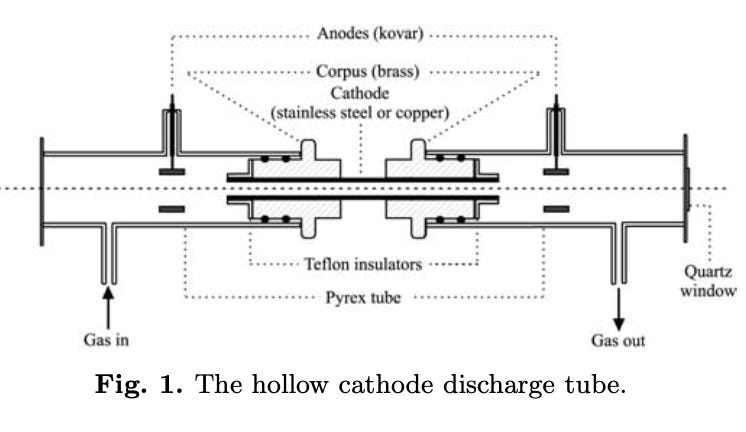
Figure 8: The Šišović Paper Experimental Apparatus – Figure 1 from the paper makes the flaws of the experimental design clear. The cathode is a tiny tube (seen at the center of the figure) only 6 mm in internal diameter and 100 mm long, and the anodes sit only 15 mm beyond each end. The plasma the spectrometer observed was the glowing column inside that 6 mm bore, so no point it could observe was ever more than 3 mm from the cathode wall where the CM says the hot hydrogen is formed and resulting Balmer line broadening occurs. The pressures used in the experiments mean that a hot hydrogen atom travels about a millimeter between collisions, which puts the farthest observable point only about three collisions from the wall. An atom accelerated in the cathode fall region and bouncing off the cathode has no trouble reaching the center of the bore still hot. This is the core issue with the experimental apparatus used by Šišović et al. Because nothing in this apparatus is more than a few collisions from the cathode fall, there is no way to discern between hydrogen heated by the cathode fall and hydrogen accelerated by another mechanism. Contrast this apparatus with that of Phillips discussed below, which was large enough such that points as far as 15 cm away from the high-field region of the plasma could be observed.
However, Šišović et al. do not show that the CM is the only source of excessive Doppler broadening of Balmer lines in all types of plasmas, because the authors never tested a plasma in which the CM’s required ingredients were absent. Their experimental apparatus fails on the following fronts:
They did not test whether a plasma created by apparatus that lacked the strong electric fields exhibited line broadening. The authors acknowledge the missing test themselves: they state that excessive broadening in a low-field microwave plasma would favor the Hydrino model, but this paper did not perform that experiment. The only plasma in this paper is one generated by strong electric fields.
Their chosen cell geometry also is fatally flawed in terms of its ability to permit appropriate testing of the CM. As shown in Figure 8 above, the hollow cathode was only 6 mm in internal diameter, meaning that no point within the observed plasma could have been more than approximately 3 mm from the nearest cathode-fall region. The apparatus therefore made it physically impossible to test whether the broadening persisted well away from the CM’s proposed source of fast hydrogen atoms. The spectrometer viewed the negative-glow region in the center of the cathode tube, where the local electric field was small, but that region remained only a few millimeters from the cathode fall. The CM could therefore attribute the broadening to fast hydrogen atoms created in the nearby high-field region and then scattered into the spectrometer’s field of view. In those plasma systems with a strong electric field, a proper test requires measurements made far enough away that field-accelerated atoms could not plausibly remain energetic. This would require a much larger plasma cell than that used in this paper, such that regions far from the electrodes could be observed for the appearance of Balmer line broadening.
A proper test of the CM in those plasmas that do have strong electric fields requires the use of thin, needle-like electrodes that don’t permit the “bouncing” back of ions accelerated towards the cathode that is required in order for the CM to explain the observed symmetrical line broadening. Stated differently, the CM predicts that the use of needle-like electrodes would result in asymmetric line broadening, as there is no “mirror” to make the line broadening symmetric. If needle-like electrodes are used and the line broadening remains symmetric, this would falsify a key prediction of the CM. This crucial experiment was not performed.
The CM holds that the energy of the hot hydrogen population that produces the line broadening derives from ions accelerated through the cathode fall. It therefore predicts that the energy of that population should rise as the cathode fall voltage rises, with everything else held constant. The paper does not run a series of experiments testing whether adjusting solely the cathode fall voltage results in a corresponding change in the degree of line broadening, while holding other variables constant. The reported voltages in the paper do vary, but that is only because the gas mixture changes between experiments.
In essence, the chief sin of Šišović et al. is that they appear to assume the CM is correct and then set up their experimental apparatus accordingly, in such a way that they can’t actually run proper testing capable of distinguishing between the competing explanations for the observed phenomena.
Fortunately, there are multiple other papers containing experiments fully capable of discerning between these competing line broadening models.
Proper Testing of the CM vs. Hydrino Model
The results from the papers discussed below collectively very conclusively disprove the CM and the broader class of FAMs as the explanation for the observed line broadening phenomena in various types of hydrogen plasma systems.
While the papers and associated experiments discussed below don’t definitively prove Hydrino exists (you can’t prove anything in science; you can only disprove hypotheses), they are very strongly consistent with Dr. Mills’ Hydrino model and rather inexplicable otherwise.
I’ll review the papers in brief, but I encourage the interested reader to review them in full.
Mills 2005
As mentioned above, the Šišović paper very explicitly says that their CM predicts that no Balmer line broadening should occur in microwave plasmas:
“Thus, the detection of excessively broad Balmer lines profiles in MID [Microwave Induced Discharge] with an inherent low electric field would be a final proof in favor of RTM [Hydrino model].”103
Dr. Mills performed exactly this experiment in a 2005 paper titled “Spectroscopic study of unique line broadening and inversion in low-pressure microwave generated water plasmas.”104
The paper contains a series of experiments in which a low-pressure water-vapor plasma is generated in a quartz tube using an Evenson microwave cavity. Unlike the Šišović paper’s glow discharge plasma setup, this experimental apparatus was electrodeless. It does not have a cathode, cathode fall, or static high-field sheath capable of accelerating positive hydrogen ions into a metal surface. There is an oscillating microwave field inside the 2.5 cm coupler, but it is well known that such a field cannot efficiently accelerate ions to the reported energies. The paper correctly states that “only the electrons respond to the microwave field,” and “that there is no mechanism of field acceleration in the cavity.” In other words, this apparatus does not have the conditions required by the CM.
The first CM prediction listed above was therefore placed in direct conflict with the Hydrino model prediction: the CM predicts no excessive Balmer line broadening should occur in these experimental microwave plasmas, while the Hydrino model predicts it should be present provided atomic hydrogen and an appropriate Hydrino catalyst were present.
The experimental findings contradict the CM prediction. The hydrogen Balmer α line was strongly broadened, and its width remained essentially unchanged as the spectrometer’s viewing point moved as far as 5 cm from the center of the microwave coupler.
The paper states that the electric field was negligible outside the coupler and estimates that the mean free path for hard-sphere collisions was less than 1 mm. “Mean free path” in this context is the average distance a particle can travel before colliding with another particle. On average, collisions with colder gas cause an energetic particle to lose energy.
Any hydrogen accelerated inside the coupler would therefore have passed through dozens of collision lengths before reaching the distant observation point and should have lost its energy long before it arrived. In plain English: there should be absolutely no Balmer line broadening observed 5 cm from the center of the coupler if the CM is correct.
The remaining controls are contrary to several other CM predictions. Because the plasma contained no cathode, there was no cathode surface available to act as the “mirror” required by the CM to redirect fast hydrogen such that the line broadening is completely symmetric. And yet, there was no observed change in line shape across the entire 5 cm scan.
Also, only the hydrogen line was broadened. The oxygen line remained narrow, contradicting the sixth CM prediction listed above that other accelerated ion species should show comparable broadening.
The researchers also replaced the microwave cavity with an RF coil and operated the same tube at the same pressure, flow rate, and roughly the same input power. That control experiment did not show Balmer line broadening even though the ordinary gas-temperature profile remained similar, which confirms that the measured effect was not an instrumental artifact or ordinary heating.
The CM cannot explain substantial, hydrogen-specific broadening in an electrodeless, essentially field-free region many collision lengths from the power coupler. The series of experiments in this paper therefore decisively falsifies the CM as an explanation for the broadening observed in this type of plasma, while producing the results predicted by the Hydrino model.
Phillips 2008
As mentioned above, Professor Jonathan Phillips is the lead author of one of the fully independent Hydrino replication papers, titled “Evidence of catalytic production of hot atomic hydrogen in RF generated hydrogen/helium plasmas.”105 This paper was published in 2008 in the International Journal of Hydrogen Energy.
Professor Phillips designed the experiments in this paper specifically so that the CM and Hydrino model predicted very different outcomes and those differing predictions could easily be tested.
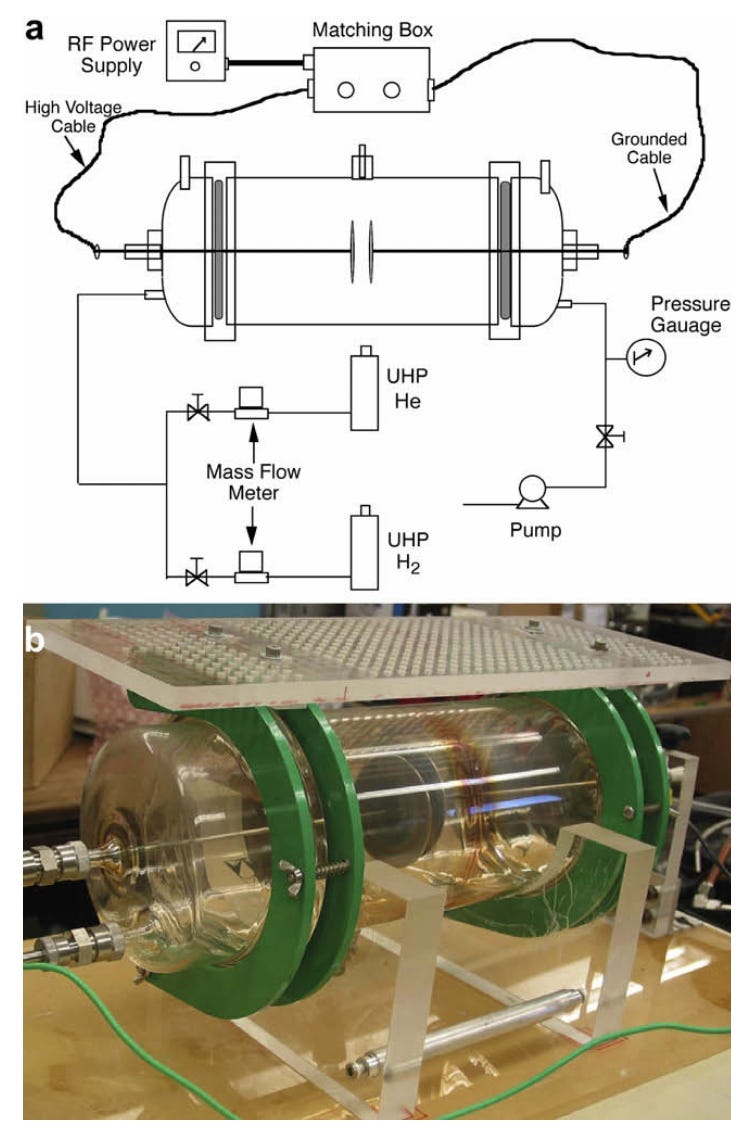
Figure 9: The Experimental Apparatus – This excerpt (Figure 1 in the paper) shows a schematic of the Phillips paper’s plasma cell. Note the large size of the glass chamber. The perforated grid at the top that is drilled with many holes permitted the observation of the degree of line broadening at locations near and far from the cathode fall.
As the figure above shows, their RF plasma chamber was large relative to the chamber in the Šišović paper: 36 cm long and 14 cm in internal diameter, with two circular electrodes separated by only 1 cm at the center. This size was a deliberate design decision, as it makes it possible to test for line broadening quite far away from the cathode fall. This testing was performed with a movable fiber-optic probe that mapped the Balmer line broadening at locations between the electrodes and as far as 15 cm away.
This was the spatial test that the tiny Šišović cell could not properly perform. The CM predicted that the hot-hydrogen population should be concentrated near the electrodes and fall rapidly with distance, while RTM predicted that the magnitude of the broadening could remain similar throughout the plasma wherever the catalytic reaction was occurring.
The paper’s results thoroughly disprove the CM and are consistent with the Hydrino model.
In helium-hydrogen plasmas, Balmer line broadening from a hot hydrogen component with an inferred energy generally between 20 and 40 eV appeared throughout the chamber, including positions as far as 15 cm from the electrodes. Even the paper’s deliberately generous mean-free-path estimate was only about 0.5 cm, putting the remote measurements roughly 30 collision lengths from the proposed CM source. Also, the lifetime of the n = 3 state (the Balmer α line, the one measured, is emitted when hydrogen falls from n = 3 to n = 2) is very short, around 10-8 seconds. This means the excitation of the emitting hydrogen must be close to the point of observation. It is simply not possible for hot hydrogen observed this far from the electrodes to be attributable to acceleration induced by the cathode fall.
Furthermore, the magnitude of the observed broadening did not steadily decline with distance from the electrodes and the broadened profiles remained symmetric. Also, reversing which electrode was powered produced no discernible change in the line broadening. These results strongly contradict the CM predictions with respect to localization, directionality, and the need for a reflecting cathode surface to serve as a “mirror.”
The paper also performed the field-scaling and gas-composition tests missing from the Šišović paper experiments. The researchers varied the RF input through 40, 100, and 150 W and measured the corresponding rise in electrode voltage. The observed amount of line broadening didn’t increase with the field strength as predicted by CM; in fact, the hottest hydrogen was recorded at 100 W rather than 150 W, even though the electrode voltage rose almost three times faster than the applied power across that range.
Another set of experiments replaced helium (a predicted Hydrino catalyst) with xenon (not a predicted Hydrino catalyst) while keeping other experiment parameters constant. Helium-hydrogen plasma contained abundant hot hydrogen and associated line broadening all throughout the chamber, while xenon-hydrogen plasma contained no significant hot hydrogen away from the electrodes and only a small warm component between them. The helium line itself remained narrow (remember from above, helium ions should be accelerated to some degree, resulting in helium line broadening, if the CM is correct).
In sum, the paper’s results showed that the observed line broadening was hydrogen-specific, catalyst-dependent, spatially remote from the electrodes, completely symmetric, and wholly uncorrelated with electric field strength. This combination thoroughly falsifies the CM as an explanation for the observed broadening.
Conversely, it exactly matches the predictions of the Hydrino model.
Akhtar, Scharer, and Mills 2009
The paper “Substantial Doppler broadening of atomic-hydrogen lines in dc and capacitively coupled RF plasmas” was published in 2009 in the Journal of Physics D: Applied Physics by Akhtar, Scharer, and Mills.106
Note that Akhtar has a Ph.D. in plasma physics from one of India’s premier technical institutions. Scharer has a Ph.D. in electrical engineering from UC Berkeley and was a full professor at UW Madison at the time the paper was written.
The experiments in this paper were designed explicitly to serve as direct tests of the CM and Hydrino models.
The experiments used two complementary plasma systems. The first was a DC glow discharge with sharply tapered tungsten electrodes. This eliminates the broad, flat cathode surface that the CM requires to act as a “mirror” and redirect fast hydrogen back toward the point of observation. Remember, this “mirror” is what’s required for the line broadening profile to be roughly symmetric. In this plasma system, the CM predicts the line broadening should be asymmetric.
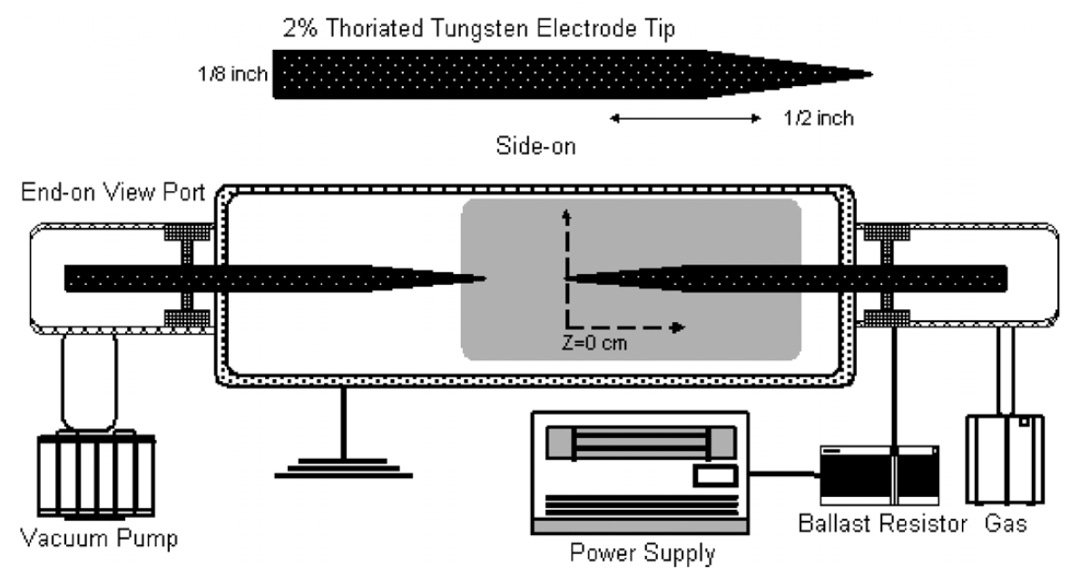
Figure 10: Experimental Plasma System 1 – This schematic (Figure 1 in the paper) shows the tapered tungsten electrodes used in the plasma system. This apparatus permits proper testing of a key prediction of the CM: that the Balmer line broadening should be asymmetric in the absence of a suitable broad flat surface to serve as a “mirror.”
The second plasma system was a large RF chamber, 36 cm long and 14 cm in internal diameter, with two plate electrodes separated by only 1 cm at its center. The researchers could observe the spectrum both parallel and perpendicular to the electric field and could sample regions as far as 15 cm from the electrodes. The apparatus directly tested the CM predictions concerning line broadening location, direction, and the need for a reflecting cathode.
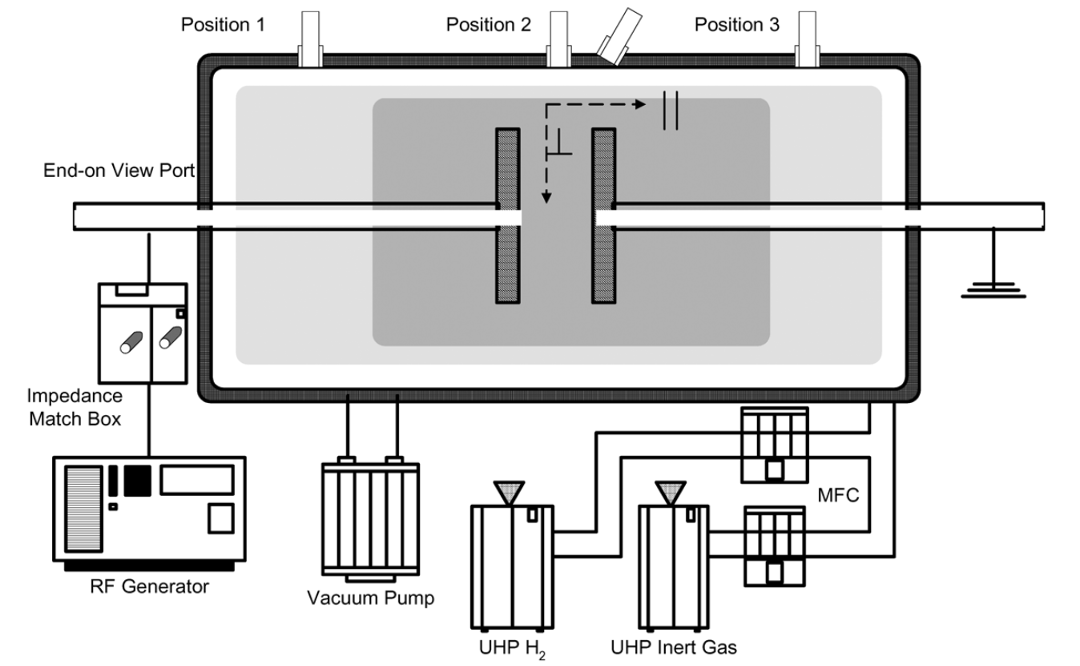
Figure 11: Experimental Plasma System 2 – This schematic (Figure 2 in the paper) shows the large quartz plasma chamber that affords ample ability to observe points far away from the strong electric fields of the cathode fall region and thus test another key prediction of the CM: that the broadening should be present solely near the cathode fall.
The results of the experiments collectively contradicted the key predictions of the CM and instead were wholly consistent with the Hydrino model.
In the needle-electrode plasma system, the Balmer line broadening from hot hydrogen remained symmetric whether the spectrometer looked toward the cathode, toward the anode, or perpendicular to the field. The CM predicts a different result due to the lack of a “mirror.”
The authors then ran a series of experiments where test cell pressure was varied from 10 mTorr to 10 Torr, a 3-order-of-magnitude change in gas density and collision conditions. If collisions with the surrounding gas were redirecting field-accelerated hot hydrogen into every direction (per CM predictions for higher-pressure systems), such an enormous pressure change should have very materially changed how the profiles depended on viewing direction. No such changes were observed. The observed line broadening remained roughly constant in all experiments.
Hot hydrogen was also measured 8 cm from the cathode tip and, in the RF chamber, as far as 15 cm from the electrodes. Contrary to the prediction of the CM, the degree of broadening remained essentially unchanged very far from the small cathode fall region that the CM says is the cause of the line broadening.
Gas composition and temperature measurements were made that also directly disprove the CM. Strongly broadened hydrogen lines appeared in argon/hydrogen and helium/hydrogen plasmas, while xenon-hydrogen plasma showed no comparable hot component. Argon and helium ions are predicted Hydrino catalyst species, whereas xenon and its ions are not. The CM predicts broadening should occur in all contexts in this series of experiments.
The hot hydrogen population had an inferred energy of 15–40 eV, even though the measured electron temperature in the RF plasma was only about 2–3 eV, while the helium and argon atoms remained below 0.5 eV. The CM does not have a mechanism that would consistently channel huge amounts of energy into hydrogen while leaving the other species in the plasma relatively cool.
In sum, the line broadening results were:
Hydrogen specific.
Dependent on gas admixture.
Symmetric without a “mirror.”
Independent of observation angle and plasma pressure.
Independent of distance from the high-field region.
As with the other two papers, this paper’s results thoroughly disprove the CM as a viable explanation for the reported line broadening.
Conversely, the results were once again wholly consistent with the Hydrino model. It’s possible that other explanations for the observed broadening exist, but I struggle to conceive of a mechanism that can explain:
Selective heating in a low-pressure hydrogen/helium plasma such that only the hydrogen species are hot (460,000 K!) at every point inside a large quartz vessel.
The fact that no such heating was observed in the same experimental apparatus with other variables held constant when the gas mixture lacked a predicted Hydrino catalyst (the Xe/H gas mixture).
Final Thoughts
To be clear, there may be some explanatory power of the CM model in certain contexts. It may well be a viable model for some Balmer line broadening observations near the cathode fall region in some plasma experiments with a strong electric field and a suitable “mirror.”
However, our literature review exercise demonstrates with crystal clarity that it is most definitely not a valid explanation for observed Doppler broadening of Balmer lines in many types of plasma experiments that are predicted to support Hydrino formation. It also underscores that the experimental design of the Šišović paper was irredeemably flawed in terms of its ability to properly test the differing predictions of the CM and the Hydrino model.
This is yet another example of the consistent failure of the critics to provide a single shred of quality experimental evidence which would invalidate Dr. Mills’ Hydrino hypothesis.
It’s also another example of the Wikipedia entry deeply misleading the reader. An unbiased page would permit mention of the subsequent experimental work that thoroughly disproves the validity of the CM in many contexts.
Before reviewing the content of the Dombey paper and de Castro paper, we first need to briefly discuss a third paper that the Wikipedia entry does not mention, as neither of the referenced papers can be understood without the context this other paper provides.
In 2005, a physicist named Jan Naudts published a short paper outlining a speculative idea. SQM has several equations for the hydrogen atom, and the relativistic ones are messier than the version taught in first-year chemistry. In his paper, Naudts points out that one of them, the Klein-Gordon equation, appears to allow a second, much more tightly bound solution that the textbooks had always thrown away. In essence, his suggestion was that SQM might already contain Hydrino states, hidden away in its own fine print.107
Dombey’s paper is a reply to Naudts.108 De Castro’s paper is a reply to Dombey.109 Dr. Mills’ GUTCP atomic model and derivation of Hydrino states are not analyzed in either paper, and neither paper cites a single thing he has written. You can verify this yourself by checking each paper’s citations.
The Dombey and de Castro papers are competent within their own context. The tightly bound solution Naudts outlined in his paper has a problem: it blows up at the exact center of the atom, at the mathematical point where the nucleus sits.
Dombey’s paper showed that this solution only survives because the nucleus is treated as an infinitely small point. If you assign the nucleus any real size at all, however tiny, the solution vanishes. De Castro’s paper showed the same thing a different way, using a requirement called orthogonality, which says that distinct energy states of an atom must have zero inner product with one another. Naudts’ solution is shown to fail that test.
Both results appear to be correct within their own context, but neither one is the slightest bit relevant to the GUTCP model and its prediction of Hydrino, and the reason why has absolutely nothing to do with whether Dr. Mills is right or wrong about Hydrino.
The central argument in both papers is a rule about how a QM-style wave function behaves at the exact center of the atom, and the GUTCP has no such thing.
Dr. Mills does not derive the Hydrino from the Klein-Gordon equation, or the Dirac equation, or the Schrödinger equation. He derives it from Maxwell’s equations applied to the electron as a two-dimensional membrane of flowing charge, from classical mechanics, and from a non-radiation condition rooted in the work of his mentor at MIT, Professor Hermann Haus. In that model the electron is an ultra-thin spherical shell of charge sitting at a specific radius, and the proton at the center has a real size rather than being an infinitely small point. There is no blow-up at the center to fix, because there is no electron charge at the center to blow up.
In short, Dombey and de Castro refuted Naudts’ Hydrino. Dr. Mills’ model wasn’t even mentioned, much less examined, and it is very different from that of Naudts.
A big part of the problem is misleading titling and improper citation. Dombey called his paper “The hydrino and other unlikely states.” De Castro named his “Orthogonality criterion for banishing hydrino states from standard quantum mechanics.”
These titles borrow Dr. Mills’ coined term for these new states of hydrogen and apply it to a mathematical object he did not derive, within the context of a mathematical framework he very explicitly rejects as wrong. Dombey and de Castro both then declare that object dead.
Note how Dr. Mills and Hydrino are referenced in Dombey’s paper. It’s just one sentence: “Claims that a tightly-bound state of hydrogen exists have, however, been widely publicised.” The supporting references are a news story in Nature, an article in The Guardian, and an article in the Financial Times. Three pieces of journalism! Dr. Mills’ name does not appear anywhere in the actual paper, nor does his theoretical framework, nor any of his Hydrino experimental work.
A physicist writing in a peer-reviewed journal sourced the entire significance of his own topic to a newspaper clipping file, then named the paper after what was in the newspapers.
In de Castro’s paper Dr. Mills’ work does not appear at all.
Is this what passes for science these days?
There is an additional problem with the de Castro paper. He writes that the size and energy of the hydrogen ground state, “just derived from the Heisenberg uncertainty principle,” should by themselves “be enough to disqualify hydrino states.”
De Castro makes a basic philosophical error with this casual dismissal. The uncertainty principle is a theorem of SQM. A theorem of one framework cannot by itself adjudicate a contest between frameworks. The only way to determine whether Hydrino states can be “disqualified,” as de Castro puts it, is experiment.
Neither de Castro nor Dombey addresses any of the many dozens of peer-reviewed experimental papers documenting anomalous spectroscopic observations, excess heat, or novel chemical compounds consistent with Hydrino states of hydrogen.
This is also not the first time that the Heisenberg uncertainty principle has been mistakenly used as justification to dismiss a novel experimental result. Physics giants Niels Bohr and John von Neumann both thought that the forerunner to the laser, the maser (microwave amplification by stimulated emission of radiation), was theoretically impossible due to this principle. According to Charles Townes, their objections to the maser ran deep:
“Such protests were not offhand opinions about obscure aspects of physics; they came from the marrow of these men’s bones. Their objections were founded on principle—the Heisenberg uncertainty principle.”110
Townes already had a working maser at the time Bohr and von Neumann objected to its very possibility on theoretical grounds. This episode highlights precisely why experiment always has the final say in science.
None of this means that Dombey and de Castro are bad physicists or that their papers are wrong, at least not from the perspective of status quo physics. Their papers are fine, and they addressed the question Naudts posed in his paper: does SQM secretly contain Hydrino states?
They find it does not, and this is precisely what Dr. Mills has been saying for thirty-five years!
The relevant question is whether Dr. Mills’ own GUTCP derivation of Hydrino states contains an error. Neither paper addresses this question in the slightest, nor does either paper even cite the GUTCP.
These are two of the main papers routinely produced as “proof” that the Hydrino was refuted, and neither paper examines Dr. Mills’ theoretical work nor reports experimental replications of his Hydrino experiments.
These papers are thus wholly irrelevant and Wikipedia’s prominent mention of them is extremely misleading.

The Context
I’ll first provide some context for the issue referenced in this passage.
The Hydrino reaction is predicted to produce very short-wavelength continuum radiation in the soft X-ray and extreme ultraviolet (EUV) regions. Light in this wavelength region is difficult to observe, because these short wavelength photons are rapidly absorbed by air at ordinary pressures. For example, if 13.5 nm photons are traveling through air at one atmosphere, about 99.9% of them are absorbed by the air within 1 mm of travel.
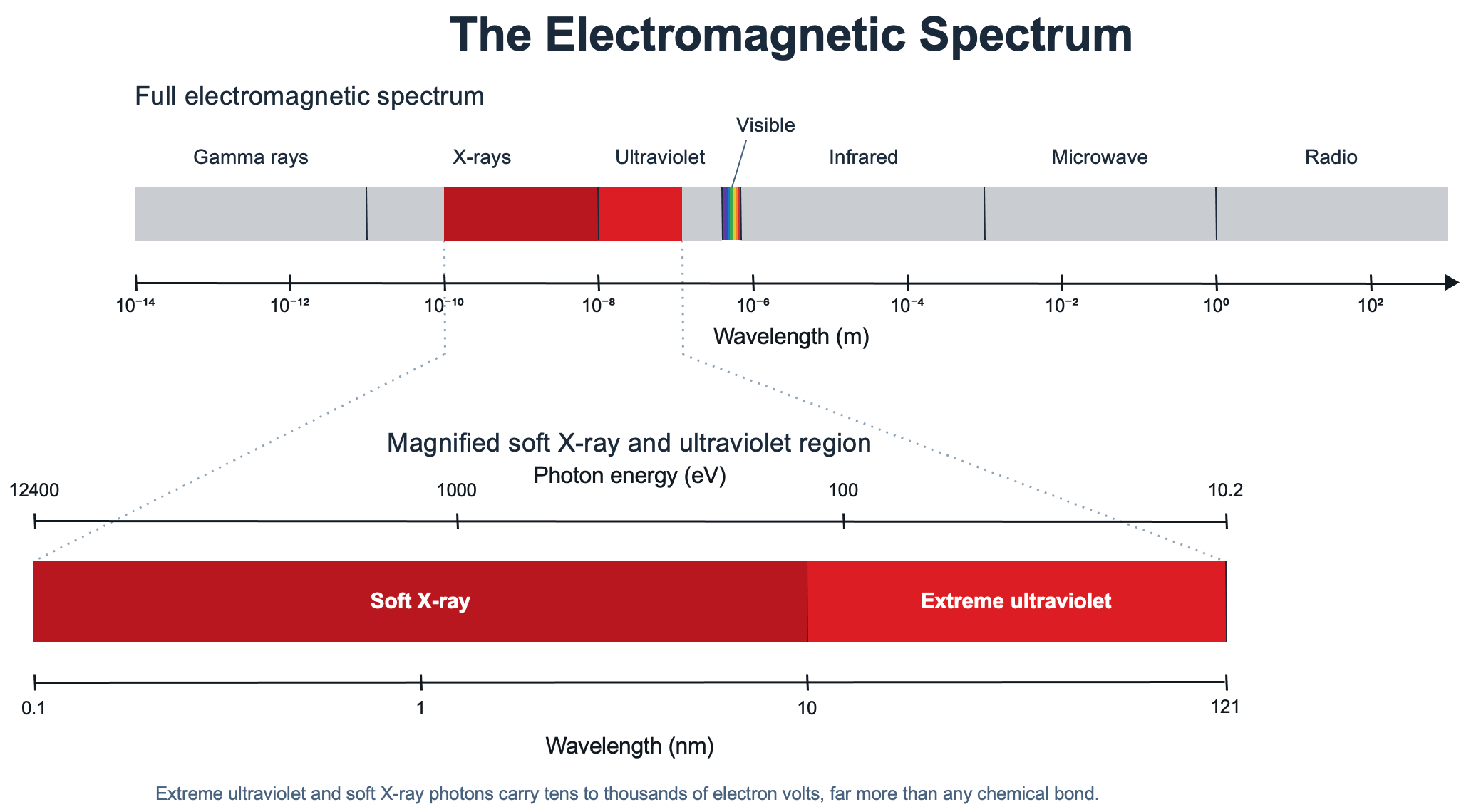
Figure 12: The Electromagnetic Spectrum – The Hydrino reaction is predicted to cause the release of short-wavelength light in the EUV and soft X-ray regions. The EUV wavelength region ranges from 121 nm down to 10 nm, and the soft X-ray region from 10 nm down to 0.1 nm.
Thus, properly observing light in this region requires that the entire optical path, from the point of emission through the spectrometer to the detector, be held under vacuum. It further requires that the plasma produced by the Hydrino reaction and its resulting soft X-ray and EUV photon emission be sufficiently diffuse such that the photons escape, rather than being reabsorbed by the plasma and re-emitted as longer-wavelength light.
This is one reason why no one noticed Hydrino formation prior to Dr. Mills. The unusual light emission characteristic of Hydrino formation is simply unobservable unless conditions are just right.
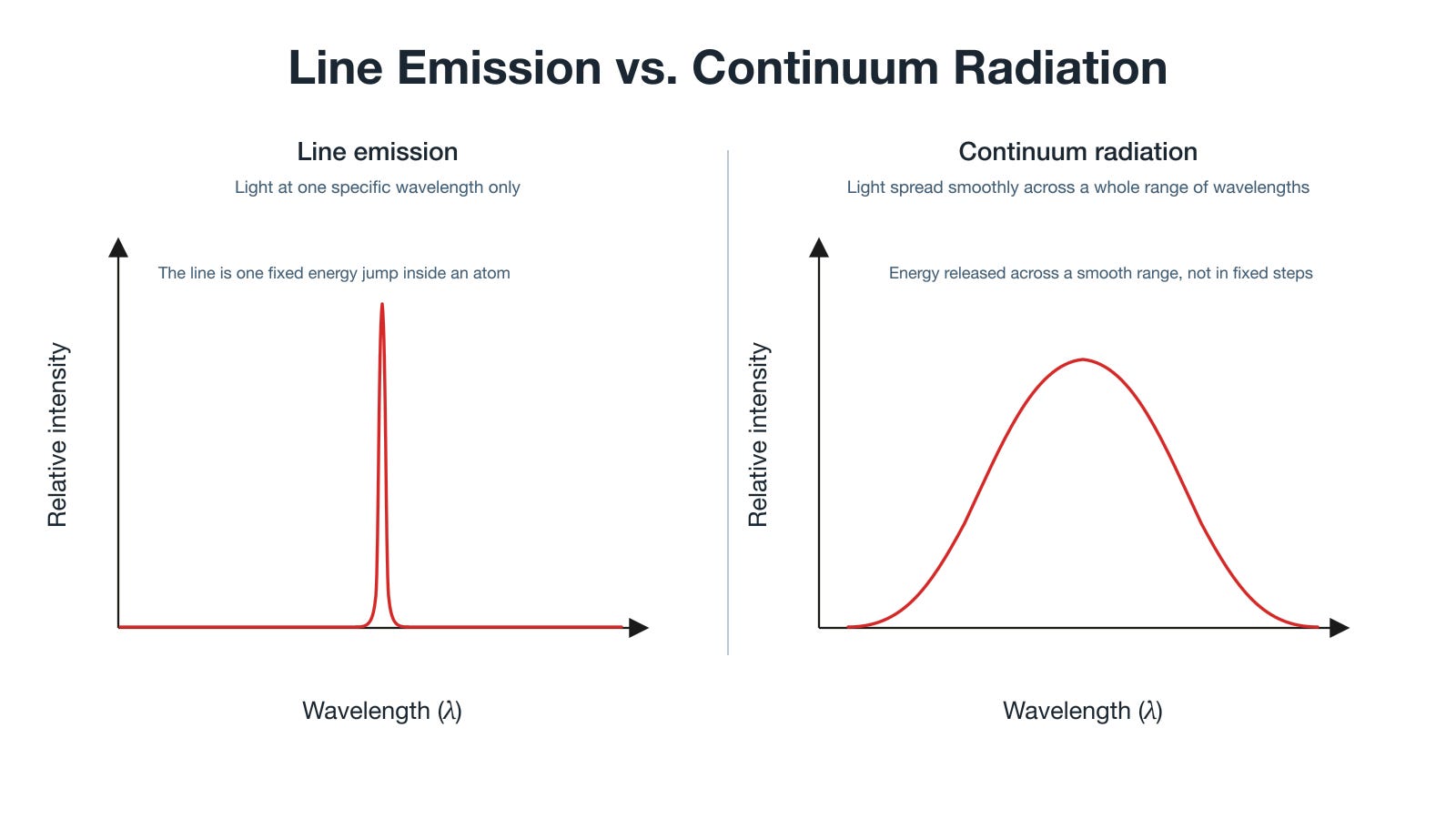
Figure 13: Line Emission Vs. Continuum Radiation – Typically, when an atom moves from an excited state to a lower-energy state, a single photon of discrete wavelength is emitted. This is called line emission. The Balmer series we discussed above is an example of the line emission of hydrogen as it falls from n > 2 states to the n = 2 state. A photon of discrete specific wavelength is released as this happens. With Hydrino formation, something unusual is predicted to occur: the production of continuum radiation with a specific short-wavelength cutoff rather than a single discrete wavelength of light. This results in a band of light spread across many wavelengths, as seen on the chart on the right, rather than a single discrete line.
Dr. Mills has performed many experiments over the years designed to detect the predicted soft X-ray and EUV continuum light emission from Hydrino formation. Professor Kunze takes issue with an early paper in this line of work, a 2003 paper that reported novel emission features in this region and described them as lines, but there are several other, newer papers that report the predicted continuum radiation, as we’ll see below.
Consilience
Professor Kunze has written a graduate-level textbook on spectroscopy, Introduction to Plasma Spectroscopy, so his criticisms must be taken seriously.111
However, before we address them, it’s very important to first take a step back from specific issues around the nuances of a particular type of spectroscopy, lest we lose the forest for the trees.
As mentioned at the outset of this article, Dr. Mills’ body of work exhibits a tremendous degree of consilience. He has used a wide array of analytical techniques in his peer-reviewed journal articles, and the findings from experiments using one technique bolster confidence in the results obtained from other experiments using other techniques when they all point to the same conclusion.
Here is a list of some of the many different types of analysis that Dr. Mills has used in his body of experimental work around Hydrino:
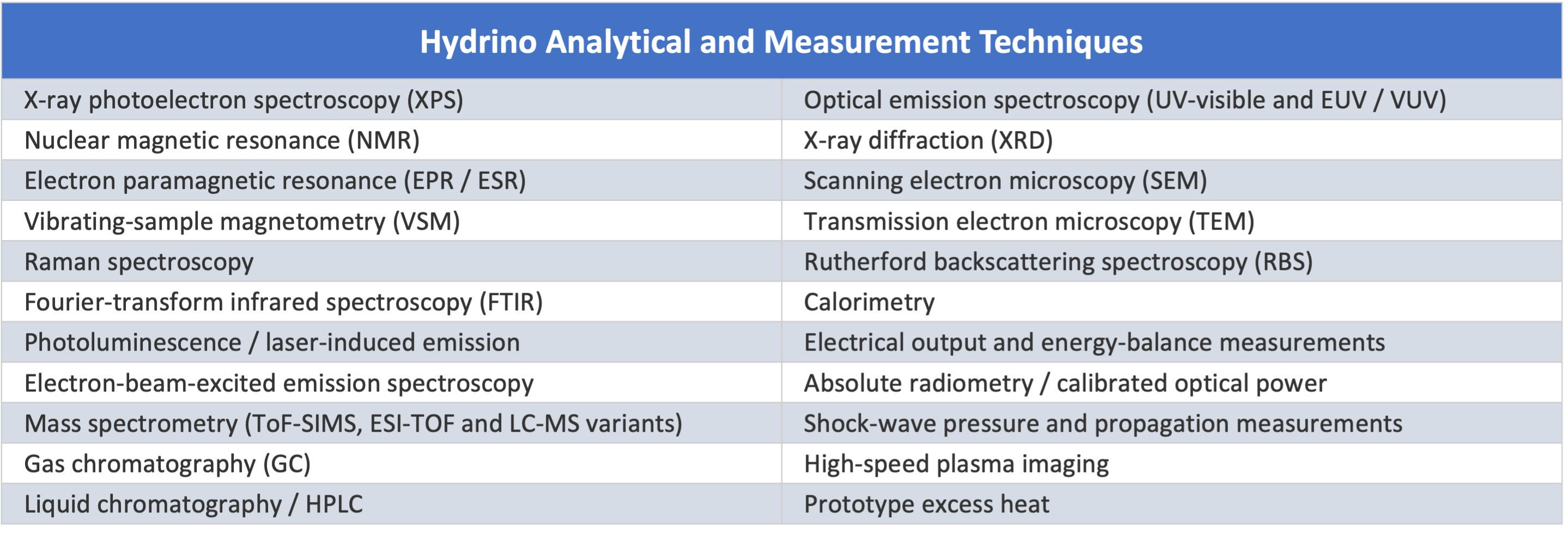
Figure 14: List of Hydrino Paper Experimental Techniques – The many different techniques provide consilience and corroborate each other.
I’ll provide a specific example of the consilience in Dr. Mills’ work using the paper in question, “Extreme ultraviolet spectroscopy of helium–hydrogen plasma” by Dr. Mills and P. Ray, which was published in 2003 in the Journal of Physics D: Applied Physics.
It has two core sets of experiments. The first set uses two spectrometers and associated equipment to examine whether the predicted novel soft X-ray and EUV light emission from Hydrino formation occurs. These experiments used microwave plasmas of helium with 2% hydrogen, a mixture predicted to support Hydrino formation, along with a long list of control gases.112 These experiments are the ones Professor Kunze takes issue with.
Novel emission features in the soft X-ray and EUV region (8 to 50 nm) were observed, all of them with the spectrometer that Professor Kunze contends is not equipped to observe light below 30 nm. He attributes the features observed below 30 nm to spectral artifacts.
He doesn’t mention it in his critique, but this paper has a second set of experiments that examines Balmer line broadening in microwave plasmas of the same kind using a third spectrometer, one capable of observing the visible-wavelength light from Balmer line emission: the Jobin Yvon Horiba 1250M.
It was used to measure the degree of Balmer line broadening in the experimental plasmas. As discussed above, Balmer line broadening is another expected feature of Hydrino formation in plasmas.
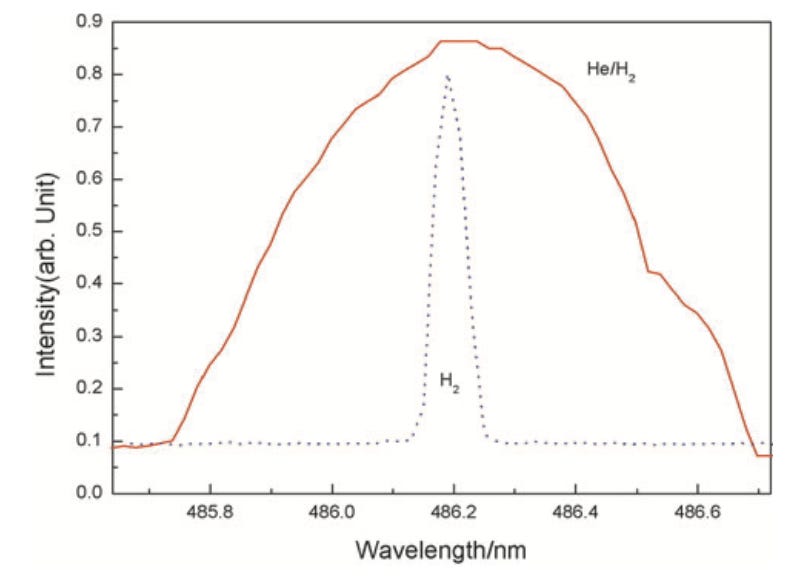
Figure 15: Excerpted from “Extreme ultraviolet spectroscopy of helium-hydrogen plasma,” Figure 10 – The 656 nm Balmer α and 486 nm Balmer β lines were observed in this paper. This figure shows how significant the broadening is when the gas mixture of the plasma (helium ions, He+, are a predicted Hydrino catalyst) is predicted to support Hydrino formation. The dotted H2 line shows how broad these lines are compared to a hydrogen-only plasma.113
The observed Balmer line broadening in gas mixtures predicted to support Hydrino formation was massive, indicating a hydrogen species temperature of 180-210 eV, which corresponds to a temperature of 2.1 to 2.4 million K.114 These were microwave plasmas, so they lack the cathode fall region that the CM and FAMs discussed above require, which rules those models out as an explanation for the observations. Pure hydrogen in the same apparatus showed line broadening corresponding to just 3 eV.
The Balmer line broadening results are exactly what Hydrino theory predicts should be observed: huge broadening when a Hydrino catalyst species is present. Conversely, no such line broadening was observed in hydrogen-only and xenon/hydrogen gas mixtures.
This is a specific example of consilience: the visible light observations of Balmer line broadening, made with a different spectrometer than the spectrometer that is the object of Professor Kunze’s skepticism, increase the confidence we can have that the soft X-ray and EUV observations were legitimate and not spectral artifacts as claimed by Professor Kunze.
Two wholly different sets of phenomena were observed with two wholly different spectrometers, but both point to a single cause: both phenomena are predicted consequences of the Hydrino reaction.
Consilience.
Kunze’s Critique
Now, let’s get into the specifics of Kunze’s critique of the first set of experiments in this paper.
The two spectrometers used to examine the soft X-ray and EUV light emission were:
“[A] normal incidence McPherson 0.2 m monochromator (Model 302) equipped with a 1200 lines mm−1 holographic grating with a platinum coating. The wavelength region covered by the monochromator was 2–560 nm. The EUV spectrum was recorded with a channel electron multiplier (CEM) at 2500–3000 µm [sic; presumably V]. The wavelength resolution was about 0.2 nm (FWHM) with an entrance and exit slit width of 50 µm.”115
“[A] McPherson 4° grazing incidence EUV spectrometer (Model 248/310G) equipped with a grating having 600 lines mm−1 with a radius of curvature of ≈1 m. The angle of incidence was 87°. The wavelength region covered by the monochromator was 5–65 nm. The wavelength resolution was about 0.4 nm (FWHM) with an entrance and exit slit width of 300 µm. A CEM at 2400 V was used to detect the EUV light.”116
Here is the manufacturer spec sheet for the Model 302. It shows a working range that starts at 30 nm and extends, depending on the grating, to as far as 2200 nm. With the 1200 lines per mm grating used in the 2003 paper, the upper limit is 550 nm.
Here is the manufacturer spec sheet for the Model 248/310G. The spec sheet shows that this spectrometer can resolve light between 1 nm and 300 nm, and with the 600 lines per mm grating used in Dr. Mills’ papers, from 1 nm to 65 nm, which includes the range stated in the paper.
Professor Kunze has two core criticisms of the paper:
For many of the paper’s key measurements, the normal incidence Model 302 was used. Professor Kunze points out that the manufacturer’s specifications, as shown by the link above, for this instrument indicate that 30 nm is the lower end of its specified working range. Dr. Mills’ paper shows data which claims that this spectrometer is accurately detecting novel spectral features down to 8 nm that are attributable to Hydrino formation. Kunze contends that these observations are impossible due to the limitations of the spectrometer and are therefore spectral artifacts. He also contends that other novel spectral features observed that are above 30 nm, well within the capabilities of the Model 302, are suspect too, because of the alleged artifacts below 30 nm.117
His second criticism is that the spectral widths of these novel features are so large that they point to artifacts as well.118
Rather than attempt to refute these criticisms, I will instead fully grant Professor Kunze that he raises valid concerns and assume that the results in Dr. Mills’ 2003 paper are indeed in doubt.
Fortunately, there is a path forward to resolve these points of scientific contention: more experimentation! Additional experiments are required to determine whether there is novel short-wavelength continuum radiation in plasmas predicted to support the Hydrino reaction.
Before we get to the resolution of this issue, I’d like to first point out a high-level issue with Professor Kunze’s critique that sits above any of the particulars of the paper in question, the same one I raised with Phelps’ critique of Phillips’ work.
Every physicist in the world, no matter how skeptical of Dr. Mills’ claims, would readily admit that the existence of Hydrino would be a monumentally important finding, albeit one very inconvenient for the current paradigm of atomic-scale physics. Given that importance, I find it strange that Professor Kunze did not simply attempt to replicate the experiments outlined in Dr. Mills’ paper himself, tweaking the experimental setup as needed to rule out the possibility of spectral artifacts.
As I’ve repeatedly stressed, experimental replication is the only way to conclusively settle a point of scientific contention.
The experiments in question are quite straightforward and could be performed easily and inexpensively by any lab already equipped for EUV spectroscopy, and Professor Kunze has expertise with the relevant analytical technique. Where is his curiosity? How can science proceed if the scientific community won’t work to replicate important novel findings?
Unfortunately, Professor Kunze did not perform this experimental work, which means that we have an unsettled dispute:
Professor Kunze hypothesizes that novel spectral features in Dr. Mills’ 2003 paper in the 8-50 nm range are artifacts from equipment not suited for measurements in this spectral region.
Dr. Mills contends that novel spectral features in this wavelength range in plasmas predicted to support Hydrino formation are the expected result.
Professor Kunze provides us with the specific means to resolve the dispute by telling us about his preferred method for additional testing as to whether there is indeed soft X-ray and EUV continuum radiation emitted in certain plasmas predicted to provoke the Hydrino reaction.
As mentioned above, the paper in question relied on two different spectrometers, one that is the object of Professor Kunze’s complaints, and another, a Model 248/310G McPherson 4° grazing incidence EUV spectrometer. Professor Kunze (and the manufacturer spec sheet) says this instrument can resolve wavelengths in the region in dispute:
“The authors also show a spectrum of the same spectral range from pure helium discharges recorded with a grazing incidence instrument, lower trace of their figure 2, which is best suited for this wavelength region. The reader can only wonder why this instrument was not employed for the investigation of the helium–hydrogen discharges searching for novel lines!”119
Further experimentation with this spectrometer, fully capable by Professor Kunze’s admission of properly resolving short-wavelength light, was performed in multiple subsequent papers by Dr. Mills. I’ll list some of those papers and key results below. To not overwhelm the reader, this review is necessarily high level and very brief. I encourage those interested to read the referenced papers in full, as they are quite compelling.
The bottom line as to what these papers show: the kind of short-wavelength continuum radiation Hydrino theory predicts is repeatedly observed in a variety of contexts. It should be noted that there were some differences in the nature of the short wavelength light observed in the original 2003 paper that Kunze critiqued and that which was observed in the 2013 and 2018 papers discussed below. This may be attributable to the different experimental methods used to provoke the Hydrino reaction.
All short wavelength light observations discussed below were made with a spectrometer Professor Kunze says is well suited to observing light in these wavelengths.
Mills 2013
The 2013 paper “Soft X-ray continuum radiation from low-energy pinch discharges of hydrogen” examines whether pinch plasmas exhibit the sort of continuum radiation predicted by Hydrino theory. Note that one of Dr. Mills’ co-authors was Professor Randy Booker, the very well-credentialed physics professor from the University of North Carolina at Asheville mentioned above.
A series of experiments was run in which a pinch plasma was created by sending a brief, capacitor-powered electrical discharge through low-pressure gases. The discharge strips electrons from some of the gas, making it electrically conductive, while the current’s magnetic field briefly squeezes the ionized gas: hence the name “pinch” plasma.
Various types of pure gases and gas mixtures were used in this paper, some predicted to support Hydrino formation, and others to serve as controls.
These experiments were performed both at BLP and at the Harvard–Smithsonian Center for Astrophysics (CfA) under a study contracted by GEN3 Partners and funded by BLP. BLP loaned the discharge source, high-voltage supplies, pumps, CCD system, and one spectrometer for the experiments at CfA, and the scientists at CfA supplied their own ultra-high-purity hydrogen and helium and a second spectrometer.120
The spectrometers used in these experiments were the type Kunze endorsed for observing short-wavelength light: both the BLP spectrometer and the CfA-supplied spectrometer were the McPherson Model 248/310G, this time with a CCD detector and a resolution of about 0.05 nm.121
Many experiments were performed, but the key finding was this: short-wavelength continuum radiation appeared when the pinch plasma contained hydrogen, as predicted by Dr. Mills’ theory. The continuum had a short-wavelength cutoff at about 10 nm, with a second band appearing as a change of slope near 22 to 23 nm, matching the predicted 10.1 nm and 22.8 nm cutoffs. The same observations were made at both laboratories.
Various control experiments with helium, oxygen, nitrogen, CO2, and argon showed no comparable feature.
Figure 16 below shows the striking difference between the emission spectra from experiments with hydrogen-containing gas and those with oxygen only.
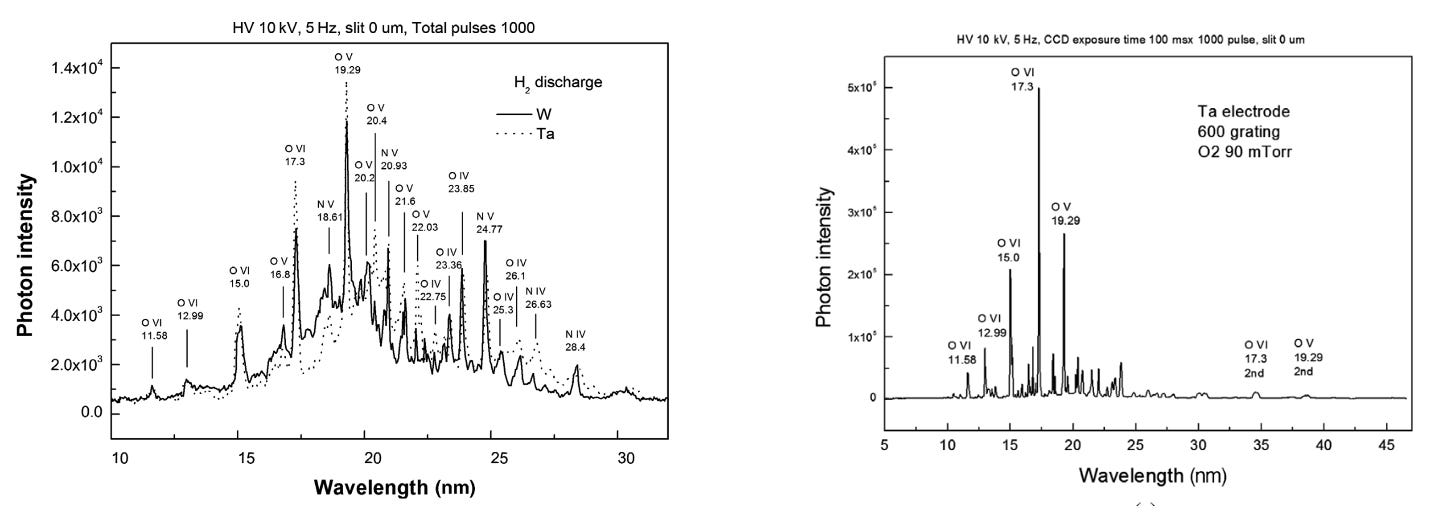
Figure 16: Left image - Figure 6 from “Soft X-ray continuum radiation from low-energy pinch discharges of hydrogen.” Right image - Figure 7a from “Soft X-ray continuum radiation from low-energy pinch discharges of hydrogen.” The left image shows the predicted short-wavelength continuum radiation observed when the pinch plasma experiment is performed with hydrogen gas: it’s the broad “hump” running from around 10 nm through 30 nm. The spikes are ordinary line emission from oxygen and nitrogen ions liberated by oxide and nitride layers on the metal electrodes. The experiments were run with two different electrode materials, tungsten and tantalum, and the observed continuum radiation was roughly the same. The right image shows no such continuum radiation when the same experiment is performed with an oxygen-only atmosphere and tantalum electrodes and instead shows only the expected ordinary line emission from various oxygen ions with no continuum “hump” feature.
The paper also examines whether the Balmer line broadening that was found in the “Extreme ultraviolet spectroscopy of helium-hydrogen plasma” paper is also found in these experiments.
The same model of visible-light spectrometer used in that paper, a Jobin Yvon Horiba 1250 M, recorded the 656.3 nm Balmer α line from the hydrogen-containing pinch plasmas. Line broadening was observed, consistent with a population of hot hydrogen with energies near 100 eV. Helium atoms in the same kind of plasma stayed below 1 eV. This was a high-voltage discharge, so a strong electric field was present, but the broadening was symmetric when viewed along the field, a result the authors argued was inconsistent with field acceleration in this setup, and it selectively heated hydrogen while leaving helium cold. Standard explanations for this broadening were considered and discarded. The results were in accordance with what Hydrino theory predicts.
This is again an example of consilience: an ordinary visible-light spectrometer found signs of the predicted fast hydrogen, without relying on the EUV detector that observed another predicted aspect of the Hydrino reaction.
This brief overview glosses over much detail. I encourage those interested to read the paper in full. It is very comprehensive and you will see that a great deal of effort was put into ruling out more prosaic explanations for the short-wavelength continuum radiation observations.
Mills 2018
In 2018, Dr. Mills published “Power determination and hydrino product characterization of ultra-low field ignition of hydrated silver shots” in the Chinese Journal of Physics.
This paper contains a series of experiments assessing whether small “shots” composed of silver and trace water or titanium powder and water exhibited the behavior predicted by Hydrino theory when ignited by a low-voltage, high-current pulse from a spot welder.122
Experiments were performed in a vacuum chamber which was connected via a vacuum tube to various types of spectrometers. One of the spectrometers was again the McPherson 248/310G, the type endorsed by Professor Kunze for observations in short-wavelength regions. It was used to detect the emission of short-wavelength continuum radiation predicted by Hydrino theory in the 5-65 nm range from the hydrated shots.123 As shown in Figure 17 below, the predicted light emission was observed.
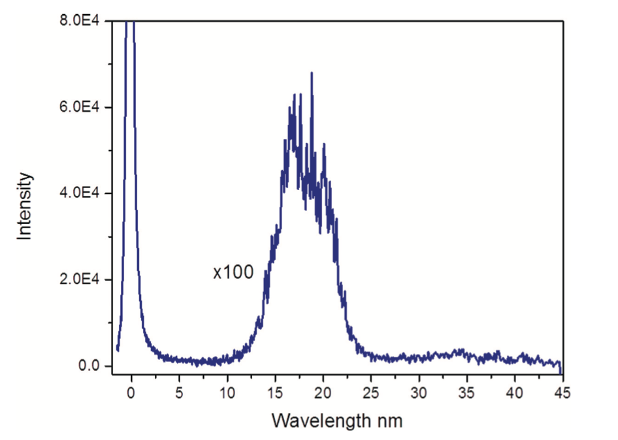
Figure 17: Predicted 10.1 nm Continuum Radiation – This is Figure 34 from the paper in question. It shows the predicted short-wavelength continuum radiation emitted by hydrated silver shots. The tall spike feature on the left at 0 nm is undispersed light reflected directly off the grating and may be ignored. The band extending from around 10 nm to 25 nm is the predicted continuum radiation. The observation was made with the McPherson 248/310G through a zirconium filter that blocks visible light and passes wavelengths near 10 nm.
In addition to the observation of the predicted short-wavelength continuum radiation, this paper contains a number of other types of experiments that are mutually reinforcing and strengthen the overall conclusion that the Hydrino reaction is responsible for the otherwise inexplicable findings:
Hydrated silver shots detonated in a bomb calorimeter released up to two and a half times the electrical energy input, while resistive controls showed no comparable gain. No ordinary exothermic chemical reaction between silver, water, argon, and hydrogen is possible.
The shockwave produced by hydrated silver shots and titanium powder and water shots when ignited by a spot welder was measured with blast pressure probes and compared with that of gunpowder. A silver shot with only 65 micromoles of water produced a blast wave traveling at a speed comparable to that from 47 mg of gunpowder. The larger titanium-and-water sample produced a faster, higher-pressure blast.
Raman spectroscopy was performed on samples exposed to the gas product from shot ignition events. The results showed the expected signature of molecular Hydrino. Controls showed no such signature.
Nuclear magnetic resonance spectroscopy and X-ray photoelectron spectroscopy were also performed on samples exposed to the same product gas. Those samples showed an NMR matrix shift and an X-ray photoelectron peak that the authors attributed to molecular Hydrino.
As with the previous paper, this summary is necessarily brief. I encourage the reader to examine the paper in full, as it is very compelling.
In addition to papers discussed above, the interested reader can also review these two papers that also demonstrate short-wavelength continuum radiation from the Hydrino reaction:
“Hydrino continuum transitions with cutoffs at 22.8 nm and 10.1 nm”
“Time-resolved hydrino continuum transitions with cutoffs at 22.8 nm and 10.1 nm”
The beauty of the scientific method is that there is typically a way to resolve points of scientific dispute. Professor Kunze raised a valid objection to an experiment, and subsequent experimentation addressed that instrument objection.
The bottom line is that experimental apparatus predicted to be supportive of Hydrino formation have been repeatedly shown to produce the predicted high-energy short-wavelength radiation using equipment fully capable of resolving light in this wavelength region.
Conclusion
The BLP Wikipedia entry has been demonstrated to be profoundly misleading. The page editors appear determined to paint a deceitful picture of the company and Dr. Mills’ work. At the very least, it’s clear that Wikipedia’s set of policies around supposedly fringe topics creates a situation in which honest reporting becomes impossible.
We’ve also seen the problems with the page’s cited critics:
Partial or complete lack of understanding of Dr. Mills’ core claims and Hydrino science basics.
Mathematical incompetence in critiques of Dr. Mills’ theoretical work.
Dubious experimental design preventing proper testing of Hydrino theory predictions.
Armchair critiques of Dr. Mills’ experimental work that were subsequently dispatched with further experimentation.
The page also wholly ignores a vast body of vitally important and highly relevant research published in peer-reviewed journals, some of it entirely independent of Dr. Mills and BLP. The page also doesn’t make it clear that there is no peer-reviewed research capable in principle of disproving Hydrino that does so.
Nothing.
If a medical journal systematically excluded volumes of important clinical trial data from a drug review and then promoted an evidence-free finding contrary to the excluded data, we would call it fraud.
Wikipedia’s treatment of BLP and Hydrino follows the same pattern of bias and exclusion.
It makes one wonder which other Wikipedia entries are misinformation.
Wikipedia, “Talk:Brilliant Light Power,” section “Neutrality & Completeness Request: Patents and Peer-Reviewed Literature,” archived revision, https://en.wikipedia.org/w/index.php?title=Talk:Brilliant_Light_Power&oldid=1346896663#Neutrality_&_Completeness_Request:_Patents_and_Peer-Reviewed_Literature.
One can quibble over which of Dr. Mills’ papers count as Hydrino experimental papers. This list is deliberately conservative.
R. L. Mills, “Maxwell’s equations and QED: Which is fact and which is fiction?,” Phys. Essays 19(2), 225–262 (2006).
R. A. Booker and M. W. Nansteel, Theory Reviews: Chapter-by-Chapter Evaluations of R. L. Mills, The Grand Unified Theory of Classical Physics, 52 unpublished reports (2006–2022), Brilliant Light Power, Inc., Cranbury, NJ, https://brilliantlightpower.com/wp-content/uploads/theory/Theory-Reviews.zip
R. A. Booker, "Report on the Evaluation of Chapter 7 in The Grand Unified Theory of Classical Physics by Dr. Randell L. Mills," unpublished report (3 December 2018), in Theory Reviews, Brilliant Light Power, Inc., https://brilliantlightpower.com/wp-content/uploads/theory/Theory-Reviews.zip.
D. R. Hofstadter, Gödel, Escher, Bach: An Eternal Golden Braid (Basic Books, New York, 1979), p. 152.
W. Thomson (Lord Kelvin), letter to B. F. S. Baden-Powell, 8 December 1896, Royal Aeronautical Society Archives, National Aerospace Library, Farnborough, United Kingdom.
“The British Association: Breaking Down the Atom—Transformation of the Elements,” The Times (London), 12 September 1933, p. 6.
R. L. Mills and S. Kneizys, “Excess heat production by the electrolysis of an aqueous potassium carbonate electrolyte and the implications for cold fusion,” Fusion Technol. 20, 65–81 (1991).
R. L. Mills, “The fallacy of Feynman’s and related arguments on the stability of the hydrogen atom according to quantum mechanics,” Ann. Fond. Louis de Broglie 30(2), 129–150 (2005).
Brilliant Light Power, Inc., Business Presentation (16 August 2025), slide 7, https://brilliantlightpower.com/pdf/Business_Presentation.pdf.
New Jersey Economic Development Authority, 2013 Annual Report (New Jersey Economic Development Authority, Trenton, NJ, 2014), p. 88, https://dspace.njstatelib.org/server/api/core/bitstreams/7b99045a-339d-4e37-9c3b-39d15fccc9e3/content.
W. H. Weinberg, “CIHT Validation Report January 2012,” technical report, 4 February 2012, https://brilliantlightpower.com/wp-content/uploads/pdf/WeinbergReport.pdf.
T. M. Copeland, “Catalyst Induced Hydrino Transition (CIHT) Electrochemical Cell Validation,” validation report, 5 January 2012, https://brilliantlightpower.com/wp-content/uploads/pdf/CopelandReport.pdf.
N. Glumac, Final Consultant Report, consultant report prepared for BlackLight Power, Inc., Cranbury, NJ, 31 January 2012, https://brilliantlightpower.com/wp-content/uploads/pdf/GlumacReport.pdf.
T. E. Stolper, America’s Newton: The Reception of the Work of Randell Mills, in Historical and Contemporary Context (BookSurge Publishing, Charleston, SC, 2008), p. 13.
R. T. Bush, “A light water excess heat reaction suggests that ‘cold fusion’ may be ‘alkali-hydrogen fusion,’” Fusion Technol. 22(2), 301–322 (1992).
R. T. Bush, “A light water excess heat reaction suggests that ‘cold fusion’ may be ‘alkali-hydrogen fusion,’” Fusion Technol. 22(2), 301–322 (1992).
T. E. Stolper, America’s Newton: The Reception of the Work of Randell Mills, in Historical and Contemporary Context (BookSurge Publishing, Charleston, SC, 2008), pp. 12–13.
V. C. Noninski, “Excess heat during the electrolysis of a light water solution of K2CO3 with a nickel cathode,” Fusion Technol. 21, 163–167 (1992).
T. E. Stolper, America’s Newton: The Reception of the Work of Randell Mills, in Historical and Contemporary Context (BookSurge Publishing, Charleston, SC, 2008), pp. 12–13.
R. Notoya, “Cold fusion by electrolysis in a light water-potassium carbonate solution with a nickel electrode,” Fusion Technol. 24, 202–204 (1993).
R. Notoya, Y. Noya, and T. Ohnishi, “Tritium generation and large excess heat evolution by electrolysis in light and heavy water-potassium carbonate solutions with nickel electrodes,” Fusion Technol. 26, 179–183 (1994).
T. Ohmori and M. Enyo, “Excess heat evolution during electrolysis of H2O with nickel, gold, silver, and tin cathodes,” Fusion Technol. 24, 293–295 (1993).
T. E. Stolper, America’s Newton: The Reception of the Work of Randell Mills, in Historical and Contemporary Context (BookSurge Publishing, Charleston, SC, 2008), p. 239.
T. E. Stolper, America’s Newton: The Reception of the Work of Randell Mills, in Historical and Contemporary Context (BookSurge Publishing, Charleston, SC, 2008), pp. 239–240.
E. Baard, “Quantum Leap,” The Village Voice, 21 December 1999, https://www.villagevoice.com/quantum-leap.
E. Baard, “Quantum Leap,” The Village Voice, 21 December 1999, https://www.villagevoice.com/quantum-leap.
N. J. Gernert and R. M. Shaubach, “Nascent Hydrogen: An Energy Source,” Final Report No. 11-1124, Contract No. F33615-93-C-2326 (Thermacore, Inc., Lancaster, PA, 24 March 1994).
J. M. Niedra, I. T. Myers, G. C. Fralick, and R. S. Baldwin, “Replication of the apparent excess heat effect in a light water-potassium carbonate-nickel electrolytic cell,” NASA Technical Memorandum 107167 (1996), https://ntrs.nasa.gov/citations/19960016952.
T. E. Stolper, America’s Newton: The Reception of the Work of Randell Mills, in Historical and Contemporary Context (BookSurge Publishing, Charleston, SC, 2008), pp. 45 and 266–267.
T. E. Stolper, America’s Newton: The Reception of the Work of Randell Mills, in Historical and Contemporary Context (BookSurge Publishing, Charleston, SC, 2008), p. 241.
T. E. Stolper, America’s Newton: The Reception of the Work of Randell Mills, in Historical and Contemporary Context (BookSurge Publishing, Charleston, SC, 2008), p. 242.
T. E. Stolper, America’s Newton: The Reception of the Work of Randell Mills, in Historical and Contemporary Context (BookSurge Publishing, Charleston, SC, 2008), p. 243.
C. W. Haldeman, E. D. Savoye, G. W. Iseler, and H. R. Clark, “Excess Energy Cell Final Report,” Advanced Concepts Committee Project No. 174, MIT Lincoln Laboratory, Lexington, MA (25 April 1995).
J. Phillips and C. Chen, “Evidence of catalytic production of hot atomic hydrogen in RF generated hydrogen/helium plasmas,” Int. J. Hydrogen Energy 33(23), 7185–7196 (2008).
H. Conrads, R. Mills, and T. Wrubel, “Emission in the deep vacuum ultraviolet from a plasma formed by incandescently heating hydrogen gas with trace amounts of potassium carbonate,” Plasma Sources Sci. Technol. 12(3), 389–395 (2003).
W. R. Hagen and R. L. Mills, “Electron paramagnetic resonance proof for the existence of molecular hydrino,” Int. J. Hydrogen Energy 47(56), 23751–23761 (2022).
M. Nansteel, “Water Bath Calorimetry (031621): Report,” technical report, April 2021, https://brilliantlightpower.com/pdf/Report_on_Water_Bath_Calorimetry_(031621)_rev.pdf.
R. Booker, Report on the Power Output of Liquid Gallium Suncells at Brilliant Light Power (Department of Physics, University of North Carolina Asheville, Asheville, NC, 11 January 2020), https://brilliantlightpower.com/pdf/Randy_Booker_Report.pdf.
S. D. Tse, Consultant Report on Onsite Molten Gallium Metal and Water Bath Calorimetry, consultant report prepared for Brilliant Light Power, Inc. (Department of Mechanical and Aerospace Engineering, Rutgers University, Piscataway, NJ, 7 February 2020), https://brilliantlightpower.com/pdf/Tse-Validation-Report-Brilliant-Light-Power.pdf.
A. J. Marchese, P. Jansson, and J. L. Schmalzel, The BlackLight Rocket Engine, NIAC CP 01-02 Phase I Final Report (College of Engineering, Rowan University, Glassboro, NJ, November 2002), https://www.niac.usra.edu/files/studies/final_report/752Marchese.pdf.
E. Baard, “Eureka? Hydrino Theorist Gets Nod From NASA-Funded Investigation,” The Village Voice, 10 December 2002, https://www.villagevoice.com/eureka/.
A. C. Clarke, Profiles of the Future: An Inquiry into the Limits of the Possible (Bantam Books, New York, 1972), p. 14.
B. Holverstott, The End of Fire: Hydrino Energy and the Future of Physics (End of Fire Publishing, 2025), Chap. 5.
T. E. Stolper, America’s Newton: The Reception of the Work of Randell Mills, in Historical and Contemporary Context (BookSurge Publishing, Charleston, SC, 2008), pp. 292–293.
T. E. Stolper, America’s Newton: The Reception of the Work of Randell Mills, in Historical and Contemporary Context (BookSurge Publishing, Charleston, SC, 2008), pp. 291–295.
B. Holverstott, The End of Fire: Hydrino Energy and the Future of Physics, 2nd ed. (End of Fire Publishing, 2025), pp. 94–98, 185–197.
T. E. Stolper, America’s Newton: The Reception of the Work of Randell Mills, in Historical and Contemporary Context (BookSurge Publishing, Charleston, SC, 2008), p. 274.
S. K. Ritter, “Cold fusion lives: Experiments create energy when none should exist,” Scientific American, 28 November 2016, https://www.scientificamerican.com/article/cold-fusion-lives-experiments-create-energy-when-none-should-exist1/.
N. J. Gernert and R. M. Shaubach, “Nascent Hydrogen: An Energy Source,” Final Report No. 11-1124, Contract No. F33615-93-C-2326 (Thermacore, Inc., Lancaster, PA, 24 March 1994).
R. L. Mills and W. R. Hagen, “Spectral identification of hydrino compound Fe₂O₃:H2(1/4) by five complementary spectroscopies,” preprint (20 March 2026), https://brilliantlightpower.com/pdf/FeOOH_Hydrino_Paper.pdf.
L. Di G. Sigalotti and F. Cruz, “Unveiling the mystery of solar-coronal heating,” Phys. Today 76(4), 34–40 (2023).
B. Edlén, “Die Deutung der Emissionslinien im Spektrum der Sonnenkorona,” Z. Astrophys. 22, 30–64 (1943).
A. Kramida, Yu. Ralchenko, J. Reader, and NIST ASD Team, NIST Atomic Spectra Database, Version 5.12 (National Institute of Standards and Technology, Gaithersburg, MD, 2024), https://doi.org/10.18434/T4W30F.
R. L. Mills, P. C. Ray, R. M. Mayo, M. Nansteel, B. Dhandapani, and J. Phillips, “Spectroscopic study of unique line broadening and inversion in low-pressure microwave generated water plasmas,” J. Plasma Phys. 71(6), 877–888 (2005).
R. L. Mills, P. C. Ray, M. Nansteel, X. Chen, R. M. Mayo, J. He, and B. Dhandapani, “Comparison of excessive Balmer α line broadening of inductively and capacitively coupled RF, microwave, and glow-discharge hydrogen plasmas with certain catalysts,” IEEE Trans. Plasma Sci. 31(3), 338–355 (2003).
R. L. Mills and K. Akhtar, “Fast H in hydrogen mixed gas microwave plasmas when an atomic hydrogen supporting surface was present,” Int. J. Hydrogen Energy 35(6), 2546–2555 (2010).
K. Akhtar, J. E. Scharer, and R. L. Mills, “Substantial Doppler broadening of atomic-hydrogen lines in dc and capacitively coupled RF plasmas,” J. Phys. D: Appl. Phys. 42(13), 135207 (2009).
R. L. Mills and K. Akhtar, “Tests of features of field-acceleration models for the extraordinary selective H Balmer α broadening in certain hydrogen-mixed plasmas,” Int. J. Hydrogen Energy 34(15), 6465–6477 (2009).
J. Phillips and C. Chen, “Evidence of catalytic production of hot atomic hydrogen in RF generated hydrogen/helium plasmas,” Int. J. Hydrogen Energy 33(23), 7185–7196 (2008).
R. Mills, J. Lotoski, and Y. Lu, “Mechanism of soft x-ray continuum radiation from low-energy pinch discharges of hydrogen and ultra-low field ignition of solid fuels,” Plasma Sci. Technol. 19, 095001 (2017).
R. L. Mills, The Grand Unified Theory of Classical Physics, February 2025 ed. (Randell L. Mills, 2025), Vol. 1, pp. 238–245.
R. L. Mills, The Grand Unified Theory of Classical Quantum Mechanics, November 1995 ed. (HydroCatalysis Power Corp., Malvern, PA, 1995).
K. Glazebrook, T. Nanayakkara, C. Schreiber, C. Lagos, L. Kawinwanichakij, C. Jacobs, H. Chittenden, G. Brammer, G. G. Kacprzak, I. Labbe, D. Marchesini, Z. C. Marsan, P. A. Oesch, C. Papovich, R.-S. Remus, K.-V. H. Tran, J. Esdaile, and A. Chandro-Gomez, “A massive galaxy that formed its stars at z ≈ 11,” Nature 628(8007), 277–281 (2024).
R. Mills, Y. Lu, and R. Frazer, “Power determination and hydrino product characterization of ultra-low field ignition of hydrated silver shots,” Chin. J. Phys. 56(4), 1667–1717 (2018).
J. Anderson, “US gas-fired turbine wait times as much as seven years; costs up sharply,” S&P Global Commodity Insights, 20 May 2025, https://www.spglobal.com/energy/en/news-research/latest-news/electric-power/052025-us-gas-fired-turbine-wait-times-as-much-as-seven-years-costs-up-sharply.
Lazard, Levelized Cost of Energy+, Version 19.0 (Lazard, July 2026), pp. 7 and 28, https://lazard.com/media/kcfconhf/lazards-lcoeplus_vf.pdf.
E. Baard, “Quantum Leap,” The Village Voice, 21 December 1999, https://www.villagevoice.com/quantum-leap.
R. L. Mills, The Grand Unified Theory of Classical Physics, February 2025 ed. (Randell L. Mills, 2025), Vol. 3, Chap. 35.
R. L. Mills, “Inorganic hydrogen and hydrogen polymer compounds and applications thereof,” International Patent Application No. WO 2000/007931 A2 (17 February 2000).
R. L. Mills, “Inorganic hydrogen and hydrogen polymer compounds and applications thereof,” International Patent Application No. WO 2000/007931 A2 (17 February 2000).
A. Rathke, “A critical analysis of the hydrino model,” New J. Phys. 7, 127 (2005).
R. L. Mills, “The grand unified theory of classical quantum mechanics,” Int. J. Hydrogen Energy 27, 565–590 (2002).
R. L. Mills, “The nature of free electrons in superfluid helium—a test of quantum mechanics and a basis to review its foundations and make a comparison to classical theory,” Int. J. Hydrogen Energy 26, 1059–1096 (2001).
R. L. Mills, “Physical solutions of the nature of the atom, the photon, and their interactions to form excited and predicted hydrino states,” Phys. Essays 20, 403–460 (2007); preprint (January 2008 version), footnote 1, p. 25.
R. L. Mills, “The nature of free electrons in superfluid helium—a test of quantum mechanics and a basis to review its foundations and make a comparison to classical theory,” Int. J. Hydrogen Energy 26, 1059–1096 (2001), Eqs. (50)–(51), p. 1070 (Rathke’s reference 25); R. L. Mills, “The grand unified theory of classical quantum mechanics,” Int. J. Hydrogen Energy 27, 565–590 (2002), Eqs. (23)–(24), p. 569 (Rathke’s reference 24).
R. L. Mills, “The nature of free electrons in superfluid helium—a test of quantum mechanics and a basis to review its foundations and make a comparison to classical theory,” Int. J. Hydrogen Energy 26, 1059–1096 (2001), Eq. (51), p. 1070; R. L. Mills, “Physical solutions of the nature of the atom, photon, and their interactions to form excited and predicted hydrino states,” preprint of Ref. 76 (January 2008 version), Eq. (29), p. 25.
R. L. Mills, “Physical solutions of the nature of the atom, photon, and their interactions to form excited and predicted hydrino states,” preprint of Ref. 76 (January 2008 version), footnote 1, p. 25, and Sec. I.H.a, p. 39, https://millsian.com/papers/Rathke%27sresp012108Web.pdf.
R. L. Mills, The Grand Unified Theory of Classical Physics, February 2025 ed. (Brilliant Light Power, Cranbury, NJ, 2025), Vol. 1, Chap. 1, “Electron Mechanics and the Corresponding Classical Wave Equation for the Derivation of the Rotational Parameters of the Electron,” pp. 63–65, Eqs. (1.56)–(1.66); see also p. 58, on the linear velocity of the modulation component.
A. Rathke, “A critical analysis of the hydrino model,” New J. Phys. 7, 127 (2005); appended corrigendum (23 June 2006), p. 9.
R. L. Mills, “The nature of free electrons in superfluid helium—a test of quantum mechanics and a basis to review its foundations and make a comparison to classical theory,” Int. J. Hydrogen Energy 26, 1059–1096 (2001), Sec. 2.4, p. 1071.
R. L. Mills, “The grand unified theory of classical quantum mechanics,” Int. J. Hydrogen Energy 27, 565–590 (2002), Sec. 10, Eqs. (37)–(38), p. 570, and Sec. 12, Eqs. (45)–(49), pp. 570–571; Rathke’s reference 24.
R. L. Mills, “The nature of free electrons in superfluid helium—a test of quantum mechanics and a basis to review its foundations and make a comparison to classical theory,” Int. J. Hydrogen Energy 26, 1059–1096 (2001), Sec. 2.7, Eqs. (74)–(77), p. 1074; R. L. Mills, “Physical solutions of the nature of the atom, photon, and their interactions to form excited and predicted hydrino states,” preprint of Ref. 76 (January 2008 version), Eqs. (97)–(99), pp. 46–47.
R. L. Mills, “Physical solutions of the nature of the atom, photon, and their interactions to form excited and predicted hydrino states,” preprint of Ref. 76 (January 2008 version), pp. 6 and 62.
R. L. Mills, “Physical solutions of the nature of the atom, photon, and their interactions to form excited and predicted hydrino states,” preprint of Ref. 76 (January 2008 version), Sec. I.A, p. 9.
R. L. Mills, “The nature of free electrons in superfluid helium—a test of quantum mechanics and a basis to review its foundations and make a comparison to classical theory,” Int. J. Hydrogen Energy 26, 1059–1096 (2001), Sec. 2.2, p. 1065, and Sec. 2.4, p. 1068.
R. L. Mills, “Physical solutions of the nature of the atom, photon, and their interactions to form excited and predicted hydrino states,” preprint of Ref. 76 (January 2008 version), Sec. I.A, p. 9 (after Eq. 5), and Sec. I.K, pp. 42–43.
R. L. Mills, “The grand unified theory of classical quantum mechanics,” Int. J. Hydrogen Energy 27, 565–590 (2002), abstract, p. 565; Sec. 2, p. 566; Sec. 8, p. 569, citing T. A. Abbott and D. J. Griffiths, “Acceleration without radiation,” Am. J. Phys. 53, 1203–1211 (1985), and G. H. Goedecke, “Classically radiationless motions and possible implications for quantum theory,” Phys. Rev. 135, B281–B288 (1964); Sec. 9, p. 570; Rathke’s reference 24.
G. H. Goedecke, “Classically radiationless motions and possible implications for quantum theory,” Phys. Rev. 135, B281–B288 (1964), Sec. II, Eq. (8), p. B282; T. A. Abbott and D. J. Griffiths, “Acceleration without radiation,” Am. J. Phys. 53, 1203–1211 (1985), pp. 1203 and 1209.
R. L. Mills, “The nature of free electrons in superfluid helium—a test of quantum mechanics and a basis to review its foundations and make a comparison to classical theory,” Int. J. Hydrogen Energy 26, 1059–1096 (2001), abstract, p. 1059, and Sec. 2.2, p. 1065; Rathke’s reference 25.
A. Rathke, “A critical analysis of the hydrino model,” New J. Phys. 7, 127 (2005), pp. 3 and 6; R. L. Mills, “Physical solutions of the nature of the atom, photon, and their interactions to form excited and predicted hydrino states,” preprint of Ref. 76 (January 2008 version), Sec. III, pp. 90–91; the calculations are in Secs. I.G, I.Q, I.R, and I.S, pp. 33, 53, 54, and 56.
R. L. Mills, “The nature of free electrons in superfluid helium—a test of quantum mechanics and a basis to review its foundations and make a comparison to classical theory,” Int. J. Hydrogen Energy 26, 1059–1096 (2001), Sec. 1.1, pp. 1062–1063, and Sec. 2.5, p. 1072.
A. Rathke, “A critical analysis of the hydrino model,” New J. Phys. 7, 127 (2005), pp. 5–6.
R. L. Mills, “The nature of free electrons in superfluid helium—a test of quantum mechanics and a basis to review its foundations and make a comparison to classical theory,” Int. J. Hydrogen Energy 26, 1059–1096 (2001), Sec. 2.2, p. 1065, and Appendix A, Sec. A.4, p. 1087.
J. Phillips, R. L. Mills, and X. Chen, “Water bath calorimetric study of excess heat generation in resonant transfer plasmas,” J. Appl. Phys. 96, 3095–3102 (2004).
A. V. Phelps, “Comment on ‘Water bath calorimetric study of excess heat generation in resonant transfer plasmas,’” J. Appl. Phys. 98, 066108 (2005).
A. V. Phelps, “Comment on ‘Water bath calorimetric study of excess heat generation in resonant transfer plasmas,’” J. Appl. Phys. 98, 066108 (2005).
J. Phillips, “Response to ‘Comment on “Water bath calorimetric study of excess heat generation in resonant transfer plasmas” [J. Appl. Phys. 96, 3095 (2004)],’” J. Appl. Phys. 98, 066109 (2005).
N. M. Šišović, G. Lj. Majstorović, and N. Konjević, “Excessive hydrogen and deuterium Balmer lines broadening in a hollow cathode glow discharges,” Eur. Phys. J. D 32(3), 347–354 (2005).
N. M. Šišović, G. Lj. Majstorović, and N. Konjević, “Excessive hydrogen and deuterium Balmer lines broadening in a hollow cathode glow discharges,” Eur. Phys. J. D 32(3), 347–354 (2005).
N. M. Šišović, G. Lj. Majstorović, and N. Konjević, “Excessive hydrogen and deuterium Balmer lines broadening in a hollow cathode glow discharges,” Eur. Phys. J. D 32(3), 347–354 (2005).
N. M. Šišović, G. Lj. Majstorović, and N. Konjević, “Excessive hydrogen and deuterium Balmer lines broadening in a hollow cathode glow discharges,” Eur. Phys. J. D 32(3), 347–354 (2005).
R. L. Mills, P. C. Ray, R. M. Mayo, M. Nansteel, B. Dhandapani, and J. Phillips, “Spectroscopic study of unique line broadening and inversion in low-pressure microwave generated water plasmas,” J. Plasma Phys. 71(6), 877–888 (2005).
J. Phillips and C. Chen, “Evidence of catalytic production of hot atomic hydrogen in RF generated hydrogen/helium plasmas,” Int. J. Hydrogen Energy 33(23), 7185–7196 (2008).
K. Akhtar, J. E. Scharer, and R. L. Mills, “Substantial Doppler broadening of atomic-hydrogen lines in dc and capacitively coupled RF plasmas,” J. Phys. D: Appl. Phys. 42(13), 135207 (2009).
J. Naudts, “On the hydrino state of the relativistic hydrogen atom,” arXiv:physics/0507193 (2005).
N. Dombey, “The hydrino and other unlikely states,” Phys. Lett. A 360(1), 62–65 (2006).
A. S. de Castro, “Orthogonality criterion for banishing hydrino states from standard quantum mechanics,” Phys. Lett. A 369, 380–383 (2007).
C. H. Townes, “The light that shines straight,” Beam Line 30(2), 20–28 (2000), especially pp. 24–25.
H.-J. Kunze, Introduction to Plasma Spectroscopy, Springer Series on Atomic, Optical, and Plasma Physics, Vol. 56 (Springer-Verlag, Berlin and Heidelberg, 2009).
R. Mills and P. Ray, “Extreme ultraviolet spectroscopy of helium–hydrogen plasma,” J. Phys. D: Appl. Phys. 36(13), 1535–1542 (2003).
This figure was mislabeled in the paper from which it was excerpted and referenced the 656 nm Balmer α line when it should have referenced the 486 nm Balmer β line.
R. Mills and P. Ray, “Extreme ultraviolet spectroscopy of helium–hydrogen plasma,” J. Phys. D: Appl. Phys. 36(13), 1535–1542 (2003).
R. Mills and P. Ray, “Extreme ultraviolet spectroscopy of helium–hydrogen plasma,” J. Phys. D: Appl. Phys. 36(13), 1535–1542 (2003).
R. Mills and P. Ray, “Extreme ultraviolet spectroscopy of helium–hydrogen plasma,” J. Phys. D: Appl. Phys. 36(13), 1535–1542 (2003).
H.-J. Kunze, “On the spectroscopic measurements used to support the postulate of states with fractional principal quantum numbers in hydrogen,” J. Phys. D: Appl. Phys. 41, 108001 (2008).
H.-J. Kunze, “On the spectroscopic measurements used to support the postulate of states with fractional principal quantum numbers in hydrogen,” J. Phys. D: Appl. Phys. 41, 108001 (2008).
H.-J. Kunze, “On the spectroscopic measurements used to support the postulate of states with fractional principal quantum numbers in hydrogen,” J. Phys. D: Appl. Phys. 41, 108001 (2008).
R. Mills, R. Booker, and Y. Lu, “Soft X-ray continuum radiation from low-energy pinch discharges of hydrogen,” J. Plasma Phys. 79(5), 489–507 (2013).
R. Mills, R. Booker, and Y. Lu, “Soft X-ray continuum radiation from low-energy pinch discharges of hydrogen,” J. Plasma Phys. 79(5), 489–507 (2013).
R. Mills, Y. Lu, and R. Frazer, “Power determination and hydrino product characterization of ultra-low field ignition of hydrated silver shots,” Chin. J. Phys. 56(4), 1667–1717 (2018).
R. Mills, Y. Lu, and R. Frazer, “Power determination and hydrino product characterization of ultra-low field ignition of hydrated silver shots,” Chin. J. Phys. 56(4), 1667–1717 (2018).
Alex,
Where should we start. Back in 1999 as a Project Manager for EPRI Strategic R&D Division I was alerted to Black Light Power's claims of the hydrino. EPRI was funding cold fusion research principally at SRI International. That group continues the investigation through Brillouin. I've always remained skeptical of cold fusion claims with there being a solid physics explanation of how energy and heat is generated.
Skip across many years and during COVID started seeing developments of breakthroughs by now Brilliant Light Power. Was very encouraged by the series of water boilers demonstration and progress in producing a working prototype. However as Dr. Randell L. Mills observed a factor of 3 to 4 in power gain wasn't enough to get anyone excited. I picked up Brett Holverstott's first book and realized the big breakthrough that took place in 2013 with the spot welder experiment. I've read most of the BLP web site and as you've astutely summarized in the papers this stuff has potential. I've had a few email exchanges with Dr. Mills on a couple of topics including the 2025 shareholders meeting. I am not currently a shareholder.
As a physics student I was never convinced similar to Einstein of the hijacking of the explanation of particle physics by the Quantum cabal. Reading through the GUT-CP leads one with a feeling that Dr. Mills has done a great service to the understanding of physical phenomenon across 85 orders of magnitude.
I was so impressed that I reached out to Brett Holverstott while he was in development of his latest book "End of Fire" meeting him in Seattle. While Brett still maintains a relationship with Dr. Mills it is interesting that the latest book is not mentioned on the BLP website.
I have watched carefully for each new "What's New" posting. There has been a big delay in news recently - at least since the last posting on July 1, 2026. There are quite a few position openings. Obviously for BLP to produce a product involves more than just the light source. There are significant developments in TPV technology but putting an energy producing sphere into play is not simple. Will we wait another 30 years for this to happen? Will Dr. Mills remain around long enough given his approach to see his life's work complete his vision?
A lot of investors and supporters are cautiously optimistic. I am sure there would be less concern if there was a bit more transparency on the part of BLP. Dr. Mills has not posted any info on the 2026 shareholders meeting.
It was clear that in the development of the current machine that until the move from New Jersey to Pennsylvania so many issues were hidden while Dr. Mills laboriously and singularly blocked and tackled through each one. Perhaps there is no one better to be able to identify each issue and develop unique solutions one by one. But serially playing a game of Whack-A-Mole leaves one doubting how this plays out in getting a functional product into the marketplace.
Staying tuned.
Confirmation of hydrino using over 20 different methods and repeated experimental validation by respected scientists?
"Not good enough. Don't you see, it's going against established theory".
I should create a Meme about that.