

Space Drive
A Potential Transportation Paradigm Shift

As if unifying all of physics with his Grand Unified Theory of Classical Physics (GUTCP) and inventing an amazing new energy source based on a theoretical prediction of the GUTCP wasn’t enough, Dr. Mills may have just discovered a novel physical phenomena with the potential to completely reinvent air and space travel.
BLP recently made this post to their website outlining a claimed reactionless propulsion effect that Dr. Mills has dubbed “space drive.”
A lengthy paper detailing an experiment testing the space drive effect can be found linked at the bottom of the post and here. Further details on the space drive and a detailed description of how the effect could be harnessed in aircraft and spacecraft can be found in this dense but very interesting space drive patent filing.
It is impossible to overstate how profoundly transformative this discovery may be. Given that the primary experiment in the paper is easily performed, it is vital that it is widely replicated.
Space Drive Experiment Summary
First, let’s discuss the basics of the space drive effect outlined in the paper. Then, we’ll review what the effect means in practice for transportation technology.
Here is a high-level summary of the paper’s key experiment:
In a series of tests, a directed plasma inside a microwave field from a standard consumer microwave produced a brief but large impulse of upwards force.
The strongest impulse reported: a burst of force strong enough to lift 175.5 lbs of cement blocks while the microwave delivered ~330 W to the plasma gas (argon with ~3% hydrogen) over ~55ms.
The claimed source of this observed impulse: free electrons liberated from crumpled aluminum foil and already moving in an upwards direction efficiently absorb microwave photons in a way that increases their kinetic energy along that same direction without a corresponding reaction mass: action with no reaction. In other words, “reactionless.”
The missing linear momentum is proposed to be taken up by the spacetime that carries the photon. If this effect survives replication efforts, it would constitute an apparent exception to Newton’s Third Law, which states that for every action there is an equal and opposite reaction.
If this effect replicates, scales, and can operate continuously, it points to an electricity to thrust pathway that could be orders of magnitude more power‑efficient than turbines or rockets, with no propellant tanks or exhaust plume.
The patent filing has very interesting details as to how the basic effect could be made continuous and integrated as a means of propulsion for practical craft. Although dense, it is well worth perusing.
Space Drive Video and Basics
Here is one of several videos that accompanied the post:
The video demonstrates the space drive effect, although it is hard to interpret what is going on without reading the accompanying paper, which provides details and is worth perusing in full.
In brief, microwaves generated by the consumer microwave oven are made incident on electrons in a plasma. The plasma is generated by the microwaves creating an arc on a piece of crumpled and serrated aluminum foil. The free electrons of the arc-generated plasma are already moving in directed fashion upwards towards the top of the oven, and the space drive effect causes them to gain kinetic energy in their pre-existing direction of travel.
This quickly sets up a positive feedback loop, with the electrons dragging the positive ions of the plasma in the same direction, creating a directional flow of high velocity, high kinetic energy plasma upwards to the top of the micrwave.
The force of the plasma is then translated to a stack of cement blocks, lifting them. A variety of gas mixtures were used in the paper’s experiments, with an atmosphere of argon and 3% hydrogen showing the strongest space drive effect.
As Dr. Mills puts it in the post that accompanied the video,
“the transition [energy transfer to the electrons] is reactionless due to the object of reaction being spacetime that propagates the [microwave] photon[s]. This force is made incident on a stack of heavy cement blocks, lifting them up by a small amount.”
As with the Hydrino, Dr. Mills’ claims around space drive will no doubt initially be contested. However, the basic physics of space drive is trivial to test. Rather than argue over whether space drive is theoretically possible, or whether the experimental results are due to some other cause, those who seek truth should simply replicate the space drive experiment linked in the paper above or seek other ways to verify the space drive effect.
The logic of this is simple:
If it survives replication efforts, is the space drive effect an extremely important finding? The answer is obviously a resounding yes. It would be one of the most important scientific discoveries of the century. Maybe ever.
Is the basic experiment easily replicated? Again, clearly yes. It is trivial to replicate, particularly relative to the effort and expense incredibly complex scientific instruments and associated experiments like LIGO and the LHC.
The man many consider to be the greatest scientific experimentalist in history, Michael Faraday, recognized the power and primacy of experimentation, writing in his lab journal that:
“Nothing is too wonderful to be true, if it be consistent with the laws of nature, and in such things as these, experiment is the best test of such consistency.”
A cheap microwave and a handful of other off-the-shelf parts allow even laypeople to verify whether the space drive effect is real and operates as claimed by Dr. Mills. The implications are beyond profound, as the experiment would provide yet another piece of strong evidence that Dr. Mills’ broader GUTCP is the correct theory of physics, and because the space drive effect is an astounding important scientific finding that might be translated into a transformational technology that will radically better the human condition.
Due to sensitivity around intellectual property, those interested in replication should reach out to Dr. Mills for permission in doing so. Those who do choose to attempt replication should take appropriate safety precautions!
Newton And Rockets
For context about the space drive effect relative to existing propulsion technology, let’s briefly discuss how rockets work and why the space drive effect seems to be an exception to Newton’s famous Third Law.
An everyday example of this law in action is a rocket like SpaceX’s awesome Starship:
The basic physics of rocket-based propulsion: vast quantities of fuel are ignited, and the resulting hot gas is pushed through a nozzle (action), resulting in an equal and opposite force (reaction) on the rocket.
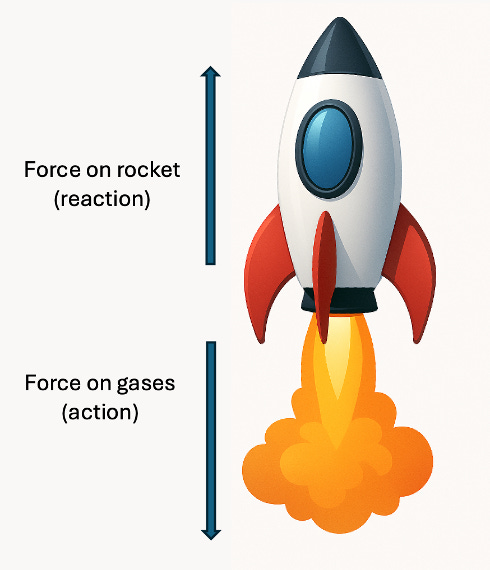
The space drive effect, being reactionless, means that it may be possible to generate thrust without the need to exhaust hot gas out the back of your rocket or plane, as with a rocket engine or jet turbine, as mentioned above.
The following image is meant to give some intuition about the practical implication of a fully realized space drive craft compared to standard rocket technology.
To be clear, it glosses over the claimed physics of space drive. However, it does accurately portray the net effect of what a space drive-powered craft could achieve: forward motion with no corresponding exhaust mass moving backwards.
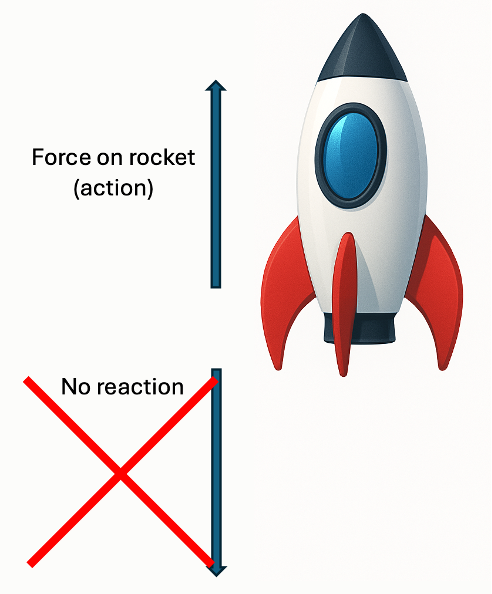
Again, this image glosses over how the space drive effect is claimed to work, but it does convey what it could enable. Just picture a rocket moving rapidly towards space with no giant exhaust plume coming out the rear, and you have a good mental image from what sort of aircraft and spacecraft the space drive might permit.
Another mental image that may be helpful: picture a classic flying saucer-shaped UFO hovering silently over a rural farmhouse. An advanced space drive powered by a SunCell would make such a craft possible…and that may not be a coincidence.

Space Drive Craft
If the space drive effect can be made continuous, it could enable aircraft and space craft with capabilities that far exceed current technology. This is because a fully realized space drive engine would very efficiently convert electricity into massive amounts of thrust in reactionless fashion.
Thrust typically refers a forward propulsive force on an aircraft or spacecraft in the direction of its travel, but this article uses it to mean propulsive force in any direction, including direction of travel.
How could the space drive effect be converted to useful thrust, you ask?
First, electricity would power a microwave generator, such as a magnetron. The microwaves would be made incident on a directionally biased plasma. The free electrons of the plasma would experience the space drive effect and be greatly accelerating in their pre-existing direction of travel. Ion-dragging would yield a very high-kinetic energy directed plasma flow.
This plasma flow can then be transduced (a fancy word for conversion and transmission of one type of energy to another) into thrust via three possible methods discussed in this patent filing mentioned above:
Electrostatic braking: arresting the high kinetic energy plasma on a negatively biased plate rigidly affixed to the space drive craft, transferring the stopping force as thrust.
MHD conversion: run the high kinetic energy plasma through a magnetohydrodynamic channel to both extract electric power and transfer momentum to the space drive craft.
Physical piston: accept the gas pressure after plasma recombination, transfer the kinetic energy to the space drive craft attached to the piston.
There would then need to be some means of constantly recirculating the plasma after it gives up its energy to the transducer and recombines into a gas for another pass through the microwave generator.
Net effect of a working space drive enginge: very efficient conversion of electricity into thrust without throwing mass overboard.
Assuming the space drive phenomenon operates as claimed by Dr. Mills, space drive craft, fully realized, would have performance characteristics that greatly surpass those of existing transportation technologies. Humanity would be able to transverse vast distances with as much thought as we currently give to a trip to the grocery store and do so far more safely and inexpensively than with existing technology.
Let’s talk about why this is the case in a bit more detail. In brief, space drive has two transformative characteristics.
Electricity To Reactionless Thrust
First, as stated above, it permits extremely efficient conversion of electricity into reactionless thrust. Let’s compare the best-case experimental result in the space drive paper with two well-known points of reference for generating thrust: the F-35 fighter jet with its single F135 turbofan engine and SpaceX’s Starship rocket, with its 33 Raptor rocket engines.

One can quibble about the comparison here: there is nuance and difference between these three means of generating thrust. One big difference is that the space drive experiment demonstrates a brief impulse of force rather than steady state thrust, so it is something of an apples and oranges comparison.
However, it does illustrate the key point: if the space drive effect can be made continuous, it may prove to be a vastly more efficient means of generating thrust than current technology.
The conversion of chemical energy into thrust, as in the F-35 and Starship, is wildly inefficient, as seen in the table above.
By contrast, the space drive effect appears to be more efficient at converting electrical energy into thrust by orders of magnitude, and it achieves this in reactionless fashion.
Combine a working space drive with a compact power source of lots of electricity like a SunCell and aircraft and spacecraft straight out of science fiction might become possible.
Judging by the experimental setup, space drives would also be relatively inexpensive to manufacture, have few moving parts, and offer enormous thrust relative to the size of a space drive. The main cost would be likely be the required high-power microwave generator.
Continuous Acceleration
Another major advantage that space drive craft would have is the ability to accelerate continuously. While operating in atmosphere, this ability would be tempered by the fact that either wind resistance or temperature buildup from air friction will eventually limit top speed. However, due to the enormous thrust of a working space drive, this top speed would dramatically exceed that of current aircraft.
Also, space drive craft designed primarily for point to point earth transportation would be able to operate at higher altitudes than current aircraft because they wouldn’t require oxygen to combust jet fuel and drive turbines nor would they need a thick atmosphere flowing over wing surfaces to generate lift. Higher operating altitudes would also reduce air friction heating issues.
Space, not surprisingly, is where a space drive would really shine. SunCell-powered space drive craft engineered for operation in the vacuum of space would be able to achieve astounding speeds that far exceed conventional rockets, which rapidly run out of fuel and are forced to then coast to their destination.
Continuous acceleration at an imperceptible (assuming passengers are oriented properly) 1g, 9.8 m/s2, for an hour in the vacuum of space rockets a space drive craft to nearly 80,000 mph. That gets you to the moon in just a few hours!
Freed from the tyranny of gravity, space drive could also make space colonization not only realistic, but trivial, even by today’s technological standards. Why, you ask? Because space drive would allow humanity to hoist vast quantities of material into space extremely inexpensively; the only marginal cost of lifting a ton into orbit is the cost of electricity, and the SunCell will soon make that cost very low indeed.
Space Drive Configuration
The presumed compactness of space drive would permit interesting and advantageous craft design parameters. One could envision as many as 6 primary drives: 1 each for +/- z, +/- y, and +/- x axes. This would allow for astoundingly maneuverable craft.
This is probably overkill for space drive craft primarily designed for earth’s atmosphere. For this application, it may prove superior to have two primary space drives oriented vertically to act against gravity and horizontally to accelerate the craft forward. Multiple smaller, less powerful space drives could provide for steering and attitudinal adjustments as needed.
Because compact space drive engines could likely be made inexpensively, space drive craft would probably have multiple small backup space drives to provide for extreme redundancy and outstanding safety.
The small drives wouldn’t have to be capable of the same thrust output as the main drives. Rather, they would simply be able to land the craft safely in the case of main drive failures. Between this redundancy and the advanced AI that will be piloting space drive craft, it seems likely that accidents of any sort will become almost unheard of. Your primary drive might fail, and your secondary backup drive might fail, but your tertiary space drive will still allow you to land safely.
It may well be the case that traveling to the moon and back in one’s space drive craft is far safer than leaving your driveway in your current vehicle.
Perspective
You may be thinking that it is quite a leap from the crude microwave experiment to moon-bound space drive craft, and it is.
However, it is a well-established fact that new technologies often initially look primitive or toy-like. This is the very first transistor produced by Bell Labs in 1947:
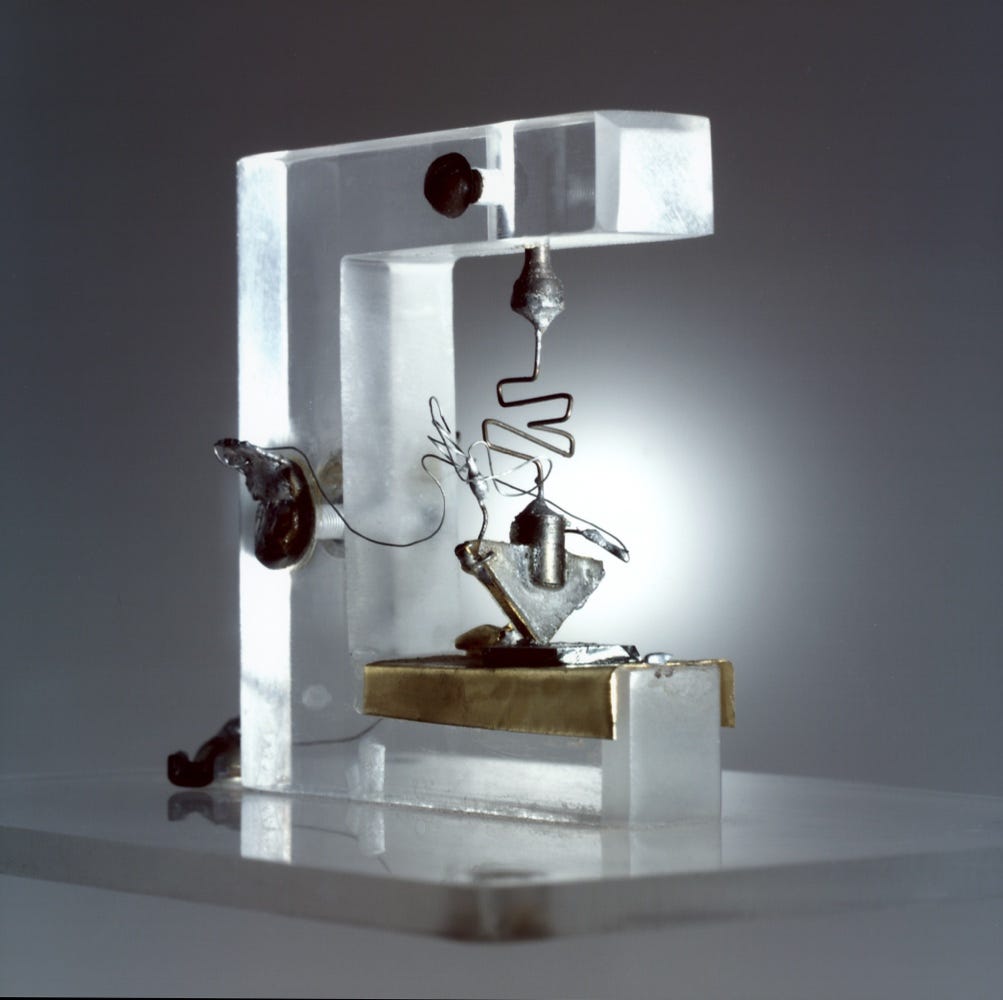
Not very impressive, is it?
1 solitary transistor, with centimeter sized features.
Apple’s most recent iPhone chip, the A18, has roughly 20 billion transistors.
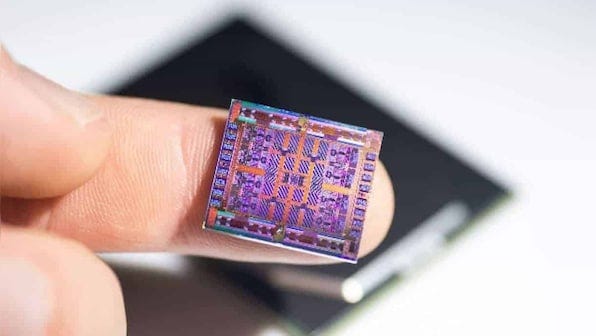
These transistors are roughly 40 million times smaller than that of the humble Bell-Labs prototype.
The point is this: do not be fooled by the relatively crude appearance of the microwave oven demo.
It is potentially fully as transformative as the Bell Labs transistor was.
Although there is quite a lot of work that would be required to engineer a space drive-based craft should the space drive effect prove itself through replication, it does not appear to require any truly novel technologies. Rather, the amalgamation of existing technologies should permit the fairly rapid creation of space drive craft.
The space drive may prove to be one of the most important inventions in human history, full stop. If the effect is replicated, the discovery would be on par with, or perhaps even more important than, other transformational transportation technologies like the wheel and the internal combustion engine.
Summary
If the space drive effect is proven by rigorous replication, made to operate continuously, and harnessed in a practical device, when combined with SunCell power, it would be a complete game-changer for both terrestrial transport and space exploration.
It would abolish the old limitations of space travel: no more huge multi-stage rockets, no more throwing away 95% of your mass as fuel, combusted and tossed overboard, and no more being limited by narrow launch windows and one-way trips.
Instead, we get ultra-high-efficiency, high-control, high-power propulsion that can lift massive payloads for a fraction of the energy of rockets, all while operating 24/7, fueled by tiny amounts of hydrogen being turned into Hydrinos in SunCells.
Fully realized, space drive could take humanity to the distant reaches of the solar system and far beyond. SunCell-powered space drive craft enable a science fiction future of unlimited personal mobility and gargantuan space stations. Humanity could travel to the moon and back with no more thought than we currently give to a weekend road trip.
Earth-based travel would also be forever changed. Residents of the backwoods of Idaho could commute to New York City for work and be home for dinner.
All of this would be far safer and far cheaper than current transportation technology.
The key to allowing a space drive craft to achieve its full potential would be a compact electricity source.
The SunCell is that source.
Humanity already stands poised at an age of incredible abundance. We shall soon have near-infinite zero marginal cost energy with the SunCell, zero marginal cost intelligence with AI, and zero marginal cost physical labor with AI-powered humanoid robots.
Harnessed wisely, these technologies will power unimaginable progress.
Assuming the space drive effect proves itself through experimental replication, we may also have unprecedented physical mobility with SunCell-powered space drive craft, allowing us to truly slip free of the surly bonds of earth and become a space-faring civilization.
What a time to be alive.
Addendum: A Space Drive Story
The following is a brief story that most would currently consider science fiction but might soon be science fact. It may help the reader internalize the dramatic changes in transportation that space drive could enable.
It’s a bright Sunday morning in the summer of 2039. The Smith family is about to do something that would have been pure science fiction a decade ago.
John and Cindy load their two kids and luggage into their new space drive craft parked in their driveway. The sleek and smooth titanium and carbon fiber body gleams in the morning sun.
Inside, the cabin is spacious and quiet. A quiet thunk sounds as the entrance door seals shut. Eight-year-old Sofia buckles in excitedly, while teenage Lucas pretends to be nonchalant, but can’t hide a grin. They plan to fly from their home in Florida to visit the Grand Canyon and come back, all in the same day. No airports, no highways. The world is theirs to explore.
“Ready?” John calls out. He taps the destination on the navigation display. The onboard AI plots a course, and the twin Hydrino-powered SunCell reactors in the back hum to life. There’s a subtle vibration as the primary space drives power up.
Cindy gives a thumbs-up. With a soft whir, the Smith family’s craft lifts straight up off the driveway. Sofia squeals as she sees the ground dropping away. “We’re flying, we’re flying!” she claps. Birds scatter below them as the craft rises above the treetops in seconds. Neighbors casually wave, now used to the sight of space drive craft soaring above their heads.
Clearing the neighborhood, John tilts the control stick forward (though the autopilot could handle it, he enjoys manual flying). The craft accelerates upwards and forward smoothly, pressing everyone gently into their seats. In a few moments, they’re cruising at 300 mph, high above the highway traffic that is now a relic of the past. Sofia’s eyes are glued to the window as their town becomes a tiny patchwork below. Lucas is busy capturing a holovideo out the other window. He secretly loves the dramatic flair of these space drive hops: much cooler than any rollercoaster, though so quiet and easy that his friends sometimes tease it’s like riding an elevator. The craft makes virtually no noise outside; a jogger on a country road hears a faint whoosh and sees a silhouette streak overhead.
They shoot across state lines in no time and continue higher into the atmosphere. Cruising altitude is 200,000 feet to take advantage of reduced wind resistance. Accelerating at a gentle and steady 0.3g, the craft quickly reaches a cruising speed of Mach 3. Inside, the family chats normally. The loudest sound is their voices and the music playing softly. The air is cool and fresh: the vehicle’s pressurized interior filters and circulates it as they fly. There’s no smell of fuel or roar of engines. It’s so peaceful that before long, Sofia has curled up and fallen asleep against Cindy’s shoulder, even as the Earth blurs below.
A little over an hour later, they arrive above Arizona. The Grand Canyon’s rusty red expanse yawns beneath them. John brings the craft lower, slowing down. Through the floor’s glass panel, they can see the Colorado River glinting far below. Cindy has always wanted to see this natural wonder, and now they’re hovering right above it. She snaps photos and her heart swells, not just at the sight, but at the experience of being here with her family, in this moment made possible by human ingenuity. There’s a tear in her eye as she thinks about how her own grandparents could never have imagined this kind of family trip.
They land gently on a remote plateau near the canyon’s edge, a location only accessible by days of hiking before. The craft sets down with pinpoint precision. They unload a picnic lunch and some camping gear from the cargo hold. For the afternoon, the family hikes and explores in blissful solitude, with their personal flyer waiting nearby.
There’s no worry about refueling: the SunCells quietly condense water from the atmosphere and electrolyze it to regenerate the small amount of hydrogen used on the trip.
After a magical sunset over the canyon, they decide on a whim to make the trip even more special. “Shall we go to orbit tonight?” Cindy suggests with a smile. The kids light up. The orbital hotel experience was something they’d talked about but hadn’t tried yet with this craft, they can do it spontaneously if there’s a room available.
John contacts the SkyVista orbital resort via satellite link. Yes, they have a family suite available. “Pack up kids, we’re going to space!” he grins.
Not many families can say that yet, but in 2039, it’s becoming a trendy adventure for those with a space drive vehicle or access to one. They secure everything and lift off again, this time angling upward toward the stars. The blue sky deepens to indigo, then black, as the craft ascends steadily. Sofia presses her face to the window as stars blaze into view and the curvature of Earth appears. There’s no sudden jolt or huge g-forces, just a steady and nearly imperceptible acceleration. In less than a half hour, they have transitioned from sitting by the Grand Canyon to floating 250 miles above Earth at the SkyVista station.
As they approach the orbital hotel, Earth’s vast marble fills half the sky behind it. The children are speechless for a moment, taking in the dazzling view of the home planet. Cindy feels John squeeze her hand; he’s as awestruck as she is. This moment, watching their kids gaze at Earth from space, is profoundly moving. They never imagined this would be possible in their lifetime, let alone feel so casual and safe. The craft’s smaller manuevering space drives makes the craft handle with pinpoint precision, coasting alongside the station’s docking platform with ease. A soft thunk and hiss sound as they dock.
That night, the Smith family toasts with juice and snacks in the SkyVista lounge, watching the sun set rapidly. They share laughs and dreamy stares out the window. Lucas is already live-streaming a montage of their day to his friends: “breakfast at home, lunch in the Canyon, bedtime in orbit!” Cindy thinks about how travel has utterly transformed: no long airport lines or cramped flights, no gas-guzzling RV. The world (and beyond) has opened up for ordinary families.
On the trip home the next day, the craft gently drops from orbit back to Florida in a controlled descent. As they re-enter the atmosphere, there’s no fiery reentry trauma; the space drive slows them so the ride down is smooth and easy.
They touch down on their lawn on a Monday morning, just in time for John to catch a virtual work meeting and for the kids to excitedly prepare show-and-tell presentations about their space vacation. The neighbors barely notice their landing. By now, seeing a family flyer come back from a trip is about as routine as seeing an SUV return from the grocery store.
The Smith family’s hearts are full of gratitude and wonder. Space drive and SunCell power have made possible a life of experiences that once were the realm of sci-fi. The family vacation has been forever redefined: no longer limited by distance or gravity.
As Cindy scrolls through the photos of Sofia and Lucas floating against the backdrop of Earth, she smiles, knowing that the future is here and it is even more wondrous than imagined. They’re already planning their next journey; perhaps a week on the Moon colony or a safari on another continent. The space drive has made the extraordinary become ordinary, and for that, the Smith family is both thrilled and humbled.
Glad you liked it Damir. I agree that 2039 may seem ambitious at the current rate of technological progress, but I think there is a strong argument that the rate of progress will increase rather rapidly as we achieve AGI and then ASI. I anticipate the rate of progress in the year 2035 to be equivalent to 5 to 10 years of 2025-level progress. Perhaps even more.
Thank you Alex for this informative article and getting us excited about the possibilities. I like the story at the end, even if 2039 seems a bit ambitious. But we can hope!